


By 2026 ai will shape the top trends in logistics trends and set priorities for operations
2026 marks a turning point for the logistics sector. Across supply chains in 2026, companies face tighter margins, higher customer expectations, and more frequent disruption. Therefore, leaders focus on cost, inventory, and resilience as the three measurable outcomes that define success. For example, early adopters report substantial gains: StartUs Insights found roughly a 15% reduction in logistics costs and a 35% improvement in inventory management. That statistic matters because it shows AI driving concrete returns quickly. Next, task-focused agents are evolving into coordinated ecosystems. The 2026 Supply Chain Report notes that “task-based AI agents are likely to evolve into an entire ecosystem of agents striving to optimize logistics processes end-to-end” (SSI, 2026 Supply Chain Report). Consequently, organizations plan differently now. They invest in modular stacks that connect data, sensors, and decision layers. Meanwhile, supply chain leaders reframe priorities. They shift capital from manual staffing to systems that reduce routine work and improve speed. For operations teams that handle email and exceptions, this shift unlocks time for higher-value tasks. For example, virtualworkforce.ai helps ops teams cut email handling time dramatically by grounding replies in ERP/TMS/TOS/WMS and email history, which improves response quality and reduces errors. Also, companies evaluate governance, explainability, and measurable KPIs before broad rollouts. In short, 2026 and beyond will reward firms that test small, measure impact, and scale fast. As a result, the era of AI will not only cut costs but also redefine how transportation management and fulfilment are scheduled and measured. Finally, expect AI agents to move from pilots to production in many logistics systems this year ahead.
agentic systems will drive automation across ai in logistics and ai in supply chains
Agentic systems now handle routine decisions in bounded domains. Gartner and other analysts expect many deployments across TMS and WMS adjacencies because bounded agents limit risk while delivering strong value (Technova Partners). For example, scheduling, dispatch, basic negotiation between services, and data entry are ideal for agentic automation. These agents act independently within narrow rules. They prioritize tasks, suggest actions, and escalate exceptions to humans. Therefore, teams delegate repetitive workflow to agentic AI while humans concentrate on exceptions and strategy. In practice, a transportation management system integrates an agent layer to orchestrate route planning, update ETAs, and reassign carriers during delays. This approach helps operators automate workflows without losing control. Also, generative AI appears as a complementary layer that drafts messages and proposals, but bounded agentic logic enforces business rules before anything is sent. Furthermore, ai systems now include audit trails and governance features. That reduces compliance risk and increases trust. Consequently, logistics providers and 3PLs can offer API-driven services that interconnect with client systems. For example, virtualworkforce.ai connects ERP/TMS/TOS/WMS data to no-code email agents that enforce SLA rules and escalation paths. This integration shows how agents can automate communication while preserving human oversight. Meanwhile, the combination of agentic and autonomous capabilities helps scale operations. It lets teams automate scheduling and fulfilment tasks, improve customer experience, and reduce manual toil. Finally, agentic AI will become a standard layer in modern supply chains, enabling rapid, controlled automation that scales across the entire supply chain.

Drowning in emails?
Here’s your way out
Save hours every day as AI Agents label and draft emails directly in Outlook or Gmail, giving your team more time to focus on high-value work.
Real-time visibility from iot will feed tms and wms for scalable supply chain decisions
Real-time visibility now powers smarter flow control. IoT, telematics, and sensors stream location, temperature, and status into message buses. Then TMS and WMS consume those feeds to orchestrate decisions. For example, live location data enables dynamic rerouting and improves predictive ETA. As a result, carriers and shippers reduce dwell time and cut stockouts. In addition, digital twins and simulation platforms use the same real-time feeds for planning and stress tests. That means planners can run “what if” scenarios before peak seasons. Also, predictive analytics draw on sensor and transactional data to forecast demand and identify bottlenecks, which improves response times and reduces waste (Kanerika). Importantly, the integration chain is straightforward: IoT devices → secure message bus → TMS/WMS → agent decision layer. This architecture supports scalable automation. It also lets teams adapt in real time when a lane is disrupted or when traffic alters ETAs. Consequently, routing decisions become more accurate and resilient. Moreover, adaptive inventory rules let warehouses make on-the-fly adjustments to picking priorities and replenishment. That optimizes fulfilment performance while lowering buffers. From a software perspective, modular logistics software and API-first TMS designs simplify these integrations. For logistics systems that handle omnichannel and complex orders, real-time visibility becomes the foundation for seamless orchestration. Finally, teams that combine live feeds, simulation, and agentic decisioning see measurable benefits: shorter lead times, improved customer experience, and fewer exception escalations.
AI will reshape procurement, risk management and prepare logistics for disruption with 3pl partnerships
Procurement and risk management now leverage AI to anticipate supplier issues. For example, predictive analytics flag supplier or route risk before failures occur, which reduces lead-time variance and improves continuity. In practice, ai-driven supplier scoring and early warning alerts let procurement teams change orders or switch lanes quickly. Also, 3PL partners extend this capability with flexible capacity and algorithmic SLAs. Consequently, companies can buy resilience as a service during the coming year. Furthermore, contract language now includes clauses for flexible capacity, dynamic pricing, and data sharing. That shift improves alignment between shippers and logistics providers. As a result, integrated logistics becomes more adaptive. Meanwhile, governance and explainability matter more than ever. Supply chain leaders demand clear audit trails for decisions and for any automated sourcing actions. Therefore, AI must support traceable reasoning and human-in-the-loop checkpoints. In addition, tools that parse unstructured data—emails, contracts, and invoices—help procurement teams react faster. For example, virtualworkforce.ai automates email-based supplier interactions and grounds replies in ERP and TMS data, which reduces manual research and speeds turnaround. Also, AI reduces risk by modeling route-level disruption, demand shocks, and supplier health. That helps planners create hedges and contingency playbooks across global supply chains. Finally, these capabilities let teams measure outcomes more clearly, such as reduced lead-time variance, improved on-time delivery, and measurable cost avoidance during disruption. Together, these improvements redefine procurement and how 3PL partnerships support resilient operations.
Drowning in emails?
Here’s your way out
Save hours every day as AI Agents label and draft emails directly in Outlook or Gmail, giving your team more time to focus on high-value work.
robotics, machine vision and wms automation will automate warehouse tasks and raise accuracy
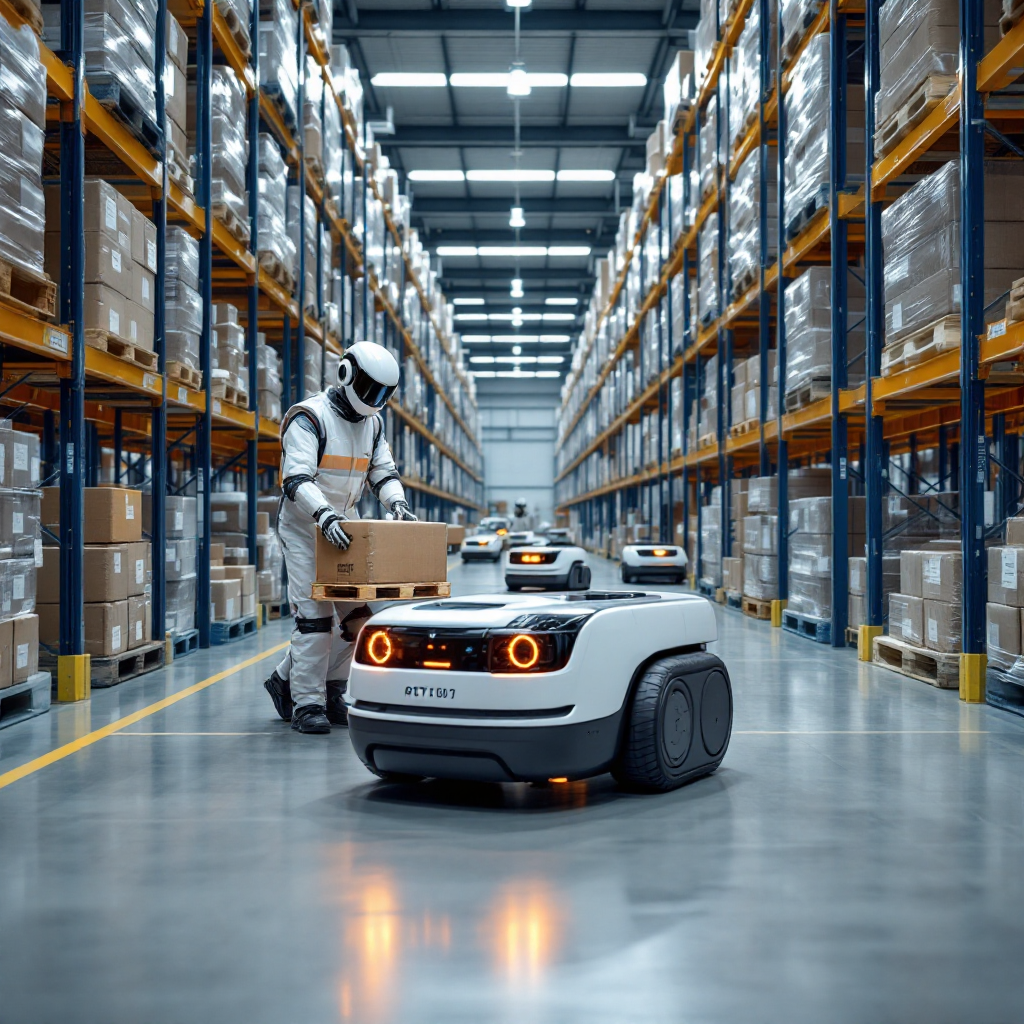
Robotics and machine vision now run critical warehouse tasks. For example, vision systems inspect packages for damage and verify picks in real time. Zebra Technologies highlights that “the adoption of AI-powered machine vision for real-time quality control will be critical in minimizing errors and waste” (Zebra). As a result, fulfilment accuracy improves and return rates fall. In addition, autonomous forklifts and collaborative robots reduce manual handling and speed throughput. These robots integrate with WMS logic to reserve slots, sequence picks, and update inventory instantly. Therefore, cycle times drop and capacity rises. Also, picking accuracy increases when machine vision cross-checks SKU labels and package contents before dispatch. That supports hyper-personalized orders and omnichannel fulfilment. However, implementation has trade-offs. Capital cost and integration effort are significant. In practice, firms balance ROI, safety, and workforce impact. They invest in training, reskilling, and new job designs. Meanwhile, software integration matters more than hardware alone. WMS platforms must expose APIs and events so robots and vision systems can interoperate. For logistics teams, the right approach is to pilot vision-assisted picks and then scale. Also, use data to quantify gains in cycle time and error rate. Robotics and vision reduce packing errors and improve customer experience. Finally, leaders should choose flexible deployments that let them add new capabilities without disrupting core workflow. This balance ensures robotics and machine vision deliver measurable improvements across distribution centers and help supply networks scale efficiently.
Scalable architectures will let tms, 3pl and carriers plug in to automate supply chain operations and manage disruption in 2026
Scalable, modular architecture underpins modern supply chain operations. API-first TMS and cloud-native WMS let carriers, 3PLs, and third-party agents plug into a shared orchestration layer. As a result, teams can add or remove services without breaking core workflow. Also, agent orchestration platforms let administrators route tasks, set escalation rules, and monitor agent performance. In practice, this design supports peak season resilience and rapid rollout of new features. Meanwhile, orchestration enables intelligent automation across transport and warehouse domains. For example, route planning agents can trigger capacity purchases from 3PL partners automatically when forecasted demand exceeds thresholds. That helps reduce spot-market cost spikes and avoids bottlenecking flows. Furthermore, modular stacks support explainability and governance. They let teams trace why a carrier was selected or why an exception escalated to a human. In addition, scalable design supports interconnect standards so logistics software and carriers interoperate smoothly. Therefore, supply chain leaders should prioritize pilots in bounded domains, ensure explainability, and measure outcomes such as cost, inventory, and service. Also, choose platforms that interconnect with your ERP, TMS, and WMS to orchestrate end-to-end supply chain processes. For teams that want to automate communication-heavy tasks, our resources on automated logistics correspondence and virtual assistants for logistics explain how no-code agents can speed email workflows and reduce errors (automated logistics correspondence). Finally, start small, measure impact, and scale: pilot a single bounded domain, validate ROI, and then expand agentic functionality across the end-to-end supply chain. This approach helps organizations adopt AI across operations while managing risk and keeping humans in control.
FAQ
What are the top logistics trends driven by AI in 2026?
AI in 2026 emphasizes cost reduction, inventory accuracy, and resilience. These trends include agentic automation for routine tasks, real-time visibility via IoT, and machine vision in warehouses.
How do agentic systems differ from traditional automation?
Agentic systems act autonomously within defined boundaries and escalate exceptions to humans. They differ from scripts by making decisions based on dynamic data and policies.
Can IoT and TMS integration improve delivery times?
Yes. Real-time feeds from IoT let TMS adjust routes and ETAs on the fly. This reduces dwell time and improves on-time delivery performance.
How will AI reshape procurement and risk management?
AI flags supplier and route risk before failures occur and automates supplier scoring. As a result, procurement teams can switch lanes or suppliers earlier and reduce lead-time variance.
What warehouse tasks are best suited for robotics and machine vision?
Picking validation, quality inspection, and pallet movement benefit most from robotics and vision. These technologies cut errors and boost throughput when tied to WMS processes.
How should logistics teams start with AI pilots?
Begin with bounded domains such as scheduling, email exceptions, or routing. Measure cost, inventory, and service impact before scaling across the entire supply chain.
Will 3PLs change contracts because of AI?
Yes. Contracts now include flexible capacity clauses and data-sharing terms. This lets shippers and 3PLs adapt more quickly during disruption.
How do no-code AI email agents help operations teams?
No-code agents draft context-aware replies and ground answers in ERP and TMS data. That reduces handling time and minimizes manual copy-paste errors across systems.
Are AI-driven systems safe for regulated logistics workflows?
They can be, with governance, audit trails, and human-in-the-loop checkpoints. Explainability features and role-based controls help ensure compliance.
What metrics should logistics teams track after AI deployment?
Track measurable outcomes like cost per shipment, inventory accuracy, dwell time, and exception rate. Also monitor response time for customer communications and ROI on pilot projects.
Drowning in emails?
Here’s your way out
Save hours every day as AI Agents label and draft emails directly in Outlook or Gmail, giving your team more time to focus on high-value work.