


ai agents in food — Overview for the food industry and food and beverage industry
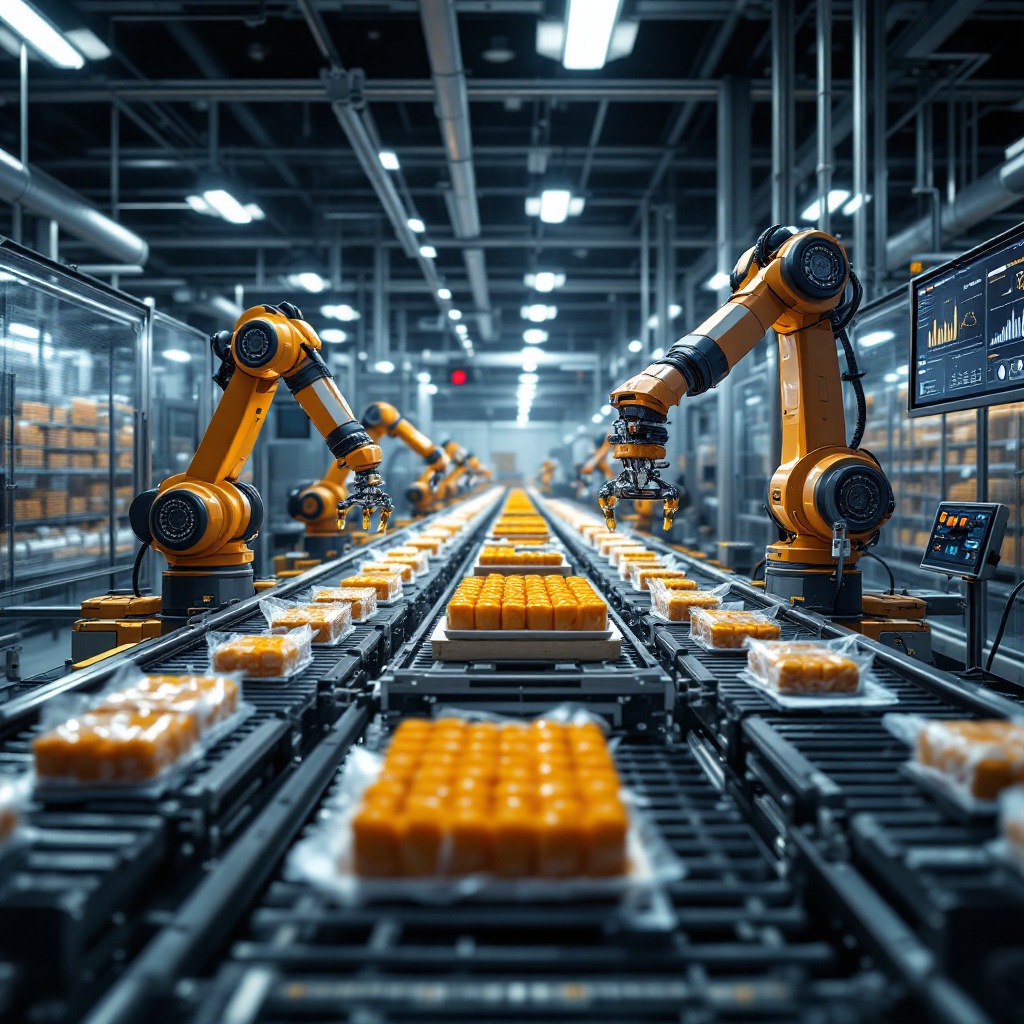
AI agents for food are continuous, decision-making systems that combine machine learning, computer vision, sensors and robotics to act across production lines and facilities. They differ from single-point analytics because they sense, decide, and act in closed loops. They learn from new data, and they improve over time. They make local choices and coordinate with other systems. In practice, an AI agent inspects, flags, and routes parts of a batch without waiting for a manual handover. This helps teams respond faster and reduce errors.
The measurable benefits are striking. For example, AI-driven systems have improved manufacturing uptime and yield by up to 20–30% through predictive maintenance and quality monitoring (HART Design). Also, quality-control accuracy with automated visual inspection commonly exceeds 95% when compared to manual methods (Inoxoft). Robotics plus AI have boosted throughput by roughly 40% on some automated lines (IdeaUsher), and these gains add up across shifts.
The scope spans from factory-floor inspection to cross-facility coordination. For instance, a line-level AI agent can detect discoloration and reject a product in real-time, and a higher-level agent can reschedule production runs to match demand. This kind of orchestration helps optimize production and inventory simultaneously. Food and beverage manufacturers also use AI agents in product formulation, where feedback from sensory test labs and market analytics accelerates iteration. As artificial intelligence moves from pilots to broader deployment, the industry sees improved operational efficiency and faster product cycles (Dataforest). Finally, companies like virtualworkforce.ai show how no-code AI assistants can streamline communications between operations teams and back-office systems, reducing response time and human error in order and inventory workflows.
use cases — ai agent, product development, ai-powered applications
Core use cases map to inspection, maintenance, formulation, and product innovation. Visual quality control uses computer vision models to find blemishes, foreign objects, and size variance. Predictive maintenance monitors vibration, temperature, and oil analysis to forecast failures and schedule repairs. Recipe and process optimisation links sensory targets to machine settings. New product development benefits when consumer analytics inform ingredient choices and pilot runs adapt quickly.
Key use cases deliver measurable lift. Visual systems reach defect detection rates above 90–95% and cut false rejects. Predictive maintenance can reduce unplanned downtime by 30–50%, and that change improves throughput and lowers costs. Robotics and AI together speed sorting and packing, which accelerates throughput by about 40% on automated lines. These examples show how AI systems help teams make faster, data-driven decisions.
AI-powered applications also compress development cycles. By linking consumer preference analytics to production constraints, product teams iterate more quickly. For example, analytics on dietary preferences and allergen patterns can feed formulation models that optimize for taste and regulatory compliance. Companies then run pilot batches with adjusted process parameters and collect feedback in days instead of months. This shortens time-to-market and reduces iteration cost.
On the technical side, teams use AI models that combine supervised vision networks, anomaly detection, and process-control optimizers. They use a single ai platform to manage models, data access, and deployment. The platform integrates with MES and ERP systems so production rules and quality gates remain consistent. When building these systems, teams must balance speed with safety. They should keep humans in the loop for critical quality decisions and set audit trails for regulatory compliance. Also, generative AI can help draft technical specs and test plans, but teams should validate outputs before they enter lab or line workflows. In short, these AI agents speed product development and raise confidence in launches while keeping regulatory and quality obligations central.
Drowning in emails?
Here’s your way out
Save hours every day as AI Agents label and draft emails directly in Outlook or Gmail, giving your team more time to focus on high-value work.
supply chain & food supply chain — inventory management for food distributors
Supply chain teams gain value when they apply AI to forecasting, ordering, and routing. In the food supply chain, demand signals arrive from POS, e-commerce, and promotions. AI agents ingest those feeds, and they predict demand at SKU-store or SKU-distribution center granularity. Accurate forecasting helps planners reduce stock-outs and excess inventory. As a result, food distributors see better order accuracy and fewer rush replenishments.
Perishable inventory management is a high-value area. Agents can recommend reorder quantities, set reorder points, and trigger dynamic markdowns for items nearing expiry. These actions reduce spoilage and improve fill rates. Industry data shows food waste reductions of roughly 15–25% when forecasting and orchestration improve (Dataforest), and some pilots report up to ~30% in targeted programs. These numbers convert to clear cost savings for distributors and retailers.
AI also helps routing and last-mile choices. Real-time telemetry from trucks and warehouses enables dynamic re-routing to prioritize high-value loads. An autonomous decision layer can switch suppliers or consolidate loads when a shipment is delayed, and doing so lowers spoilage risk. For instance, a supplier change might be recommended when transit time exceeds a freshness threshold. Those decisions require rules and visibility into regulatory compliance, temperature logs, and supplier certifications.
KPIs to watch include inventory days, fill rate, spoilage percentage, and on-time delivery. For food distributors, reducing stock levels while increasing order accuracy improves cash flow. To implement, teams combine demand forecasting models with inventory management systems and a lightweight ai assistant that drafts exception emails. Solutions like virtualworkforce.ai can automate much of the email handling around exceptions, proof-of-delivery queries, and supplier coordination by grounding replies in ERP and freight systems. This lowers email handling time and helps planners act faster. Overall, AI helps predict demand, streamline order flows, and reduce waste across supply chain functions.
automation and workflow — ai tools and implementing ai on the line
Start with a pilot on a single workflow. Validate models with labelled data. Then scale by integrating with MES and ERP. Practical steps matter. First, map the current workflow and identify handoffs. Next, collect quality images, sensor streams, and historical downtime logs. Label data consistently. Then train computer vision models and anomaly detectors. Finally, deploy edge inference for latency-sensitive checks and central orchestration for scheduling.
The typical stack includes vision models, anomaly detection algorithms, schedule optimizers, and an agent orchestration layer. Here, AI tools help manage models and monitor performance. Teams must design change control to protect food safety and traceability. They should version models, lock production rules, and require sign-offs for rule changes. Also, integrate model outputs into operator interfaces and exception workflows so teams can act quickly.
Operational advice focuses on data quality and deployment hygiene. Ensure consistent lighting and camera calibration for vision tasks. Stream sensor data with timestamps and durable identifiers. Edge inference reduces latency and keeps critical checks local to the line. For the rest, stream summarized signals to cloud systems for analytics and batch retraining. When introducing automating tasks, maintain clear escalation paths. Keep humans in the loop for out-of-spec events and final acceptance sampling.
Implementing AI requires governance and change management. Define acceptance criteria before go-live. Train operators and quality staff on new interfaces. Monitor model drift and schedule retraining windows. Connect systems through API so decisions can act on goals and update MES automatically. For communication-heavy exceptions, an ai assistant can draft and send emails grounded in ERP context, lowering handling time and improving consistency; see how automated logistics correspondence works in practice with a logistics-focused virtual assistant (automated logistics correspondence). This combined approach helps streamline production processes and optimize production while meeting regulatory and safety requirements.

Drowning in emails?
Here’s your way out
Save hours every day as AI Agents label and draft emails directly in Outlook or Gmail, giving your team more time to focus on high-value work.
autonomous and agentic ai — ai-powered systems for food distribution
Agentic AI and autonomous systems differ from rule-based automation because they can make local scheduling or routing decisions with minimal human input. An agentic AI can evaluate options, weigh constraints, and make a recommendation or act autonomously within set limits. This makes it possible to reroute a truck, reprioritize packing, or switch a supplier when conditions change. These capabilities improve responsiveness and reduce spoilage risk in food distribution.
In distribution, real-time telemetry and dynamic pricing signals feed decision layers that optimize loads and routes. Systems can select which orders to consolidate and which to split. They can also assign priority to time-sensitive goods. When a delay occurs, an autonomous scheduler can propose alternate carriers or change delivery windows. It can also trigger automated emails or exception notes so teams stay informed and can intervene when necessary.
Risk controls are essential. Keep humans in the loop by setting approval thresholds for high-risk decisions. Maintain detailed audit logs for every action the system takes. Constrain choices with safety and regulatory rules so the system cannot violate temperature or traceability requirements. Systems should record why they made a choice so auditors can review decisions later. These controls help with regulatory compliance and build operator trust.
Agentic AI helps food distributors reduce delays and improve order accuracy. It can optimize pick paths in a DC, manage load balancing across vehicles, and recommend supplier switches when transit time breaches freshness windows. For teams evaluating these systems, consider vendor capabilities for API integration and model explainability. Also, evaluate how the system will interact with your ERP and TMS. If you want to automate email workflows around exceptions, check solutions that ground replies in source systems; virtualworkforce.ai offers a no-code assistant that connects to ERP, TMS, and WMS so teams keep context and speed in communications (ERP email automation for logistics). When designed well, agentic AI can autonomously reduce spoilage and improve customer service while preserving human oversight.
waste reduction — business case, product development and scaling across the food and beverage sector
Build the business case with measured pilots. Quantify tonnes of waste avoided, uptime gains, and labour reduction to calculate payback. Start small and measure impact. For instance, pilot a vision system on one SKU and track rejects versus manual inspection. Or pilot a demand forecast for a subset of stores and measure spoilage change. Use those results to estimate cost savings and ROI across the network.
Scaling requires standardised data schemas and repeatable workflows. Define master data for SKUs, batch IDs, and expiry attributes. Train cross-functional teams across operations, quality, and IT so they can replicate successful recipes. Also, standardise the ML lifecycle, from labelling rules to retraining schedules. This reduces friction when moving from pilot to multi-site rollout and helps keep regulatory compliance uniform.
Executives care about final metrics. Report tonnes of waste avoided, percentage uptime improvement, cost per unit reduction, and time-to-market for new products. Waste reduction programs that combine forecasting, routing, and markdown strategies commonly lower food waste by 15–25% (Dataforest), and those savings translate directly into margins. Include labour efficiency gains from automating repetitive tasks and communication. For email-heavy exception handling, a no-code ai assistant can cut handling time from roughly 4.5 minutes to 1.5 minutes per email, which scales to significant savings across teams (virtual assistant for logistics).
When you present the case, link waste reduction to product development and promotion planning. Use predictive analytics to match promotions to likely sell-through windows so you avoid creating excess stock that becomes food waste. Finally, choose AI suppliers that support systems through API, provide clear model governance, and align with your operational goals. That approach ensures you transform operations, reduce waste, and capture cost savings while keeping humans involved where it matters most.
FAQ
What are AI agents and how do they differ from traditional analytics?
AI agents are continuous, decision-making systems that sense, decide, and act, unlike traditional analytics which only report or predict. Agents can make or recommend operational actions and then follow up, which shortens response time and drives measurable outcomes.
How do AI agents improve quality control in food production?
AI agents use computer vision and sensor fusion to detect defects, contamination, and size variance with high accuracy. They operate in real-time on the line and can flag or remove defective items, improving consistency and reducing human inspection errors.
Can AI help reduce food waste in distribution?
Yes. By improving demand forecasts, optimising routing, and guiding dynamic markdowns, AI helps lower spoilage and overstock. Industry reports show waste reductions commonly in the 15–25% range with targeted programs.
What steps are required to implement AI on a production line?
Begin with a pilot, collect and label consistent data, validate models, and integrate with MES/ERP systems. Deploy edge inference for latency-sensitive checks and set change-control and retraining processes for production reliability.
Are autonomous AI systems safe for food distribution decisions?
They can be, when configured with safety constraints, human-in-the-loop thresholds, and full audit logs. Proper governance and rules ensure decisions meet regulatory compliance and protect product integrity.
How do AI agents speed product development?
Agents link consumer analytics to production constraints, enabling rapid formulation testing and faster pilot runs. This reduces iteration time and helps teams accelerate time-to-market.
What KPIs should food distributors track when using AI?
Track inventory days, fill rate, spoilage percentage, on-time delivery, and order accuracy. These KPIs show how AI affects cash flow, service, and waste reduction.
How does virtualworkforce.ai fit into AI workflows for logistics?
virtualworkforce.ai provides a no-code AI assistant that drafts context-aware emails grounded in ERP, TMS, and WMS data. It reduces handling time for exceptions and improves consistency in logistics communications.
Do AI solutions require major changes to existing systems?
Not necessarily. Many AI solutions integrate through APIs and work with existing MES, ERP, and TMS systems. The key is standardised data schemas and clear integration plans to avoid disruption.
What are common ai implementation challenges in the food sector?
Challenges include data quality, model governance, change control, and ensuring regulatory compliance. Address these by standardising labels, defining retraining schedules, and keeping humans in the loop for critical decisions.
Drowning in emails?
Here’s your way out
Save hours every day as AI Agents label and draft emails directly in Outlook or Gmail, giving your team more time to focus on high-value work.