


ai agent — overview: what AI agents are and why HR should care
An AI agent is an autonomous software system that completes tasks for people. It often combines generative AI with APIs to fetch data, take actions, and close workflows. For HR teams, an AI agent can reduce routine work, speed responses, and apply policies consistently. The basic difference is simple: traditional HR automation follows fixed rules while an AI agent senses context, composes answers, and adapts over time. As a result, agents provide speed and consistency that free up HR staff for higher-value work.
Adoption of agentic AI is growing fast. For example, 31% of organizations now use AI within HR processes, and agentic AI tools reached 35% adoption in two years, with many more planning implementation (HR Executive). A separate study found 65% of HR executives reported productivity gains after deploying intelligent assistants for routine workflows (Tenet). These numbers show enterprise momentum. They also show why HR leaders must evaluate how an AI agent in HR would fit into current practice.
Compared with traditional HR bots, an AI agent can draft replies, synthesize policy, and trigger downstream processes across systems. It can take an email, identify intent, consult payroll rules, then either route the case or resolve it. In operations, vendors like virtualworkforce.ai automate full message lifecycles and ground replies in ERP or SharePoint data, demonstrating how AI agents integrate with business systems to reduce handling time dramatically. This example shows how an ai agent can transform busy inboxes into auditable workflows and thus transform your hr operations.
Outcomes are measurable. AI agents automate repetitive requests, reduce average response times, and allow HR professionals to focus on strategy. They also improve consistency in enforcement and reduce human error. For HR leaders who aim to optimize hr, an AI agent is a pragmatic tool. It allows hr professionals to focus on people while the agent handles routine hr tasks. For organizations planning to move beyond simple automation, agentic ai offers a clear next step.
ai agent in hr: adoption, impact and hard numbers
Adoption of AI in HR is uneven but rising. Surveys show 31% of organizations use AI inside HR today and more are planning rapid deployment (HR Executive). Agentic ai adoption jumped to 35% within two years, with 44% planning implementation soon (MIT Sloan). High-performing HR teams are more likely to adopt agentic approaches; 52% of top teams reported use compared with 32% of lower-performing peers (Lattice). These contrasts matter for hr leaders choosing where to invest.
Measured impacts include productivity and trust. Sixty-five percent of HR executives said AI agents greatly improved productivity in routine work such as time-off and benefits administration (Tenet). Time-to-hire and case resolution often improve when AI agents automate scheduling and first-touch screening. Employee trust is shifting as well: over 50% of workers now report greater trust in AI for tasks like performance feedback and learning recommendations (ServiceNow). That trust matters when agents provide recommendations for development or compensation.
Still, uptake gaps persist. Nearly half of organizations report no active AI pilot in employee relations, a signal that sensitive hr processes remain cautious (HR Acuity). Common barriers include data quality, bias concerns, privacy rules, and integration complexity. Responsible AI governance is essential. As one Lattice expert put it, “Responsible rollout requires clean data, clear guardrails, and ongoing monitoring to ensure AI supports ethical and effective HR practices” (Lattice). That guidance aligns with PwC and Mercer recommendations that CHROs balance automation with human oversight.

For hr teams across the enterprise, the choice is not whether to use AI, but how to use it safely. Deploying ai agents can improve consistency while freeing HR staff to tackle strategic priorities. At the same time, organizations must invest in data hygiene and governance to ensure fair outcomes. The facts show clear gains, yet they also show where attention is required to scale with confidence.
Drowning in emails?
Here’s your way out
Save hours every day as AI Agents label and draft emails directly in Outlook or Gmail, giving your team more time to focus on high-value work.
use cases for ai agents: core HR workflows to automate and augment
AI agent use cases span the full HR lifecycle. In recruitment, agents source candidates, pre-screen resumes, schedule interviews, and keep candidates engaged. They save recruiter time and shorten time-to-hire. For onboarding and learning, an ai agent can create a personalised onboarding journey, auto-generate required documentation, and recommend courses based on role and skill gaps. This reduces new-hire friction and increases early engagement.
In HR operations, AI agents handle payroll queries, leave approvals, and benefits questions. They can enforce rules, check compliance, and log approvals. For employee experience and retention, conversational ai chat support answers FAQs, while sentiment monitoring flags risks. Agents can also suggest personalised development nudges to retain high performers. These are practical hr use cases that show clear return on investment. For example, vendors report cutting email handling time by two-thirds in operational inboxes; that same pattern applies when agents automate HR emails and requests.
An example mini case ties recruiting to onboarding. An AI agent screens applicants and tags top candidates. It then books interviews and generates a tailored offer letter. Once the offer is accepted, the same agent kicks off onboarding tasks, populates the HR system, and schedules first-week training. The result: faster hires, smoother hand-offs, and fewer administrative errors. This end-to-end flow shows how agents work across connected systems.
These use cases for ai agents allow HR to automate repeatable touchpoints and augment decisions where needed. Agents provide first-touch support and escalate complex cases to humans. That pattern helps HR scale without losing quality. Teams that adopt enterprise ai agents see lower manual load, better traceability, and consistent policy application. When planning pilots, choose clear, measurable workflows such as scheduling, FAQ resolution, and benefits queries. These common hr tasks are ideal starting points for deploying ai agents that help hr teams and keep employees satisfied.
ai agents for hr: integrating with existing hr systems and AI platform choices
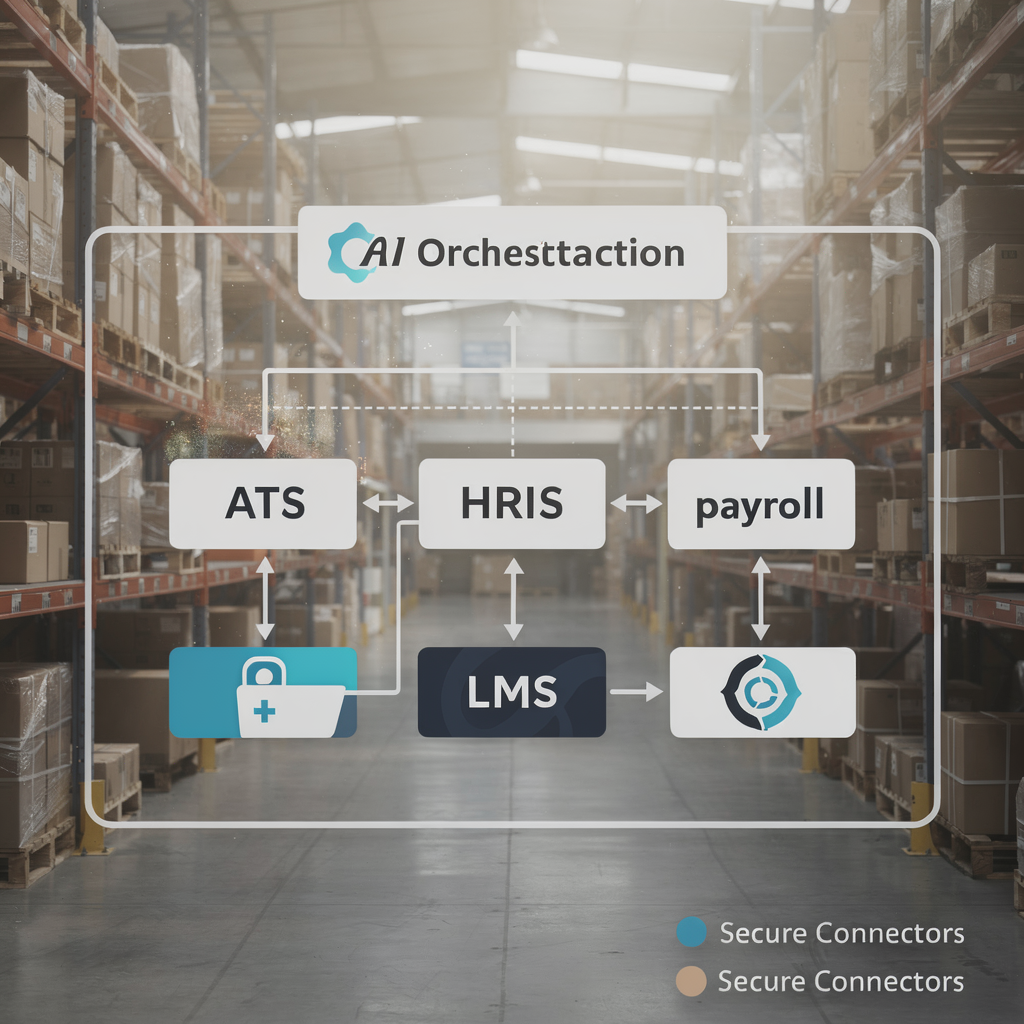
Integrating an AI agent with existing HR systems is critical. Practical integration points include ATS, HRIS, payroll, LMS, ticketing, and calendar systems. Agents exchange data via connectors and APIs, trigger workflows, and update the HR system as the single source of truth. Good designs map data fields, set access controls, and log every action so audit trails remain intact.
Architectural layers matter. Start with secure connectors to ERP or HRIS, then add an orchestration layer that calls the agent. Identity and security are non-negotiable; role-based access and least-privilege models protect sensitive hr data. An ai platform choice affects speed of rollout. Some vendors offer out-of-the-box agents for specific HR processes, while enterprise AI platforms let you build custom agents. Each approach has trade-offs between speed and control.
For teams that rely on email as a primary workflow, solutions like virtualworkforce.ai show how an AI agent can be grounded in ERP, TMS, WMS, and document stores to draft accurate replies and push structured data back into systems. That pattern applies inside HR as well: agents create records, tag cases, and escalate when rules require human review. For HR leaders, the key is pick an approach that integrates cleanly with existing hr systems and preserves a single source of truth.
Interoperability guidance includes maintaining consistent identifiers for employees, syncing core HR master data, and recording agent actions for audit. Choose connectors that support common formats and allow for policy checks. When deciding between vendor agents and an open ai platform, weigh governance needs. Vendor-built HR agents can accelerate pilots, while custom solutions provide more control over logic and data flows. Either way, integrating ai agents requires collaboration between IT, HR, and security to ensure every step supports compliance and measurement.
Finally, document the integration plan and run end-to-end tests before full deployment. This reduces surprises and protects employee data. A well-integrated agent becomes a reliable assistant that reduces toil, speeds resolution, and helps hr leaders focus on strategy rather than manual tasks.
Drowning in emails?
Here’s your way out
Save hours every day as AI Agents label and draft emails directly in Outlook or Gmail, giving your team more time to focus on high-value work.
hr ai agent: key components, governance and practices for using ai
Deploying an hr ai agent requires clear components and governance. Key components of ai include prompt templates, orchestration engines, connectors to HR data, and monitoring dashboards. These pieces let an agent read context, act, and report outcomes. An agent must respect role-based access and data minimisation rules to protect employee privacy. That approach supports both functionality and compliance.
Governance should cover transparency, explainability, and bias testing. Test models with real-life scenarios and measure disparate outcomes. Include human review steps for sensitive hr decisions and implement approval gates for changes. As Lattice recommends, “clean data, clear guardrails, and ongoing monitoring” form the core of a responsible rollout (Lattice). CHROs should set policy that requires human sign-off for compensation, disciplinary actions, and other sensitive hr matters.
A practical policy checklist includes escalation paths for disputes, role-based logging, and consent mechanisms for employees. Ensure that agents provide explainable recommendations and that employees can request human review. Use bias detection tools and schedule periodic audits. Ongoing practice involves retraining models, A/B testing agent behaviours, and maintaining data hygiene. These steps reduce risk and improve agent performance over time.
Technical monitoring is equally important. Track agent accuracy, resolution times, and complaint rates. Build dashboards that show trends and alert on anomalies. Log every action to create an auditable trail. This ensures that AI agents support HR objectives while allowing HR teams across the company to intervene when needed. Agents can also support continuous improvement by surfacing common hr processes that remain manual.
Finally, align governance with local regulations such as GDPR and with company values. Ensure responsible ai is embedded into procurement and vendor management. Proper governance makes AI adoption sustainable. It allows hr professionals to focus on coaching and strategy, while the agent automates routine hr tasks and documents each step for transparency.
using ai agents for hr: rollout steps, KPIs and benefits of using ai agents for HR teams
Start small. A phased rollout reduces risk and builds momentum. First, pilot a low-risk workflow such as scheduling or FAQ resolution. Then measure impact and iterate. After successful pilots, scale to more complex workflows. This approach aligns with advisory recommendations that CHROs should leverage agents to handle advisory work while humans keep strategic oversight (PwC).
KPIs should be concrete. Track time-to-hire, case resolution time, HR staff hours freed, employee satisfaction, error rates, and compliance incidents. Measure before and after baseline performance so you can quantify ROI. For example, many teams report a dramatic drop in handling time for operational messages when agents are deployed. These same metrics apply when automating routine HR emails and requests.
Expected benefits include efficiency gains, consistent policy enforcement, and improved employee experience. Agents help HR scale without proportionally increasing headcount, allowing hr professionals to focus on strategy and coaching. They provide timely answers and reduce human bottlenecks. At the same time, risks such as privacy breaches and bias must be mitigated with monitoring, audit trails, and transparent communication to employees.
Risk mitigation includes clear change communications, human-in-the-loop controls for sensitive decisions, and continuous auditing. Also, ensure that agents provide clear paths to human support. Using ai agents for hr should improve trust; therefore track satisfaction and adjust agent behaviour. Finally, choose an ai solution that integrates with existing HR platforms and supports governance needs. For teams that run email-heavy operations, tools that automate lifecycle email workflows provide a strong template for how agents operate in practice; see resources on ERP email automation for examples ERP email automation.
Rollouts succeed when hr staff and IT collaborate, when KPIs are tracked, and when responsible ai practices are enforced. Deploying ai agents with clear goals allows hr leaders to optimize hr and transform hr with measurable benefits. Over time, agents can automate routine hr tasks and enable HR teams across the business to concentrate on talent strategy and employee development. For more on scaling operational AI, consider guidance on how to scale logistics operations with AI agents scale logistics operations with AI agents, or explore how AI improves customer and employee communication improve logistics customer service with AI.
FAQ
What is an AI agent in HR?
An AI agent is autonomous software that performs tasks such as screening, scheduling, and answering employee questions. It combines natural language capabilities with connectors to HR systems to act and to log outcomes.
How do AI agents improve recruitment?
AI agents speed sourcing and screening and reduce time-to-hire by automating initial outreach and scheduling. They also ensure consistent candidate communication and capture structured data for the HR system.
Are AI agents safe for sensitive HR decisions?
They can be, when used with governance. Require human sign-off for compensation or disciplinary actions and run bias checks and audits to ensure fairness and compliance.
How do AI agents integrate with existing HR systems?
Agents connect via APIs and secure connectors to ATS, HRIS, payroll, and LMS systems. They update the HR system as the single source of truth and keep detailed logs for audits.
What KPIs should HR track after deploying agents?
Track time-to-hire, case resolution time, HR staff hours freed, employee satisfaction, error rates, and compliance incidents. These metrics measure both efficiency and trust.
Can AI agents reduce HR workload?
Yes. AI agents automate routine hr tasks and free up HR staff for strategic work. That allows HR professionals to focus on coaching, planning, and higher-value activities.
Do employees trust AI in HR?
Trust is growing; over half of workers now say they trust AI for certain HR functions such as performance feedback. Transparent practices and human review help maintain trust.
What governance is needed for HR AI agents?
Governance should include explainability, bias testing, role-based access, data minimisation, approval gates, and audit trails. Ongoing monitoring and retraining are also essential.
Should HR build agents or buy them?
Choice depends on control and speed. Vendor agents accelerate pilots, while custom builds give more control over data and logic. Align the choice with governance needs and integration complexity.
How do I start a pilot for AI agents in HR?
Start with a low-risk, high-value workflow like scheduling or FAQs. Measure baseline metrics, run a short pilot, and scale based on results. Ensure IT, HR, and compliance teams are aligned before broader deployment.
Drowning in emails?
Here’s your way out
Save hours every day as AI Agents label and draft emails directly in Outlook or Gmail, giving your team more time to focus on high-value work.