


Mit KI angefangen — Warum Druckunternehmen und Druckereien mit KI und Automatisierung beginnen sollten
Druckunternehmen, die mit KI bei einfachen E-Mail-Aufgaben begonnen haben, sehen schnelle Vorteile. Erstens reduziert KI die Zeit für manuelle Aufgaben. Zweitens beschleunigt sie die Auftragskommunikation und verringert Fehler. Zum Beispiel berichten Unternehmen, die automatisierte E-Mail-Workflows einführen, von einer Steigerung der Betriebseffizienz um ungefähr 20–30 % und schnelleren Kundenreaktionszeiten (Statistiken zu Managed-Print-Services 2026). Außerdem bleibt E-Mail-Marketing eines der kosteneffektivsten Kanäle für das Marketing von Druckereien, mit hohen ROI-Zahlen, die von Branchenstudien berichtet werden (Statista: E-Mail-Marketing weltweit). Daher macht ein Start mit KI sowohl finanziell als auch operativ Sinn.
Nachfolgend schnelle Erfolge, die Druckbetriebe sofort helfen. Erstens: Bestätigungen automatisieren. Zweitens: Proof-Erinnerungen und Lieferstatus-Updates senden. Drittens: Kundenanfragen mit Intent-Detection an das richtige Team weiterleiten. Diese Schritte reduzieren manuelle Aufgaben und verbessern die Kundenzufriedenheit. Beispielsweise bearbeitet Büropersonal über 120 E-Mails pro Mitarbeiter und Tag; Automatisierung begrenzt die Zeit für Triage und verhindert den Verlust von Kontext (Workplace-E-Mail-Statistiken 2025). Außerdem hat virtualworkforce.ai KI-Agenten entwickelt, die den gesamten E-Mail-Lebenszyklus für Betriebsteams automatisieren und die Bearbeitungszeit pro E-Mail von etwa 4,5 Minuten auf 1,5 Minuten reduzieren. Dieses Ergebnis verringert Verzögerungen in der Produktion und senkt Nacharbeiten.
Praktische Checkliste für einen schnellen Start:
- Bestätigungen und Quittungen für jede Bestellung automatisieren.
- Automatisierte Proof-Erinnerungen senden, die an den Auftragsstatus gebunden sind.
- Vorlagenantworten für häufige Anfragen verwenden, um Zeit zu sparen.
- E-Mail-Intents mit Ihrem MIS oder ERP integrieren, um Genauigkeit zu gewährleisten.
Beachten Sie auch Datensicherheit und Einwilligung. Pilotieren Sie als Nächstes einen Workflow in einer einzelnen Produktlinie wie Broschüren oder Digitaldruck, messen Sie die Ergebnisse und skalieren Sie dann. Schließlich halten Sie den Prozess iterativ. Erst bereitstellen, dann messen und dann optimieren. Diese Schritte helfen Führungskräften in Druckunternehmen, manuelle E-Mail-Arbeit in einen zuverlässigen, prüfbaren Workflow zu verwandeln. Infolgedessen verbringen Teams weniger Zeit mit sich wiederholenden Aufgaben und mehr Zeit mit wertschöpfender Arbeit.
AI tools and automation: Practical tools for print shop workflow and throughput
KI-Tools für eine Druckerei konzentrieren sich auf E-Mail-Assistenten, CRM-Integration und Terminierungs-Bots. Wählen Sie zuerst Tools, die sich in MIS-, RIP- und ERP-Systeme integrieren lassen. Verbinden Sie dann Ihr CRM, damit Kundendaten in jede E-Mail einfließen. Lösungen, die Antworten in ERP- und WMS-Daten verankern, reduzieren beispielsweise Suchaufwand und Fehler. Außerdem verbindet virtualworkforce.ai operative Daten und automatisiert Antworten, sodass Teams manuelle Triage vermeiden. So erhalten Sie konsistente Antworten und schnelleren Durchsatz.
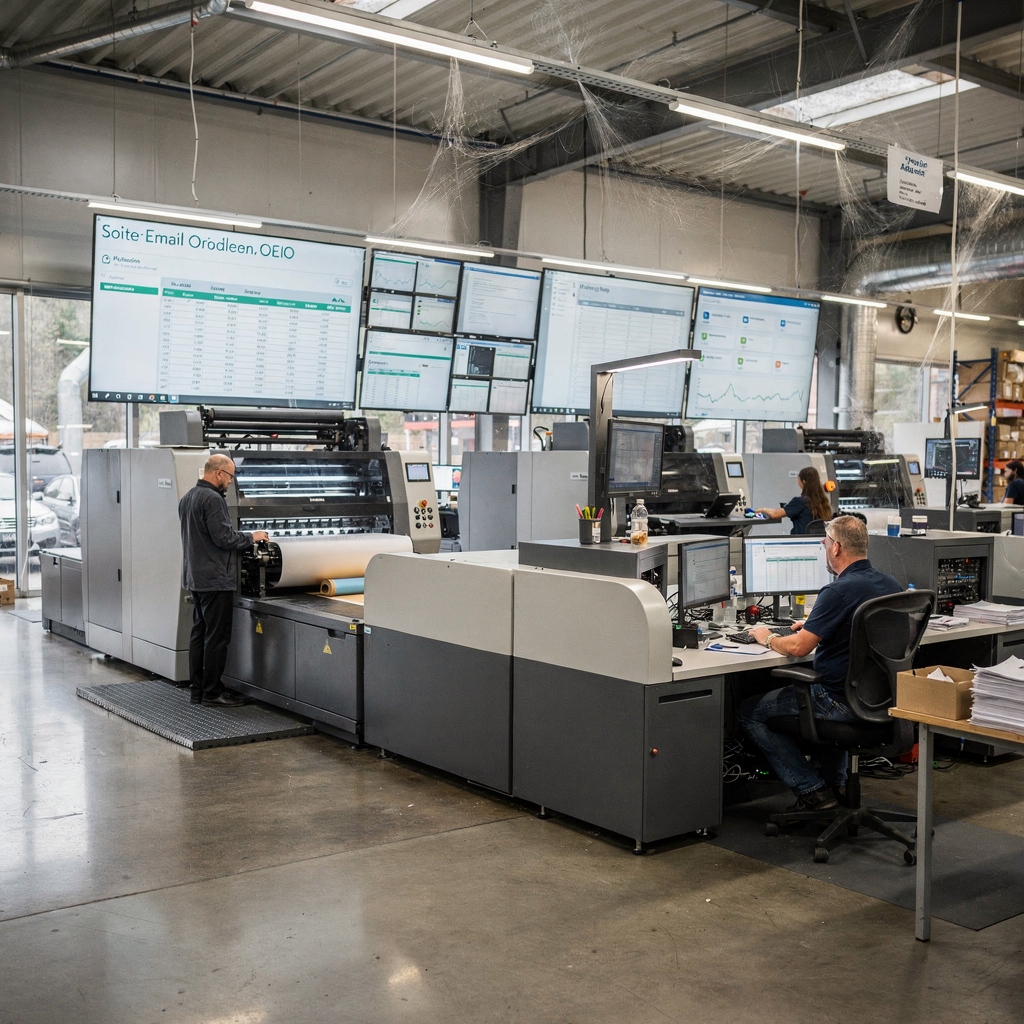
Key practical tools and what they do:
- Email assistants: classify intent, draft replies and route emails.
- CRM integrations: centralise customer data and order history.
- Scheduling bots: book proofs, slots and delivery windows automatically.
- Simple ML job routing: route jobs by size, finish and deadline to optimise throughput.
Integration checklist for MIS/RIP/ERP:
- API access to ERP for order and shipping data.
- Webhooks from MIS for status updates.
- Secure OAuth or SSO for identity and governance.
Also, evaluate selection criteria before you buy. Consider data security, ease of templates, and ability to scale. Next, ensure the tool supports ai-powered automation and thread-aware memory for shared inboxes. In addition, test tools like email assistants with a pilot that handles high-volume status updates. For example, automating proof reminders and shipping notices can cut rework and reduce downtime on the production floor. Moreover, you should view metrics such as order turnaround, throughput and reduction in manual lookups. Finally, connect to ERP email automation resources for technical guidance (ERP-E-Mail-Automatisierung für Logistik). This helps when adapting enterprise-grade connectors to a print environment.
Drowning in emails?
Here’s your way out
Save hours every day as AI Agents label and draft emails directly in Outlook or Gmail, giving your team more time to focus on high-value work.
email marketing and direct mail: Automate marketing for printers to boost conversion
Email marketing and direct mail work best when they run together. First, automated email sequences prime a customer before a direct mail drop. Then, an automated follow up captures responses. Studies show personalised email campaigns yield higher open and click rates, which lifts conversion (E-Mail-Newsletter-Statistiken). Also, combining channels offers measurable benefits. For instance, integrated campaigns often produce higher response rates than single-channel efforts. Therefore, use automated direct mail campaigns alongside email to boost conversion.
Campaign timeline and automated sequence example:
- Week 0: Pre-mail email with personalised offer and sample images.
- Week 1: Direct mail brochure or variable data printing postcard lands.
- Week 2: Reminder email with time-limited discount, A/B tested subject lines.
- Week 3: Follow-up email asking for feedback and offering re-order incentives.
Checklist for marketing automation and direct mail automation:
- Use customer data to personalise offers based on past orders.
- Automate segmentation via CRM and trigger emails at optimal times.
- Track responses with UTM links and integrate campaign analytics.
- Test direct mail formats such as brochure and postcard to measure benefits of direct mail.
Also, maintain compliance for consent and data handling. Next, use variable data printing to tailor messages and personalise creative. In addition, measure conversion and ROI from each channel. For reference, email offers a large ROI across industries and helps marketing for printers grow their customer base (Forbes Advisor zu E-Mail-ROI). Finally, plan A/B tests for subject lines, creative and timing. Tools like CRM-triggered sequences and ai-powered marketing can automate these tests. For practical help, see templates and campaign examples for automated sequences that marketing teams can deploy quickly (Automatisierte Logistikkorrespondenz). Use those ideas as a starting point for printing services.
help printing companies: AI assistants, customer data and workflows that help print and transform operations
AI assistants can automate routine queries and free customer service teams for complex work. Also, they classify emails by intent, attach order context and draft grounded replies. For example, an AI agent can check ERP, TMS or WMS and return an accurate status in seconds. This reduces manual lookups and raises customer satisfaction. In fact, clear status updates lower follow-ups and speed response times.

Steps to use AI assistants in print operations:
- Map common email types: proofs, quotes, delivery, invoices.
- Connect customer data sources securely to feed the assistant.
- Set escalation rules for exceptions and complex jobs.
- Define tone and templates for consistent replies.
Data hygiene and consent checklist:
- Verify customer consent for marketing and notifications.
- Clean email lists and remove duplicates before automation.
- Encrypt PII and control access via roles and audit logs.
Also, AI can segment customers by behaviour and value. Then, you can automate re-order reminders for high-value accounts. In addition, tools deliver analytics and data-driven insights so teams can optimise production schedules and improve quality control. For instance, using machine learning algorithms to predict bottlenecks improves throughput and reduces rework. Moreover, consider generative AI only for draft copy. Always ground replies in operational data to avoid errors. Virtualworkforce.ai shows how thread-aware agents preserve context across long conversations, which helps printing services manage thousands of print orders accurately. Finally, a short pilot that automates order-status emails will demonstrate measurable gains. Use that pilot to expand into billing, returns and cross-sell sequences. This approach lets print companies transform manual email into an auditable workflow and reshape customer support.
Drowning in emails?
Here’s your way out
Save hours every day as AI Agents label and draft emails directly in Outlook or Gmail, giving your team more time to focus on high-value work.
real-world template and marketing materials: Case studies for commercial printers and the print industry
This chapter gives reproducible templates and short case studies that commercial printers can deploy quickly. First, a case study: a mid-size commercial printer automated pre-press notifications and customer replies. As a result, they reduced errors, lowered rework by 18% and lifted on-time delivery. Also, their marketing campaigns saw higher response thanks to personalised emails tied to direct mail. For benchmarking, see integrated campaign metrics and best practices noted in industry reports (E-Mail-Marketing-Statistiken 2026).
One-step deployable email template examples:
- Order confirmation: „Order X received. Expected proof by [date]. Reply STOP to pause.“ Use ERP data to populate fields.
- Proof reminder: „Your proof is ready. Review before [date]. Click to approve or request change.“
- Delivery notice: „Shipment dispatched via [carrier]. Track here: [link].“
Direct mail creative template idea:
- Brochure front: clear headline, sample images of print products, QR to landing page.
- Back: personalised offer and CTA with a tracked code.
A/B test ideas:
- Test subject line short vs descriptive for open-rate lift.
- Test brochure vs postcard for response among small business customers.
- Test call-to-action placement for higher conversion.
Metric examples to track:
- Open rate and click-through for email.
- Direct mail response and conversion rates.
- Order turnaround and rework rate on print production.
Also, capture measurable results by linking campaign UTM tags to CRM. Then, review analytics weekly to decide next steps. In addition, use templates as a baseline and iterate. For practical templates and reproducible campaign cadences, adapt materials to your digital printing lines and high-volume runs. Finally, test one template per product family for quick feedback. These real-world steps help commercial printers improve conversion and customer satisfaction with limited effort.
ai could help print shops: Roadmap to implement automation tools, measure ROI and get started
This roadmap covers six months and gives three pilot projects to start. First three pilots to run in months 0–3:
- Email assistant for order updates and proof reminders.
- Automated cross-sell email series after delivery to boost repeat business.
- Integrated direct mail follow up linking brochure drop to an email funnel.
Six-month phased plan:
- Month 1: Map workflows and select tools like ai-powered automation and CRM connectors.
- Month 2: Implement pilot for order-status emails and integrate ERP. See design tips on integrating email drafting with logistics AI approaches (Beispiele für virtuelle Logistikassistenten).
- Month 3: Measure KPIs and adjust templates.
- Month 4: Extend to marketing automation and direct mail automation.
- Month 5: Add ML routing for job scheduling and predictive maintenance to reduce downtime.
- Month 6: Roll out across product lines and train teams.
KPIs to track and how to measure:
- Response rate and response times for emails.
- Order turnaround and throughput on the production floor.
- Rework percentage and quality control incidents.
- Marketing campaigns conversion and ROI for direct mail plus email.
Also, forecast ROI conservatively. For example, email automation often increases open rates and click rates when personalised, which improves conversion and revenue (E-Mail-Newsletter-Statistiken). In addition, track staff time saved. Virtualworkforce.ai customers report cutting email handling time significantly, which translates into savings and higher capacity. Next, governance matters. Define access rules, audit logs and escalation paths. Then, run staff training and document playbooks. Also, use decision matrices to prioritise pilots based on expected impact and ease of implementation. Finally, iterate fast. Test, measure and then scale to reshape print operations. This roadmap helps teams make informed decisions and see measurable gains quickly.
FAQ
How can AI help my print business with email communication?
AI kann eingehende E-Mails klassifizieren, Antworten entwerfen und Nachrichten an die richtigen Teams weiterleiten. Außerdem zieht sie Auftragsdaten aus ERP oder MIS, um genaue, zeitnahe Antworten zu liefern, die manuelle Aufgaben reduzieren.
What quick wins should a printer aim for when starting with AI?
Beginnen Sie mit automatisierten Bestellbestätigungen, Proof-Erinnerungen und Versandbenachrichtigungen. Diese Workflows verkürzen Antwortzeiten und reduzieren Nacharbeiten, während sie messbare Verbesserungen im Durchsatz liefern.
Will automation tools integrate with my existing MIS or RIP?
Die meisten modernen Tools nutzen APIs oder Webhooks, um sich in MIS-, RIP- und ERP-Systeme zu integrieren. Zur Orientierung bei Connector-Pattern und Beispielen siehe ERP-E-Mail-Automatisierungsanwendungen (ERP-E-Mail-Automatisierung für Logistik).
Can AI improve my marketing for printers and direct mail performance?
Ja. KI-gestützte Segmentierung und personalisierte E-Mails erhöhen Öffnungs- und Klickraten, und die Kombination von E-Mail mit Direktmail führt oft zu höheren Conversion-Raten. Verwenden Sie getrackte Sequenzen, um den ROI genau zu messen.
What data hygiene steps are essential before automating emails?
Stellen Sie Einwilligungen sicher, bereinigen Sie Ihre E-Mail-Listen, entfernen Sie Duplikate und verschlüsseln Sie personenbezogene Daten. Definieren Sie außerdem rollenbasierte Zugriffe und führen Sie Audit-Logs, um Kundendaten zu schützen.
Are there measurable benchmarks I should expect after automation?
Benchmarks variieren, aber Unternehmen sehen oft Betriebs-effizienzgewinne im Bereich von 20–30 % für automatisierte Workflows (Statistiken zu Managed-Print-Services 2026). E-Mail-ROI und Conversion-Verbesserungen hängen vom Kampagnendesign ab.
How do I test direct mail combined with email?
Versenden Sie eine Pre-Mail-E-Mail, um Empfänger vorzuwärmen, senden Sie dann die Direktmail und folgen Sie mit einer Post-Mail-E-Mail. Tracken Sie UTM-Links und Codes, um die Vorteile von Direktmail im Vergleich zu reinen E-Mail-Kampagnen zu messen.
Can AI predict issues on the production floor?
Ja. Machine-Learning-Algorithmen können Wartungsbedarf vorhersagen, Engpässe erkennen und Ausfallzeiten prognostizieren. Nutzen Sie Analysen, um in Echtzeit Anpassungen vorzunehmen und ungeplante Unterbrechungen zu reduzieren.
What are common pitfalls when automating printer customer support?
Häufige Fallstricke sind schlechte Datenintegration, schwache Eskalationsregeln und automatisierte Antworten, die nicht in operativen Daten verankert sind. Vermeiden Sie diese, indem Sie sicherstellen, dass Tools mit dem ERP verbunden sind und klare Eskalationspfade definiert werden.
How should I measure the ROI of an email assistant pilot?
Verfolgen Sie die pro E-Mail eingesparte Zeit, die Reduktion manueller Aufgaben, Abnahmen bei Nacharbeiten und Änderungen der Kundenzufriedenheit. Kombinieren Sie diese mit Kampagnen-Conversions und Umsatzsteigerungen, um einen konservativen ROI zu berechnen. Zur Orientierung siehe Logging- und Korrespondenz-Automatisierungsmethoden (Beispiele für automatisierte Korrespondenz).
Drowning in emails?
Here’s your way out
Save hours every day as AI Agents label and draft emails directly in Outlook or Gmail, giving your team more time to focus on high-value work.