


ai agent — what it is and why procurement teams must understand it
An AI agent is an autonomous or semi-autonomous software actor that senses data, makes decisions, and executes tasks. It differs from simple automation because it can reason across steps, learn from outcomes, and adapt. It also differs from generic AI tools that only return analysis or text. An AI agent can monitor inputs, choose an action, and then complete that action. In practice, this means fewer manual steps, and faster, repeatable outcomes for a procurement team.
There are distinct agent types that matter to procurement. Retrieval agents search, index, and classify documents and supplier records. Planning agents design and manage multi-step sourcing workflows. Monitoring agents watch supplier health, flag alerts, and trigger mitigation steps. Together, these agents form a layered approach that supports intake, sourcing, and supplier monitoring.
For example, imagine an AI agent that scans market feeds, compares supplier ratings and lead times, ranks suppliers, and then starts a request for quote. The agent fills the RFx with relevant terms, attaches historic spend data, and routes the RFx to the right category manager. The procurement team then reviews a short list rather than building that list from scratch. This reduces cycle time and lowers risk of human error.
Why should procurement leaders learn this? First, agents remove repetitive work. Second, they surface strategic options using data. Third, they operate continuously so teams get real‑time alerts on supplier issues and market shifts. As IBM observes, “AI agents can streamline the process of selecting suppliers by analyzing historical data, performance metrics, financial stability and market conditions” (IBM). For procurement professionals, the shift from manual to agent‑assisted work is practical and measurable.
ai agent in procurement: core roles from sourcing to supplier risk monitoring
What roles do agents play across the procurement lifecycle? They support supplier discovery, automate RFx drafting, extract contract clauses, and run continuous risk monitoring. In sourcing, retrieval agents pull supplier records and external financial feeds. In negotiation, planning agents assemble comparable offers and suggest concession tradeoffs. After contracting, monitoring agents score supplier performance and alert stakeholders to issues.
Vendor platforms already show outcomes. Ivalua reports that AI agents are starting to empower procurement teams to be proactive in uncovering opportunities and avoiding disruptions (Ivalua). Suplari highlights improved spend and risk visibility when agents analyze transactions and supplier behaviors (Suplari). These cases show faster onboarding, clearer risk signals, and more consistent supplier performance reviews.
Where agents add value in a simple flow is clear: intake → source → negotiate → contract → monitor. At intake, retrieval agents classify requests and pull vendor history. At source, planning agents create RFx templates and score responses. At negotiate, agents surface benchmark pricing and concessions. For contract, extraction agents locate clauses and map obligations. For monitoring, continuous agents track delivery, compliance, and external alerts.
Tools fit by role. Use procurement software that supports retrieval and monitoring for supplier discovery. Use planning agents embedded in sourcing tools for strategic sourcing and negotiation support. For teams that handle lots of operational emails tied to suppliers, virtualworkforce.ai automates the full email lifecycle so category managers spend less time on manual triage and more time on value work (automated logistics correspondence). These matches show how agents replace low‑value tasks while improving quality across the procurement process.

Drowning in emails?
Here’s your way out
Save hours every day as AI Agents label and draft emails directly in Outlook or Gmail, giving your team more time to focus on high-value work.
agentic ai and agentic ai in procurement: autonomy, limits and governance
Agentic AI describes agents that take multi-step actions and adapt without a human providing every step. These agents plan, execute, and then re-plan based on results. In procurement, agentic AI in procurement can run sourcing sprints overnight, complete RFx rounds, and start remediation for supplier issues. This capability shortens cycle time and scales monitoring.
Benefits are clear: faster decisions, 24/7 monitoring, and reduced manual load. However, limits exist. Agents that act without strong data tend to make poor choices. Unintended actions can create compliance or legal exposure. For that reason, governance must define what an agent may do and when a person must approve.
Use a governance checklist. First, require a human‑in‑the‑loop for high‑value approvals and contract commitments. Second, implement action guardrails that prevent agents from changing contract terms or issuing payments. Third, keep audit logs and require explainability for any decision that affects supplier status. Fourth, enforce data quality controls and regular model checks. These steps avoid common stalls in pilots where integration and data issues block progress; many teams pilot agentic projects but struggle to scale due to poor data and integration hurdles (Inventive AI / Gartner summary).
While agentic AI systems can improve responsiveness, procurement leaders should plan pilots that keep humans in critical loops. This balance lets teams test autonomy safely, and then expand it once controls and explainability meet legal and procurement standards. For a practical pattern, start with monitoring agents that raise alerts and do not act, and then move to agents that can propose actions and wait for approval. That staged approach supports adoption and lowers risk while the organization builds confidence in agentic ai technology.
benefits of ai agents and ai in procurement: speed, savings and better procurement decisions
AI agents deliver measurable benefits. They shorten the procurement cycle, reduce manual effort, and surface cost savings. They also improve supplier resilience by offering early warnings on supplier health and market shifts. For teams that need proof points, target metrics like fewer sourcing days, higher RFx automation rates, and lower supplier disruption incidents.
For example, many procurement teams measure sourcing cycle days and aim to reduce them. An agent that drafts RFx documents and pre-fills supplier data can cut the cycle by days. Another metric is the percentage of RFx responses that an agent processes automatically. Higher automation frees staff to negotiate complex terms. Also, tracking reduction in supplier disruptions shows longer-term resilience gains.
Adoption statistics reinforce the trend. A recent study found that 73% of procurement professionals report already using AI for procurement-related tasks (PR Newswire). Additionally, about 40% of procurement functions have implemented or piloted generative AI solutions, showing a notable shift toward advanced capabilities (McKinsey).
Practical tips matter. First, measure both efficiency (time saved) and outcomes (cost reduction and fewer supplier incidents). Second, set short pilots with clear KPIs such as reducing cycle time by a target percentage and increasing automated RFx throughput. Third, pair agents with proven procurement software and integrations; for email-driven operational flows, see virtualworkforce.ai’s guide on scaling logistics operations with AI agents for context (how to scale logistics operations with AI agents).
Drowning in emails?
Here’s your way out
Save hours every day as AI Agents label and draft emails directly in Outlook or Gmail, giving your team more time to focus on high-value work.
supplier, source and strategic sourcing: procurement agents for supplier selection and risk management
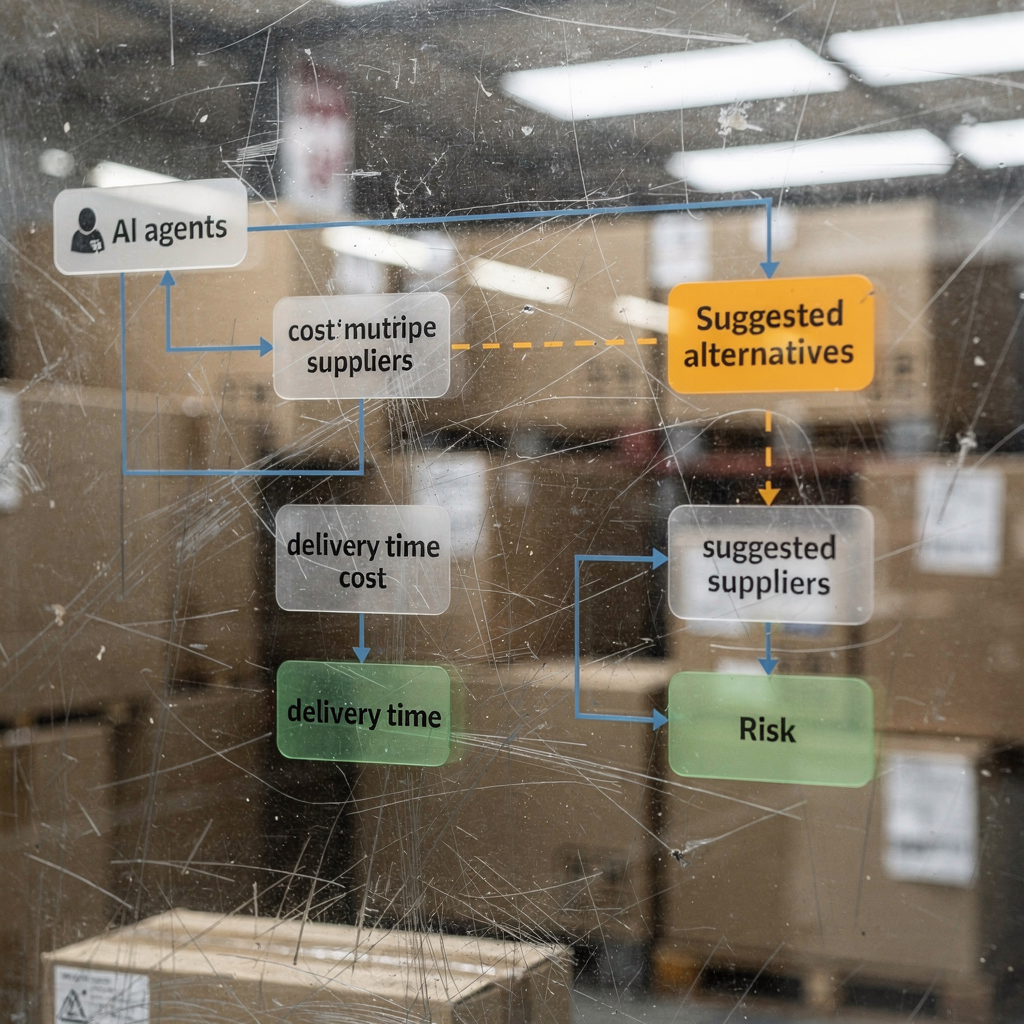
How do agents support supplier selection? They automate scoring across historical performance, financial indicators, and external market news. Retrieval agents pull internal spend and supplier data, and then combine it with external feeds such as credit scores and sanctions lists. The result is an objective supplier score that helps buyers prioritize interviews and site visits.
For risk management, agents provide continuous supplier scoring and early warning alerts. They run scenario testing and recommend alternative sources when risk thresholds trigger. This approach helps procurement teams to avoid supply chain disruptions by switching to pre‑qualified alternatives or by creating buffer stock plans. In short, procurement agents can reduce surprise outages.
A strategic sourcing use case shows value. An agent analyzes spend, finds low-volume fragmentation, and suggests consolidation or dual‑sourcing. It simulates the impact on cost and lead time, and it generates a recommended sourcing plan. Procurement leaders then review options and approve changes that lower cost and improve resilience. Tools like Ivalua and IBM show examples where agents have sped onboarding and improved contract and risk analytics (Ivalua, IBM).
Implementation notes: combine internal spend and supplier records with external financial and news feeds to get reliable scores. Also, keep a human reviewer for supplier de‑risking steps. For procurement teams that manage a high volume of supplier emails and documents, automation that links email context to supplier records—such as virtualworkforce.ai’s ERP email automation—can cut handling time and improve traceability (ERP email automation).
procurement software, procurement operations and procurement organisation: how to implement ai-powered procurement and automate procurement at scale for strategic procurement
Start with use case selection. Identify high-volume, repeatable tasks that waste time. Typical candidates include RFx drafting, supplier onboarding, and operational email triage. Then, clean and map data from ERP, P2P, and contract systems. Integration is essential because agents need reliable data to act. Without data hygiene, pilots stall and AI adoption slows.
Next, pick pilot workflows and integrate with procurement software and procurement platforms. Work with IT to map APIs and access controls. Build a small centre of excellence or assign an AI steward to measure outcomes and enforce governance. Procurement leaders must sponsor pilots and communicate expected benefits. These steps help procurement departments move from experiment to scale.
Organisational changes follow. Train procurement employees on new agent capabilities. Redefine SLAs and roles so people handle exceptions and strategic tasks. Create KPIs such as reduced cycle time, compliance rate, and fewer supplier incidents. Also track user adoption and ROI over a clear timeline. Practical barriers include legacy system integration, poor data quality, and change resistance. Address these with phased pilots, clear guardrails, and regular feedback loops.
For operational email workflows tied to suppliers and logistics, vendors like virtualworkforce.ai show how agents automatically reduce manual triage. Their agents understand intent, pull data from ERP and WMS, and draft grounded replies in Outlook or Gmail. This kind of automation frees teams to focus on negotiation and supplier relationship work. In short, modern AI solutions let procurement operating models shift from tactical to strategic, and they help procurement become a true driver of cost and resilience.
FAQ
What is an AI agent in procurement?
An AI agent is software that senses data, decides, and acts on tasks in procurement. It can find suppliers, draft RFx, or monitor supplier risk while reducing manual steps.
How do AI agents improve supplier selection?
Agents score suppliers using internal performance history and external financial and market data. They then rank and recommend suppliers so buyers can focus on negotiation and strategy.
Are agentic AI systems safe for procurement?
Agentic AI systems can act autonomously, so governance is essential. Use human approvals for critical actions, set guardrails, and require audit logs to manage risk.
What ROI can procurement expect from agents?
ROI comes from faster sourcing cycles, lower manual effort, and fewer supplier disruptions. Measure cycle time, automation rates, and risk incident reductions to track value.
How do I start a pilot with AI agents?
Begin with a clear use case and clean the relevant data. Integrate with ERP or P2P, set KPIs, and assign a sponsor and AI steward to manage the pilot.
Can AI agents handle contractual review?
Yes. Contract‑extraction agents can find clauses and flag risks, but humans should review final contract changes. Agents help speed review and reduce errors.
Do AI agents replace procurement teams?
No. They remove repetitive tasks and enable procurement teams to focus on higher‑value work like strategy and supplier relationships. Agents augment human roles rather than replace them.
How do I combine internal and external data for scoring?
Link spend and supplier records from ERP with external feeds such as credit scores, news, and sanctions lists. High‑quality, integrated data improves scoring accuracy and decision making.
What are common barriers to scaling AI in procurement?
Common barriers include legacy systems, poor data quality, and change resistance. Mitigate these with phased pilots, clear governance, and executive sponsorship.
Where can I learn more about operational email automation for procurement and logistics?
Look for vendor resources on automating logistics emails and ERP integration to see examples of agents in action. For instance, virtualworkforce.ai explains how to automate email workflows and scale logistics operations with AI agents (how to scale logistics operations without hiring).
Drowning in emails?
Here’s your way out
Save hours every day as AI Agents label and draft emails directly in Outlook or Gmail, giving your team more time to focus on high-value work.