


AI for government: AI solutions that transform government contracting for defense contractors
AI for government has moved from pilot projects to core capability in acquisition workflows. Agencies now use AI tools for search, summarisation, generative text and analytics to speed research, parse requirements and support source selection. For example, AI search accelerates reach-back to past proposals and past performance. Generative AI drafts compliant clauses and summaries. Analytics spot risk in supplier networks. The Defense Acquisition University describes how AI can “enhance research capabilities and align acquisition strategies with the National Defense Strategy” and improve contract types, competition strategies, and source selection processes (DAU 2024). That guidance shows how to integrate AI into government contracting without losing auditability.
At the same time, validation matters. A 2025 study found AI assistants returned at least one issue in about 45% of news-query responses, which underlines why procurement teams must test outputs before relying on them for acquisition decisions (2025 reliability study). Therefore, contracting teams should require verification steps in proposals and accept only high-quality evidence chains when decisions affect national security.
Concrete example: a capture team uses an AI assistant to parse an RFP into a compliance matrix, then runs a human red team pass. Example two: source selection boards use analytics to normalise past performance scores and remove bias. Example three: a program office uses AI summarisation to compress a 300‑page technical requirement into a two‑page decision brief for leadership. Checklist (technical + compliance): ensure model provenance is logged; require audit trails for training data; define acceptance thresholds for automated outputs; map decisions back to source documents. For teams that want to automate operational email-and-document flows in logistics or contracting, consider tools that integrate with ERP and email to create structured data from unstructured messages, such as a virtual assistant for logistics (virtual assistant logistics).
When agencies and government contractor teams adopt AI solutions, they must balance speed with trust. Use AI to accelerate routine tasks, but always include human-in-the-loop checks for mission-critical decisions. This approach helps transform acquisition while maintaining the highest security and compliance standards.
GovCon capture: use AI to streamline proposals, win contracts and improve bid success
GovCon capture teams now use AI to streamline proposal workflows and win contracts faster. An AI tool can extract requirements from requests for proposals, map obligations to a compliance matrix, and auto-populate boilerplate language. That reduces time spent on repetitive drafting and improves consistency across proposals. In practice, AI drafts initial responses, while subject-matter experts refine technical sections. The result: shorter turnaround and improved win rates when teams combine AI drafting with human review.
Concrete example: a business development lead uses AI to generate a first-pass technical approach. Example two: a capture manager automates cost-volume templates and links them to historical rates. Example three: a contracting team runs an AI-driven red-team to surface potential compliance gaps and conflicting claims. These vendor-neutral notes show how AI can improve repeatability and reduce errors.
Checklist (technical + compliance): validate the RFP parsing accuracy against three historical RFPs; ensure electronic signatures and version control for red-line histories; document model outputs in the proposal’s audit appendix. Firms must also consider data rights and system security plans when they use external models. For government contractor teams that handle high-volume operational correspondence, tools that integrate with email and ERP systems can close the loop between capture and delivery; see a case study on automated logistics correspondence (automated logistics correspondence).
AI also supports win strategies beyond drafting. It analyses competitor signals in past proposals, highlights differentiators, and suggests pricing ranges. Teams that use AI responsibly can improve bid consistency and repeatability. Still, teams must keep model outputs auditable. That builds trust with evaluators and with contracting officers who must meet the highest security standards. With the right controls, AI-powered solutions help teams win contracts while keeping human judgement central to final decisions.

Drowning in emails?
Here’s your way out
Save hours every day as AI Agents label and draft emails directly in Outlook or Gmail, giving your team more time to focus on high-value work.
Compliant AI and CUI: deploy compliant AI that meets CMMC, procurement and national security requirements
Protecting Controlled Unclassified Information (CUI) must guide every AI deployment. Government contractors that process CUI need compliant environments, documented controls and contractual clauses that protect data rights. CMMC 2.0 introduces maturity levels and practices to protect CUI; teams must map AI workflows against CMMC controls and DoD guidance on handling CUI. You should require vendors to provide system security plans and artifact evidence for model training and inference environments.
Concrete example: a prime integrates a purpose-built on‑prem model for proposal redaction and keeps training data air-gapped to meet the highest security standards. Example two: a subcontractor uses an accredited cloud with logging that supports audits. Example three: a capture team includes contractual language that limits model reuse of proposal text and defines ownership of outputs. Checklist (technical + compliance): classify data as CUI or non-CUI; choose model deployment (air-gapped, accredited cloud, or on-prem); define SLA language for vendor logging and data retention; produce system security plans mapped to NIST and CMMC controls; include incident response terms in procurement.
When you deploy AI, prefer models and architectures that provide provenance and explainability. This is essential for mission-critical solutions and national security programs. Also, ensure procurement teams include compliance proof as part of evaluation criteria. For contracting teams focused on operational email and document automation, integrating a vetted AI platform that supports access control and audit trails can speed deployment while meeting security and compliance needs; view recommendations on scaling operations without new headcount (how to scale logistics operations without hiring).
Finally, confirm that contracts include clauses that require vendors to meet the CMMC baseline, evidence NIST-aligned controls, and support audits. That reduces legal and operational risk. A compliant model pathway enables teams to use AI capabilities in production without compromising national security.
AI-driven readiness: deploy latent AI and tactical AI at scale to improve defence readiness and the tactical edge
AI-driven readiness focuses on delivering latent AI and tactical AI that improve DEFENSE READINESS and the tactical edge. Use cases include predictive maintenance, logistics optimisation, scenario modelling, training simulation, and near‑real‑time analytics at the tactical edge. DARPA and other agencies invest in AI-enabled detection and attribution systems to enhance deterrence and operational awareness (detection and attribution initiatives). Those programs emphasise robustness and verification for models deployed near forward operating bases and in disconnected environments.
Concrete example: a brigade uses predictive maintenance models to prioritise parts and reduce downtime at forward operating bases. Example two: a logistics cell runs optimisation models to consolidate shipments and reduce fuel use. Example three: a training command uses scenario generation to expand exercises and stress decision-making under uncertainty. Checklist (technical + compliance): test machine learning models across degraded-comms scenarios; require explainability layers for tactical AI decisions; ensure ruggedised hardware and secure boot for edge nodes; include rollback plans and offline verification for ai deployed in the field.
Teams must manage latency, compute and connectivity constraints. Latent AI techniques compress models for low-latency inference. Tactical AI solutions require purpose-built architectures to operate in disconnected or air-gapped conditions. The power of AI is in making faster, actionable decisions at the point of need. But teams must verify outputs before they change operations. The International AI Safety Report 2025 states that “general-purpose AI capabilities that integrate diverse data types are critical for advancing defense research, but they must be developed with stringent safety and ethical standards” (International AI Safety Report 2025).
When implementing AI at scale, ensure you have a clear path to operationalize AI with security and reproducibility. That helps warfighters and commanders rely on AI-driven insights during military operations and defence operations while reducing the risk of unexpected behavior.
Drowning in emails?
Here’s your way out
Save hours every day as AI Agents label and draft emails directly in Outlook or Gmail, giving your team more time to focus on high-value work.
AI platform and security: build an AI platform for mission-critical, secure government contracting and machine learning lifecycle management
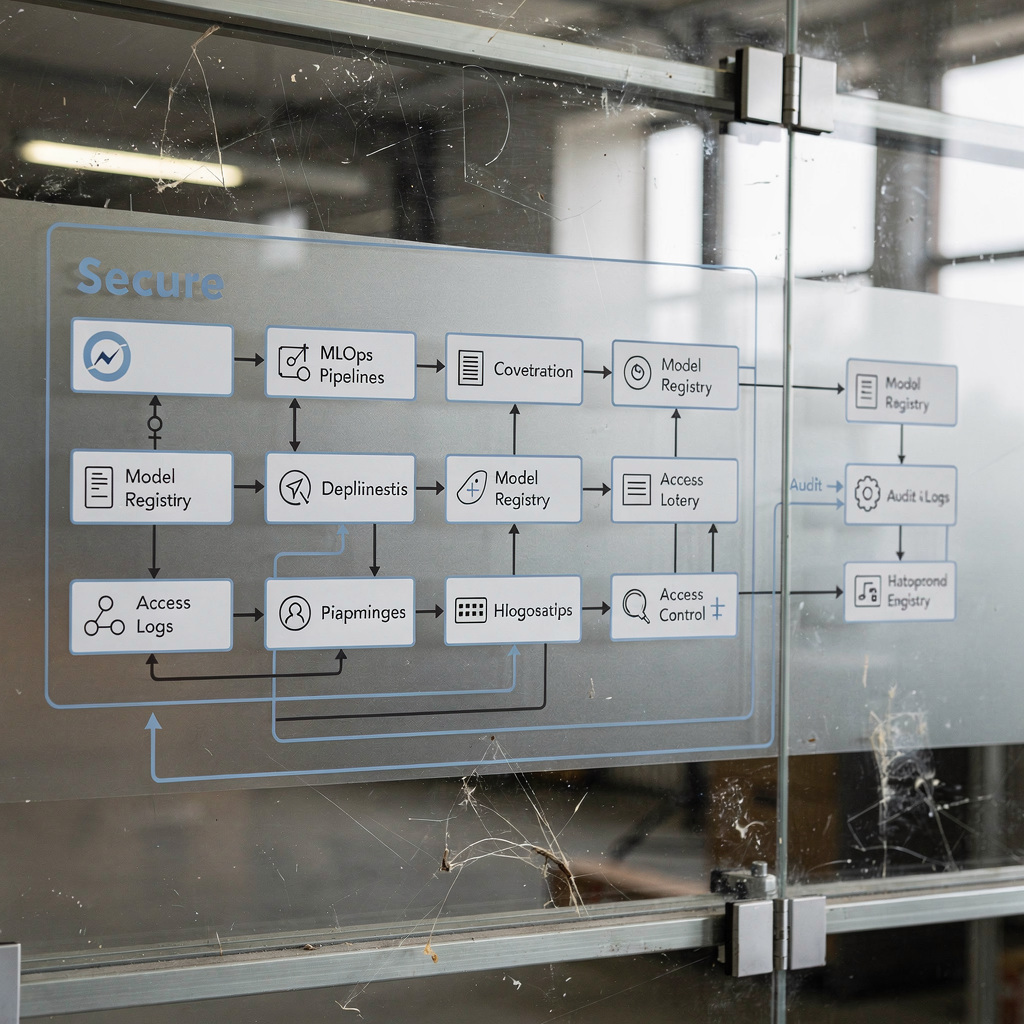
An AI platform for mission-critical work must combine secure MLOps, CI/CD for models, access control for sensitive data, robust logging and a clear lifecycle for machine learning artefacts. Platform controls should support audits, evidence collection and incident response. For instance, a model registry that tracks dataset provenance and model versions enables traceability. That capability supports contracting teams that must demonstrate compliance during source selection or audits.
Concrete example: a prime builds an air-gapped staging environment for high-risk models with automated testing and signed-release pipelines. Example two: a mid-tier integrator deploys an AI platform that enforces role-based access to CUI and where every inference call records metadata for later review. Example three: an operations team integrates email automation into the platform so that audit trails link correspondence to the originating model inference. Checklist (technical + compliance): implement tamper-evident logging; require model explainability modules; produce lifecycle documentation for each release; align controls with NIST and CMMC guidance; include vendor risk management in procurement.
Platforms also need to support explainability and resilience. Explainability matters for mission-critical solutions and for building trust with evaluators. Resilience includes graceful degradation and isolation for compromised components. For teams that want to streamline operational email, platforms that connect to ERP and email systems can create structured data and reduce manual triage; learn how AI streamlines freight communication and email drafting (best tools for logistics communication).
To deploy AI at scale, embed security and compliance into the platform from day one. That way you can demonstrate to DoD evaluators that models were tested, signed, and deployed according to policy. This approach improves operational efficiency and reduces time to field mission-critical solutions while meeting security and compliance requirements.
Top AI use cases and procurement paths: cutting-edge generative AI for warfighter support and how top government contractors deploy solutions to transform mission capability
Top AI use cases for defense include generative AI for documentation and intelligence synthesis, analytics for command and control (C2), cybersecurity automation, and predictive logistics. Leading contractors combine generative AI capabilities with domain models to deliver actionable intelligence and faster decision cycles. Trends in federal hiring and investment show growing demand for these skills; USAJobs and industry reporting document increased AI-related postings across agencies and the U.S. federal workforce (federal workforce trends).
Procurement routes that accelerate access to commercial AI include GSA schedules, DoD pilot programmes and blanket purchase agreements (BPAs). Capture teams should plan proofs of concept, red-team evaluations and compliance packs as part of their capture plan. Concrete example: a contractor wins a pilot by delivering a PoC that demonstrates reduced analyst time through generative summaries and measurable reduction in time-to-insight. Example two: a firm wins a BPA after showing a compliant model lifecycle and system security plans. Example three: a supplier leverages a GSA schedule to provide an AI service that meets agreed SLA and audit requirements. Checklist (technical + compliance): map procurement vehicle to compliance needs; run a PoC focused on measurable KPIs; include red-team testing and compliance evidence in proposals.
Adopting generative AI in defense requires careful procurement language that protects CUI and limits model reuse. For capture and business development teams, include specific deliverables in proposals that show how AI-powered solutions will meet the highest security standards and produce repeatable win rates. Top government contractors now use AI-powered solutions to transform mission capability while maintaining security and compliance. To explore practical logistics and operations automation that reduces email handling time and increases traceability, see how a virtual workforce can improve logistics customer service (how to improve logistics customer service with AI).
Finally, focus on strategic priorities: prove safe, explainable models; show measurable impact on readiness and defense readiness; and ensure procurement paths include compliance evidence. This approach helps teams win contracts while delivering mission-critical value to warfighters and decision-makers.
FAQ
What is AI for government and how does it differ from commercial AI?
AI for government applies artificial intelligence to public-sector missions, including acquisition, defence operations and public safety. It requires additional controls for CUI, auditability and compliance compared with many commercial deployments.
How can AI help government contractors win contracts?
AI can automate RFP parsing, create compliance matrices and draft first-pass responses to requests for proposals. When combined with human review and compliance evidence, these tools help contracting teams improve consistency and win rates.
What are the key compliance steps when handling CUI with AI?
Classify data, choose an accredited deployment option (air-gapped, on-prem or accredited cloud), require system security plans and include vendor SLA and logging clauses in procurement. These steps help meet CMMC and NIST expectations.
What is latent AI and why does it matter for the tactical edge?
Latent AI compresses models and optimises inference for low-latency deployments, enabling analytics in disconnected or constrained environments. This matters for forward operating bases and other tactical environments where connectivity is limited.
Which procurement routes speed access to commercial AI for defense work?
GSA schedules, DoD pilot programmes and BPAs often accelerate procurement of commercial AI services. Capture teams should pair procurement paths with PoCs and red-team testing to demonstrate compliance and performance.
How do you ensure an AI platform is secure for mission-critical workloads?
Build secure MLOps with role-based access, tamper-evident logging, model registries and CI/CD pipelines. Align controls with NIST and include system security plans in proposals to meet evaluators’ expectations.
Are AI assistants reliable enough for acquisition decisions?
AI assistants speed research and summarisation, but studies show they can still make errors. For example, a 2025 analysis found issues in a significant share of responses, so human validation remains essential (2025 study).
What are practical use cases for generative AI in defense?
Generative AI helps synthesise intelligence, draft technical documentation and create exercise scenarios for training. When paired with verification, it reduces analyst burden and accelerates decision-making.
How should contracting teams include AI compliance in proposals?
Include artifacts like system security plans, model lifecycle documentation, PoC results and red-team reports. State how you will meet CMMC controls and how the platform records provenance for audits.
Where can I learn more about integrating AI with operational email workflows?
Practical guides and case studies about automating logistics email and improving customer service show how AI agents reduce handling time and increase traceability. See vendor-neutral examples and integration notes on automating logistics correspondence (automated logistics correspondence).
Drowning in emails?
Here’s your way out
Save hours every day as AI Agents label and draft emails directly in Outlook or Gmail, giving your team more time to focus on high-value work.