


ai-powered back office: why ai agent adoption matters for your real estate business
AI is changing how back office work gets done in real estate. First, AI reduces repetitive data entry and paperwork. Second, AI automates transaction orchestration, document processing, tenant communications and basic compliance checks. Also, AI agents can read contracts, extract key dates, and push structured records into an existing CRM or accounting system. In practice, this saves time and reduces avoidable errors. For example, about 79% of businesses use AI agents today, which shows broad adoption and measurable ROI.
Moreover, research finds that roughly 15.2% of AI projects focus on back-office functions. Next, commercial real estate data shows that 92% of CRE firms have started pilots, though only about 5% have fully realised their programs. Therefore, the interest is strong and the execution is still maturing. Also, market forecasts expect AI in the sector to grow rapidly, with estimates that the market will approach $1,303.09 billion by 2030, driven in part by back-office automation.
AI agents for real estate often focus on paperwork automation. For instance, tools like Dotloop handle transaction and document automation, while platforms like Cherre combine data and workflow to improve deal visibility. Additionally, AI-powered email automation can tame operational inboxes that trap critical requests; virtualworkforce.ai uses AI agents to automate the full email lifecycle for ops teams, which helps teams reduce handling time and increase consistency. In addition, firms that adopt AI see faster closings, fewer errors, and lower operational cost per transaction. Therefore, real estate brokerages and broker teams should evaluate where AI can streamline the most manual processes.
Finally, when a real estate agent or a back office team evaluates AI, they should prioritise integrations with MLS, CRM and accounting systems. Also, they should demand audit trails and human-in-the-loop controls. For additional reading on automating operational email and how AI can help operational teams, see virtualworkforce.ai’s guides on scaling logistics operations with AI agents and automated logistics correspondence for similar patterns and vendor considerations.
real estate agent workflows: which ai tools for real estate automate listing-to-close processes
Listing-to-close workflows include many repetitive tasks that an AI tool can automate. First, agents create a listing, write a listing description, gather listing photos, and schedule marketing. Next, lead capture flows into a CRM, offers arrive, negotiations occur, and contracts get signed. Then, compliance checks, escrow steps and closing tasks follow. Also, routine tenant and buyer communications add hours each week. AI helps at each stage by extracting data, drafting messages, orchestrating tasks and nudging humans when required.

For listing creation, tools like Ylopo and generative content modules can produce high-quality marketing copy and suggested photos. Also, AI virtual staging and AI image enhancements improve visual appeal without on-site staging. For transaction flows, Dotloop centralises document signing and versioning. Also, AI CRMs bridge lead to transaction by prioritising leads and scheduling follow-ups. AI can automate the extraction of contract terms and key dates, which often yields the fastest ROI. In fact, document extraction, e-signatures and task orchestration typically deliver measurable time savings within weeks.
Typical time savings vary by task. For instance, writing a listing description moves from 20–40 minutes to a few seconds with AI suggestions. Meanwhile, contract abstraction and data entry that used to take 30–90 minutes per contract can fall to a few minutes with AI-assisted document processing. Also, automating reminders and status updates reduces manual follow-up and missed deadlines. Therefore, agents can focus on client conversations and negotiations instead of admin work. In addition, solo agents and teams both benefit: solo agents gain bandwidth, and teams improve consistency across new listings and closings.
When assessing AI tools for real estate, look for integrations with MLS and your CRM, support for bulk uploads of listing photos, and clear audit logs for compliance. Also, evaluate whether the AI tool supports multi-step AI workflows, including offer management, contract generation, and automated scheduling for signings. For vendors that focus on operational email and task automation, consider resources on how to improve logistics customer service with AI to understand email lifecycle automation patterns and how they apply to transactional email in property transactions.
Drowning in emails? Here’s your way out
Save hours every day as AI Agents label and draft emails directly in Outlook or Gmail, giving your team more time to focus on high-value work.
ai tool selection: how to choose the right ai tool and the right ai tools for real estate back office
Choosing the right AI tool starts with a clear map of your current processes. First, list connectors you need: MLS, your CRM, accounting software, and document storage. Next, require data security, encryption and audit trails. Also, ensure that the vendor supports human-in-the-loop review and provides clear explainability for decisions affecting contracts or compliance. In practice, ask for a proof-of-concept that runs on a representative dataset and measures time saved, accuracy and error rates.
Selection criteria should include integration depth, vendor support, SLA terms and data residency. Additionally, test how the AI tool handles edge cases and exceptions. Also, require the vendor to show a clear escalation path when the AI cannot fully resolve a query. For example, virtualworkforce.ai connects operational systems and grounds replies in ERP, TMS, WMS and SharePoint to draft accurate replies inside Outlook or Gmail. Furthermore, this kind of deep grounding prevents hallucinations and keeps responses auditable.
Procurement checklist items: required connectors (MLS, CRM, accounting), availability of SLAs, data residency options, a pilot scope and success criteria, and vendor references from real estate firms or brokerages. Also, verify whether the AI tool supports role-based access controls and logs every automated action. Next, evaluate whether the AI model provides explainable outputs for valuation or compliance decisions. Moreover, confirm backup and recovery processes and incident response timing.
Vendor examples split by speciality. Some vendors specialise in document processing and lease abstraction; others focus on tenant communication and chatbots. Also, some platforms offer a full AI-powered transaction suite that covers listing-to-close, while others provide focused AI agents for specific tasks. For a logistics-focused example of end-to-end email automation that mirrors operational needs in real estate back offices, review virtualworkforce.ai’s materials on ERP email automation in logistics to see how deep data grounding and thread-aware memory support accuracy and traceability. Finally, run a short pilot with your chosen right AI tool and measure against the pilot metrics before scaling.
valuation, compliance and tenant workflows: use ai to improve accuracy and reduce risk
AI supports valuation by normalising data, identifying comparable transactions and flagging outliers. Also, AI can assist with automated compliance checks by validating signatures, dates and required disclosures. Further, AI helps with lease abstraction, tenant screening and fraud detection by scanning documents, extracting identity information, and cross-checking public records. In addition, AI can create standardised outputs that compliance teams can review quickly, which reduces bottlenecks and speeds approvals.
Metrics to track include error reduction, time to approval, number of compliance flags, and dispute incidence. Also, measure false positive and false negative rates in screening workflows. For valuation work, track variance between AI-suggested valuation and appraiser estimates and monitor how frequently valuation adjustments require manual override. Also, track how AI affects time from offer acceptance to close and how it reduces duplicate data entry across systems.
Tenant workflows improve when AI automates initial inquiries and KYC. For instance, a tenant chatbot can answer FAQ, collect documents, and kick off tenant screening. Also, automated KYC and document verification tools check IDs and flag potential fraud. AI helps property management teams by streamlining maintenance requests, routing work orders and providing consistent tenant replies. In practice, this reduces the manual triage burden and increases tenant satisfaction.
Tool patterns include lease abstraction engines that output structured lease terms, tenant chatbots that handle routine requests, and automated valuation modules that pull public records and market indicators. Also, AI-enabled audit trails and timestamped decisions make compliance reviews faster. For real estate firms operating in commercial real estate and residential markets, successful AI deployments close more deals and reduce compliance risk. Finally, consider pairing an AI assistant with human reviewers to keep high-risk decisions under human control and to teach AI from corrections over time.
Drowning in emails? Here’s your way out
Save hours every day as AI Agents label and draft emails directly in Outlook or Gmail, giving your team more time to focus on high-value work.
use case and automation: agentic ai for listing description, transaction automation and tenant handling
Agentic AI refers to multi-step agents that act across systems with a degree of autonomy while following rules and escalation paths. First, an agentic AI can auto-generate a listing description, enrich it with market data and recommended listing photos, and post the property to major portals. Next, it can manage incoming offers, summarise key terms, and create draft contracts ready for human review. Then, the same agent can schedule signings, send reminders, and update the CRM when milestones complete.
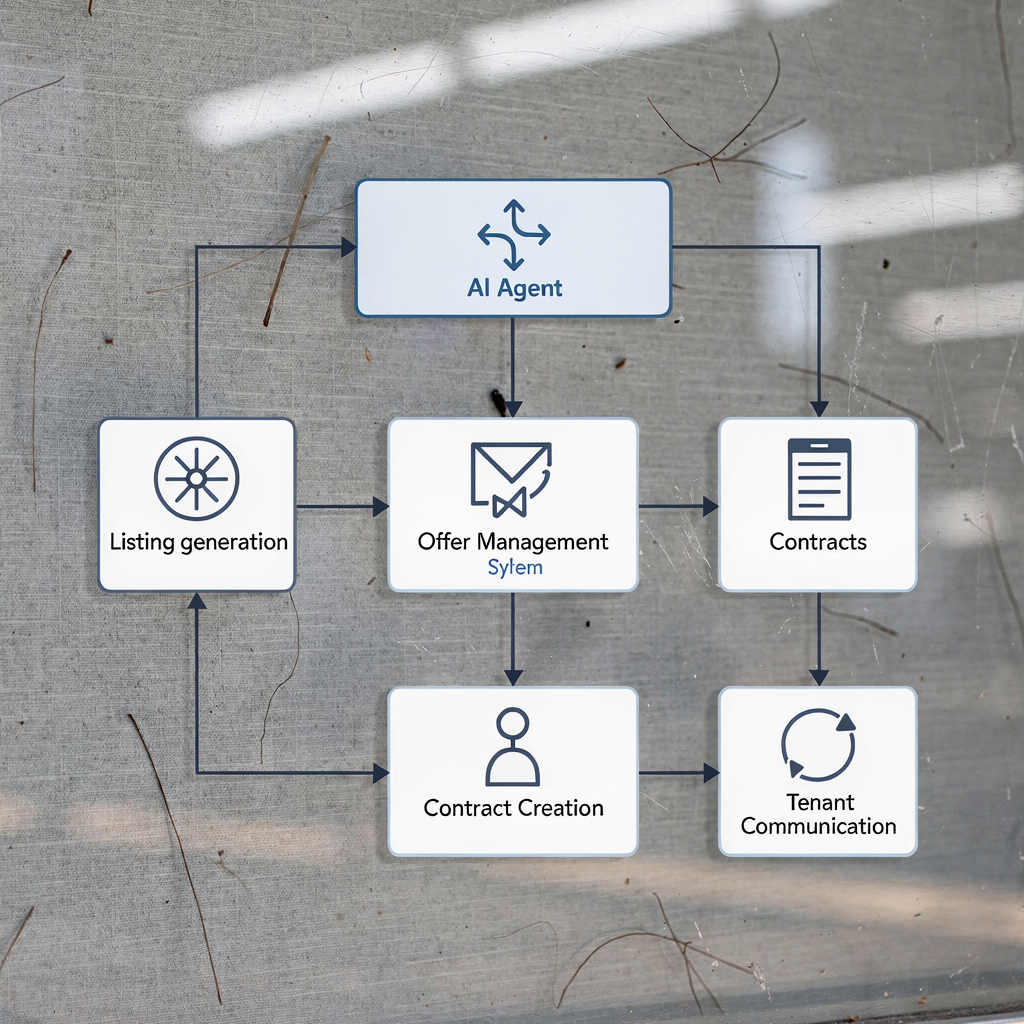
Concrete step-by-step flow for a new listing: 1) Auto-generate a listing description and suggest five candidate listing photos enhanced with AI image tools. 2) Post the property to portals and social channels. 3) Capture leads into CRM and score them. 4) When offers arrive, summarise each offer and notify the agent. 5) Trigger contract creation with extracted terms and route documents for e-signature. 6) After signatures, update accounting and calendar systems and send closing reminders. Also, AI can handle tenant onboarding by verifying documents and generating a move-in checklist.
Expected throughput improvements vary. For a mid-size brokerage, automating listing creation and offer management can increase processed listings by 20–40% without adding staff. Also, transaction cycle times can shorten by days when contract generation and e-signatures flow automatically. Moreover, using agentic AI means the system can act across applications, but it must include guardrails: escalation, human review for high-value or unusual transactions, and transparent logs for audit. Also, ensure the agentic AI honours privacy and data-residency requirements and that you can teach AI by correcting outputs over time.
For teams wondering how to deploy this pattern, start with high-volume, low-risk workflows like writing listing descriptions and scheduling viewings. Also, pair an AI assistant with a human reviewer initially. This approach yields quick wins and builds trust. Finally, document the process and measure real results against targets for time saved and error reduction to justify scaling agentic AI across more complex real estate transactions.
best practices: use ai safely — ai for real estate agents, ai solutions and measuring ROI
Governance and operations matter. First, deploy in phases: pilot, iterate, then scale. Also, involve back-office staff early so they can shape workflows and ownership. Next, define clear KPIs for pilots: time saved per task, reduction in errors, cost per transaction and adoption rate. For pilots, run a 30–90 day test and capture baseline metrics. In addition, use a template to record results and feedback, and require roll-back plans if the AI fails to meet accuracy thresholds.
Security and compliance checklist items include data minimisation, role-based access controls, encryption in transit and at rest, audit logs and vendor risk assessments. Also, ensure the vendor can explain how the AI model reaches decisions and can provide human-readable logs for compliance reviews. For email- and document-heavy workflows, choose AI solutions that create structured data and link back to source documents. For example, virtualworkforce.ai provides thread-aware email memory and deep grounding across operational systems so replies are both accurate and auditable.
KPI recommendations: time saved per email or document, cost per transaction, error rate, and internal adoption metrics. Also, monitor customer satisfaction and time to close. For ROI, quantify savings from reduced overtime, fewer late fees, and faster closings. Next, prioritise 1–2 high-volume processes for a pilot. Also, choose processes where automation delivers fast wins, like document extraction or e-signatures. Additionally, include human agents in the loop to handle exceptions and to teach AI improvements.
Final next steps: run a 30–90 day pilot, prioritise one or two high-volume processes, measure outcomes and scale when the pilot meets targets. Also, consider partnering with a vendor that offers zero-code setup, full control and strong operational grounding. For templates and examples from an operations perspective, see virtualworkforce.ai’s posts on how to scale logistics operations without hiring and their ROI assessments for automated correspondence. Finally, remember that successful AI reduces busywork so real estate professionals can focus on clients and closing more deals.
FAQ
What is an AI agent and how does it help back-office work?
An AI agent is a software component that performs tasks autonomously or semi-autonomously across systems. It helps back-office work by extracting data, orchestrating tasks, drafting responses and escalating only when needed, which reduces manual effort and speeds up processing.
Which parts of a listing-to-close workflow can AI automate?
AI can automate listing creation, writing a listing description, photo enhancement, CRM lead capture, offer summarisation, contract generation and e-signatures. Also, AI manages reminders and routine tenant or buyer communications to streamline the path to close.
How do I choose the right AI tool for my brokerage?
Choose a tool that integrates with your MLS, CRM and accounting systems, provides encryption and audit logs, supports human review and offers a pilot program. Also, verify vendor SLAs, data residency and real customer references before signing a contract.
Can AI improve valuation accuracy?
Yes. AI can normalise inputs, find comparables and flag anomalies, which helps valuation teams produce consistent estimates faster. However, human review is advisable for high-value or unusual properties to confirm the AI’s output.
Are AI solutions safe for tenant screening and KYC?
AI solutions can speed tenant screening and KYC by verifying identities and cross-checking records. Also, choose vendors that provide explainability, audit trails and low false positive rates to reduce risk in tenant decisions.
What is agentic AI and when should I use it?
Agentic AI is a multi-step agent that acts across systems following rules and escalation paths. Use it for end-to-end processes like posting a listing, managing offers, creating contracts and updating systems, while keeping human oversight for high-risk steps.
How should I measure ROI for AI pilots?
Track time saved per task, cost per transaction, error reduction and adoption rates. Also, measure impacts on time to close and customer satisfaction and compare them to baseline metrics collected before the pilot.
What governance practices are essential for AI in real estate?
Essential practices include access controls, data minimisation, audit logs, incident response and human-in-the-loop approvals for high-risk decisions. Also, maintain documentation on models and their training data where possible for compliance.
Can AI handle email-heavy back-office work?
Yes. AI agents can classify emails, extract intent, draft replies grounded in operational systems and escalate complex threads with full context. For operations teams facing high email volumes, end-to-end email automation restores time for higher-value work.
How do I start a pilot without disrupting current operations?
Start with a low-risk, high-volume process such as document extraction or reminder automation. Also, set a short pilot window, define success criteria, keep humans in the loop and scale only after meeting targets and validating accuracy.
Ready to revolutionize your workplace?
Achieve more with your existing team with Virtual Workforce.