


How ai is transforming staffing firms: ai assistant and ai tools automate recruitment workflow to cut time-to-hire and time on admin
Start with a clear metric: staffing firms report roughly a 36% reduction in recruitment costs after AI roll-outs. Also, this figure captures savings across interviewing, scheduling and hiring. First, consider the repetitive manual tasks that consume recruiter time. Next, imagine those tasks handled by an assistant that can parse CVs, draft messages and run interview scheduling automatically. Then, the staffing team can focus on client relationships and candidate fit.
For example, an automated scheduling bot replaces back-and-forth email chains and reduces interview scheduling friction. Also, resume screening that uses deep-learning AI can flag qualified candidates faster than manual review. As a result, time-to-hire can drop dramatically in many case studies, sometimes by 60–70% in targeted workflows. Furthermore, automated status updates to candidates free recruiters from constant manual notifications, improving candidate engagement.
To show the before/after workflow consider this short sequence. Before: job posted, resumes land in an inbox, manual data entry, manual shortlisting, hours lost on interview scheduling, long candidate wait times. After: AI handles resume screening and resume screening tags, scheduling tools book interviews, the recruiting assistant sends status updates and the recruiter reviews a short, explainable shortlist. Also, the assistant keeps audit logs for compliance and quality control.
Finally, quick wins include three items to implement now. First, connect an AI-powered CV parser to your ATS to reduce manual data entry. Second, deploy interview scheduling integrations to remove calendar friction. Third, set up automated candidate updates to cut time on admin. For detailed operational automation that goes beyond hiring emails and into operational messages, see how virtualworkforce.ai automates the full email lifecycle for ops teams and reduces handling time per message in practice.
ATS integration and ai recruiter screening: speed CV review, improve placement and recruiter productivity
Integrating an ATS with AI creates a tight loop from application to hire. Also, AI inside the ATS speeds CV review by extracting structured data and scoring candidates. For example, an ATS → AI screen → recruiter review flow can reduce screening time from hours to minutes. Next, recruiters receive explainable rank scores and automated shortlists. As a result, placement rates improve and recruiters spend less time on manual work.
In practice, ATS integrations use resume screening, parsing and scoring engines that tag skills, certifications and experience. Also, automated shortlists can route qualified candidates to the right recruiter or client consultant. Therefore, recruiter productivity rises because the recruiter focuses only on the best matches rather than the whole pile of applications. In fact, firms report large drops in screening time and hours saved per role across the staffing teams.
For ROI, consider this simple snippet. Reduced cost-per-hire comes from lower recruiter hours and faster placements. Also, higher placement velocity lets agencies fill more roles with the same headcount. Next, track placement and time-to-hire on a dashboard to show the business impact. For more on turning email and operational throughput into consistent outcomes that support recruiter workflows, review automated logistics correspondence examples at virtualworkforce.ai for ideas on end-to-end automation that complements ATS-driven hiring pipelines here.
Finally, keep explainability and auditability in the loop. AI scoring should produce human-readable reasons for a candidate’s rank. Also, route borderline matches for human review and keep an escalation path. For a concise visual, think: ATS → AI parser/ranker → shortlist → recruiter review → interview scheduling. That pipeline reduces manual data entry and fills roles faster while preserving recruiter oversight.

Drowning in emails? Here’s your way out
Save hours every day as AI Agents label and draft emails directly in Outlook or Gmail, giving your team more time to focus on high-value work.
Conversational ai and ai agents for staffing agencies: improve candidate experience and scale outreach to recruit faster
Conversational AI and AI agents let staffing agencies engage candidates at scale, 24/7. Also, chatbots and text flows manage high-volume hiring and keep candidates informed. For example, chat-based qualification flows can run initial candidate screening, confirm availability for interview scheduling and capture essential documentation. Next, automated SMS or WhatsApp outreach increases response rates and shortens the recruitment pipeline.
However, candidate trust matters. In a recent analysis, 73% of entry-level applicants suspect that AI blocked their application, so transparency is essential (IntuitionLabs). Therefore, best practice is to disclose when a candidate interacts with an AI agent and to provide clear opt-in choices and an easy human handover. Also, AI agents should surface a human contact for complex questions and escalate when intent suggests a personal touch.
For candidate engagement, conversational tools handle screening conversations, qualification flows and re-engagement campaigns. Also, they can trigger follow-ups and reminders to reduce drop-off. As a result, staffing teams can run outreach campaigns without adding headcount, and recruiters get cleaner, qualified candidates in their pipeline. For those interested in operational email automation that complements candidate outreach — for example, offer letters or onboarding comms — see virtualworkforce.ai’s work on automating logistics emails, which shows how to ground outgoing messages in enterprise data practically.
Finally, use conversational AI to scale but design for fairness. Also, maintain logs and transcripts to audit decisions. Then, tune language models to avoid biased phrasing and to protect candidate privacy. This balance keeps the recruiting experience efficient and trustworthy. Conversational solutions and voice AI can support a consistent hiring experience while ensuring a human-led final decision where it matters.
Analytics, talent intelligence and ROI: measure recruiting operations to prove enterprise-grade value
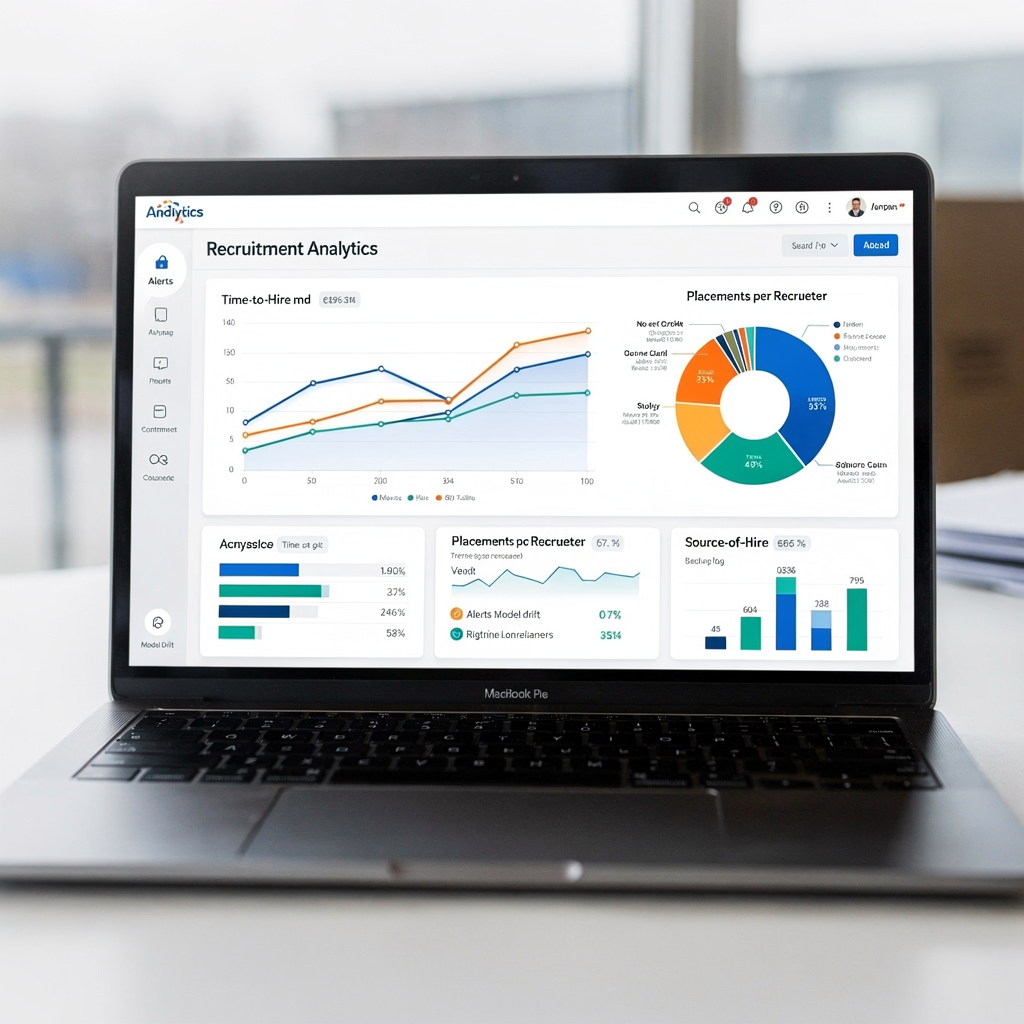
Analytics and talent intelligence turn AI outputs into measurable ROI. Also, track time-to-hire, cost-per-hire, placements per recruiter and time on admin to prove value to clients. For example, cohort analysis shows which sources produce qualified candidates and which job boards need more investment. Next, dashboards should display recruitment operations KPIs for hiring managers and senior leaders so they can act quickly.
Enterprise-grade requirements matter. Also, security and compliance must sit alongside the analytics stack. Therefore, choose an intelligence platform that supports audit logs, role-based access and data residency controls. In addition, use source-of-hire attribution to optimise outreach and advertising spend. As a result, firms can improve placement and reduce churn in talent pools.
For a 90-day roll-out, track a short metrics table: baseline time-to-hire, cost-per-hire, candidate screening time, placements per recruiter and time on admin. Then, compare weekly and adjust models to avoid drift. Also, include churn forecasting to predict client-side turnover and to advise clients proactively. For context on enterprise and operational automation that enhances ROI beyond hiring — for example, consistent email handling and escalation for offers and onboarding — see a practical ROI discussion at virtualworkforce.ai on operational gains here.
Finally, analytics helps close the loop between AI experiments and business outcomes. Also, continuous monitoring and human-in-the-loop adjustments prevent model bias and keep the recruiting strategy aligned to client goals. Use dashboards to make insights visible, and then use talent intelligence to guide investments in channels and training for staff and recruiters.
Drowning in emails? Here’s your way out
Save hours every day as AI Agents label and draft emails directly in Outlook or Gmail, giving your team more time to focus on high-value work.
Automation, assistant for staffing firms and ai interviewer: keep human oversight to protect fairness in recruitment
Automation accelerates routine work, but human oversight preserves fairness and fit. Also, an assistant for staffing firms should be configured to escalate decisions where context matters. For example, an AI interviewer can perform structured pre-screening questions, record responses and flag red-flag answers for human review. Next, recruiters retain authority for final interviews and client discussions.
AI helps make data-driven decisions. For instance, a 2024 study found that “AI aids HR professionals in making data-driven decisions, improving fairness and accuracy in candidate selection” (PMC). Therefore, embed explainability and bias testing in any deployment. Also, keep audit logs and human review paths to ensure decisions are defensible and transparent.
Implementation checklist items include bias testing, transparency to candidates, escalation routes and regular model revalidation. Also, require human review for borderline rejects and for roles with regulatory risk. In addition, document how the AI interviewer scores responses and what thresholds trigger a recruiter notification. As a result, recruiters can trust the suggestions and can focus on complex judgement calls.
Finally, set governance: define who owns model performance, who runs audits and how to document candidate disputes. Also, align fairness checks with security and compliance policies. That approach keeps automation tools effective and keeps candidates safe. When configured well, recruiting automation reduces repetitive manual tasks while preserving the human decisions that protect candidate dignity and client outcomes.
Best practices and 10 best ai recruitment tools for staff and recruiters: implement ethically to transform talent acquisition and talent management
Start with selection criteria: integration, explainability, security and a short ROI timeline. Also, include change management and training for hiring managers so adoption sticks. For example, leaders report that many employees already use GenAI frequently, so training accelerates mature use (BCG). Next, prioritise tools that minimise manual data entry and that complement existing ATS workflows.
Categories of AI to consider include conversational platforms, ATS AI modules, screening engines and analytics suites. Also, ask vendors for explainable model outputs and for integrations with scheduling tools and job boards. For small agencies, choose lightweight deployments that can scale. In addition, enterprise-grade buyers should require security and compliance support. Finally, make sure the vendor supports talent management and talent acquisition end-to-end.
Here is a concise snapshot of the 10 best AI categories and a one-line benefit for each: 1) Conversational chatbots — scale candidate engagement; 2) ATS AI modules — speed resume screening; 3) Resume screening engines — find qualified candidates; 4) Scheduling integrations — reduce interview scheduling friction; 5) Analytics dashboards — show ROI; 6) Talent intelligence platforms — predict churn; 7) Automated outreach tools — improve outreach efficiency; 8) AI interviewer modules — pre-screen at scale; 9) Compliance tools — preserve security and compliance; 10) AI recruiting software bundles — end-to-end recruitment workflow support. Also, include ai recruiting tools and ai recruitment tools in procurement conversations to align expectations.
Finally, remember best practices: run bias tests, log decisions, train staff, and measure recruiting operations after launch. Also, pilot features on a small cohort and expand once metrics confirm improvements. For more about operational automation and how to scale without adding headcount, virtualworkforce.ai explains practical steps to reduce admin work and improve consistency in communications read more.
FAQ
What is an AI assistant for staffing firms?
An AI assistant is software that automates repetitive recruitment tasks such as resume screening, interview scheduling and candidate communications. It helps recruiters manage volume and improves consistency while allowing humans to focus on judgement and client relationships.
How much can AI reduce recruitment costs?
Studies show firms can see around a 36% reduction in recruitment-related costs after implementing AI systems (SHRM). Savings come from lower interviewing time, reduced admin work and faster placements.
Will AI replace recruiters?
No. AI handles repetitive manual tasks and scales outreach, while recruiters keep responsibility for candidate fit, client relations and final hiring decisions. The best deployments combine AI with human oversight to protect fairness.
How do conversational AI agents improve candidate experience?
Conversational AI provides 24/7 responses, qualification flows and re-engagement campaigns, which reduce drop-off and speed the recruitment pipeline. However, transparency about AI use and easy human handover are essential to maintain trust.
Can an ATS integrate with AI tools?
Yes, many ATS platforms integrate with AI modules for resume parsing, explainable rank scores and automated shortlists. That integration reduces manual data entry and boosts recruiter productivity.
What metrics should I track to show ROI?
Track time-to-hire, cost-per-hire, placements per recruiter, time on admin and quality-of-hire. Dashboards that update these KPIs make it easy to prove business value and guide adjustments.
How do I manage fairness and bias?
Implement bias testing, require explainable outputs, and set human review for borderline cases. Also, keep audit logs and revalidate models periodically to prevent drift and maintain compliance.
Are there specific tools for high-volume hiring?
Yes, conversational AI, automated screening engines and scheduling tools are tailored for high-volume hiring and can scale outreach without large headcounts. They improve speed and reduce candidate drop-off.
How quickly can small agencies see benefits?
Small agencies can see measurable improvements within 30–90 days if they prioritise quick integrations like resume parsing and scheduling tools. Training and change management help maintain adoption.
Where can I learn more about automating communications related to hiring?
For examples of end-to-end email and operational automation that support recruitment communications and onboarding, explore virtualworkforce.ai resources which show how to ground messages in enterprise data and reduce admin work here.
Ready to revolutionize your workplace?
Achieve more with your existing team with Virtual Workforce.