


Why ai and ai in property management matter for tenant communication and tenant satisfaction
AI has moved from experiments to everyday tools in property management. First, AI powers conversational systems that handle tenant concerns around the clock. Second, AI enables consistent replies and faster response cycles. For property owners and property teams this matters because tenants expect speed and clarity. Also, metrics like response times and tenant satisfaction are easy to measure. For example, about 92% of commercial real estate firms have started or plan to pilot AI initiatives, while only 5% have fully achieved their AI program goals. These numbers show strong interest but also real scaling challenges.
AI fits into modern property management as conversational AI, AI assistants and automated workflows that reduce manual work. Also, AI can triage tenant inquiries, send lease reminders, and update tenants about a maintenance request. Property managers gain time to focus on relationship building. Furthermore, when teams set measurable goals they track improvement clearly. Good KPIs include time-to-first-response, time-to-resolution, Net Promoter Score and occupancy. Also, tracking the number of tenant requests handled without escalation shows the value of automation.
Virtualworkforce.ai builds AI agents that automate the full email lifecycle for ops teams. Therefore, teams that use our platform see faster, more consistent resident communication and fewer errors. Also, property management companies can map email workflows to a property management system so tenant records stay accurate. Finally, early adopters report faster acknowledgement of tenant requests, which directly improves tenant satisfaction.
Set the scene by choosing clear metrics. First, measure response times for messages. Second, measure changes in tenant satisfaction and tenant turnover. Third, track how many tenant interactions are resolved by AI vs. sent to a property manager. These outcomes make it simple to show progress and to iterate on the AI model and workflows.
How ai agent, ai chatbots and ai assistant automate maintenance request triage and cut response times
AI agents and AI chatbots differ in capability. A rule-based chatbot follows scripts. An AI agent uses natural language and context to adapt. Consequently, AI agents can read a tenant message, detect urgency, and prioritise a maintenance request. For example, a tenant reports no hot water. The AI agent asks clarifying questions, checks the property maintenance log, and either dispatches a technician or schedules a callback. This reduces handoffs and speeds service delivery. Pilots show that conversational AI can reduce response times by up to 40%.
Practical workflows are simple and reliable. First, the AI acknowledges receipt and logs the tenant request. Next, the AI triages severity and assigns a priority code. Then, the AI schedules a contractor or queues the ticket for a maintenance technician. Finally, the AI sends status updates to the tenant until the task is complete. During any step the AI assistant can escalate to a human when empathy or judgment is required.
Use KPIs to measure impact. Track time-to-first-response, time-to-resolution and the share of maintenance request tickets auto-triaged. Also, measure tenant feedback after closure. For social housing pilots, combining conversational AI with eligibility scoring cut allocation times and improved processing speed, showing how AI can both prioritise and support complex workflows (case example).

Workflows like this also free up management staff to focus on tough tenant concerns. When an AI triages, the property manager only reviews edge cases. Therefore, teams see more predictable scheduling and fewer missed updates. Also, AI reduces repetitive email handling, a key operational bottleneck that virtualworkforce.ai targets with end-to-end email automation for ops teams.
Drowning in emails?
Here’s your way out
Save hours every day as AI Agents label and draft emails directly in Outlook or Gmail, giving your team more time to focus on high-value work.
Deploying property management ai, property management ai agent and property management software to automate leases, tenant screening and tenant interactions
AI helps with lease automation, tenant screening and routine tenant interactions. For leases, AI can draft, populate and send lease documents, then manage reminders for renewals and signatures. Also, AI reduces manual errors in lease management and keeps version history in a property management system. For tenant screening, AI speeds background checks and eligibility scoring while keeping an audit trail. In one pilot, faster allocations in social housing were achieved by combining conversational AI with scoring tools (pilot).
Property management AI agent implementations should connect to key data sources. These include tenant records, payment ledgers and maintenance logs. Also, integrate with property management software and the ERP that stores billing and vendor details. For tenant screening, verification steps must be clear. Use consented data, document sources, and keep logs for compliance. Also, include human review for any decision with high risk of bias.
A simple implementation checklist helps property teams take action. First, map the high-volume tenant interactions to automate. Second, connect data sources and define access policies. Third, configure business rules for leasing, renewals, and screening. Fourth, pilot with a subset of properties and measure KPIs. Fifth, scale once results are validated. For teams curious about operational ROI, our guide on scaling operations explains how AI reduces handling time per message and increases consistency (operations ROI).
Leasing agents and real estate agent teams benefit too. AI can assist with scheduling property viewings, pre-qualifying prospects and sending tailored lease offers. Also, automating routine messages frees leasing agents to focus on high-value negotiation and showings. The automation gains translate into productivity improvements estimated at 20–30% across property management workflows (market analysis).
Integrating agents for real estate with a management system and property management tools to ensure consistent communication at scale
Integration is the backbone of consistent communication. An AI agent must read and write data from a property management system, CRM, and maintenance platform. First, map data objects: tenant records, lease documents, maintenance tickets and billing entries. Next, define API connections and data flows. Also, ensure message templates and tone are centrally managed so tenants see consistent communication.
Multi-channel sync matters. The AI should send updates via email, SMS and the tenant portal. Also, the AI should keep a thread-aware memory so context is not lost across channels. For multinational portfolios, language support and localization are important. For property management companies that operate at scale, this avoids duplicate messages and conflicting information.
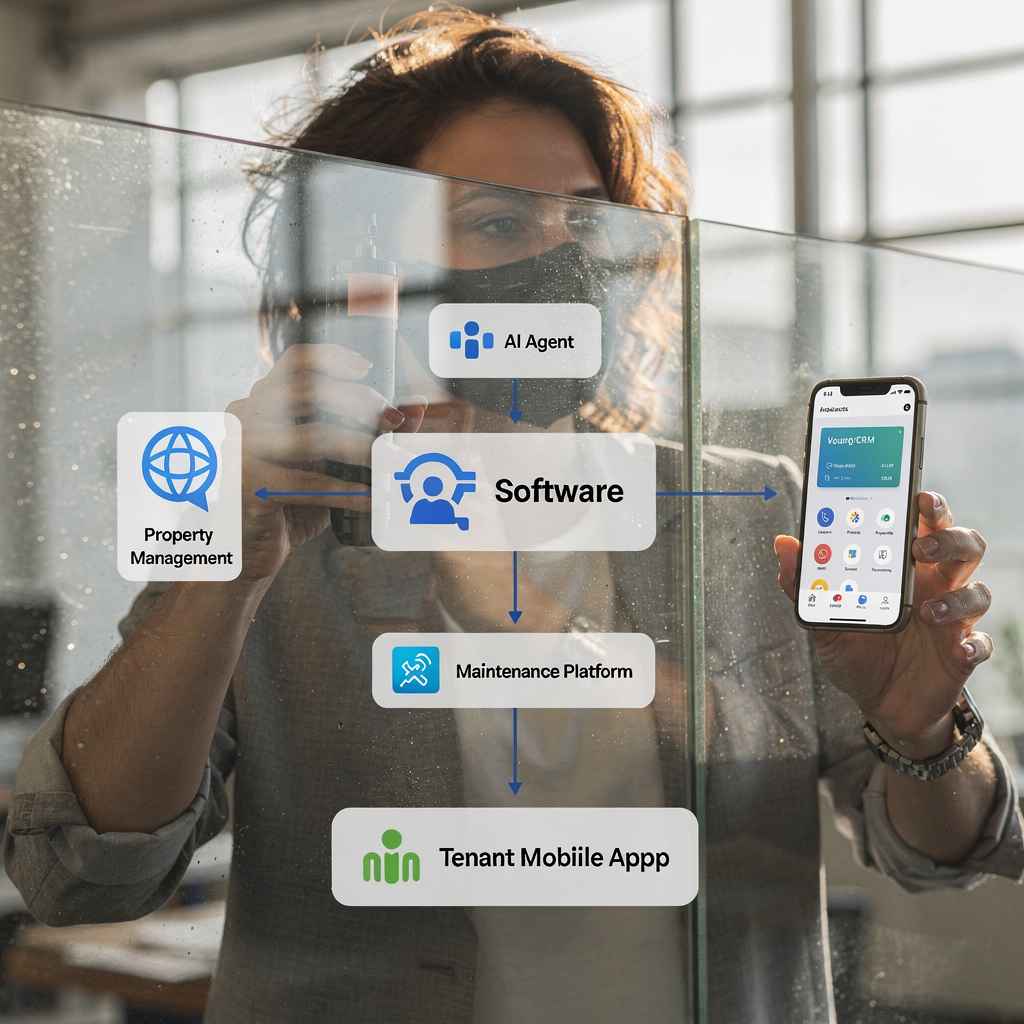
Guard against common risks. Data privacy is crucial. Implement encryption at rest and in transit. Also, add SLA clauses and data mapping rules to reduce vendor lock-in. For API rate limits, design queueing and backoff logic. To mitigate bias in tenant screening, log decisions and include a human-in-the-loop for disputed outcomes. Additionally, add clear escalation protocols when tenants need empathy or legal clarification.
For consistent tenant communication, use standard update cadences. For example: acknowledge a tenant request within one hour, provide a triage update within six hours, and give a completion notice within 24 hours. If the AI cannot resolve the issue within its scope, it escalates to the property manager with full context. Tools and guides on automating inbox workflows can help teams set these rules and map them to everyday operations (automation playbook).
Drowning in emails?
Here’s your way out
Save hours every day as AI Agents label and draft emails directly in Outlook or Gmail, giving your team more time to focus on high-value work.
Measuring impact: response times, tenant satisfaction and ai solutions for the property manager
Clear metrics drive adoption. Track response times and time-to-resolution first. Then, measure tenant satisfaction and tenant feedback after each interaction. Also, follow occupancy and tenant turnover to see long-term effects. For example, some firms report productivity gains of 20–30% after deploying AI agents for tenant interactions (market analysis). Also, pilots show up to a 40% reduction in response times (usage stats).
Design A/B tests during pilots. Group similar properties and route half the tenant requests through the AI agent, and half through the standard workflow. Then compare KPIs. Also, use NPS and short in-app surveys to capture tenant satisfaction. Be sure to measure cost per service request and staff time saved. These numbers make the business case for scale.
Dashboards should include live KPIs: current inbox length, average response times, percent auto-resolved, and tenant satisfaction scores. Also, set review cadences. Weekly reviews are good at first. Then move to monthly once the system stabilises. For property managers, seeing these dashboards reduces friction with leadership and makes investment decisions clearer. If you want practical templates for email automation and operational gains, our resources explain how to reduce handling time and increase consistency across long conversations (scaling with AI agents).
To close the 5% success gap between pilots and full programs, focus on data quality, governance and user training. Start small, measure often, and iterate. Also, set clear escalation rules so the AI handles routine items while management staff handle nuanced tenant concerns.
Risks, governance and the future of property management with ai and automation, ai for real estate and ai agent template ideas
Risk management must be part of any rollout. Top risks include privacy breaches, bias in tenant screening, and loss of human empathy in complex cases. Also, integration failures can break workflows. To govern AI, require consent for tenant data, keep comprehensive logs and implement human-in-the-loop rules for sensitive decisions. Also, schedule regular audits to detect drift and bias.
Design escalation protocols. If a tenant expresses distress or a legally sensitive issue, the AI should flag the message and alert the property manager immediately. Also, retain full context with the ticket to speed human response. For compliance, keep audit trails that show the data sources used for any decision. This protects both tenants and the property management business.
Looking ahead, applications of AI will expand. Expect predictive maintenance that anticipates a part failure, dynamic leasing that adjusts offers to market demand, and virtual viewings that use advanced AI to personalise tours. Also, agents for real estate will increasingly work alongside real estate professionals and leasing agent teams to improve throughput. These advances will reshape the role of the property manager toward relationship building, strategy and portfolio performance.
Here is an AI agent template property teams can adapt:
– Purpose: automate routine tenant communication and triage maintenance request tickets.
– Persona: polite, timely, and factual; on-brand for the property.
– Scope: acknowledge messages, triage urgency, schedule vendors, draft lease reminders, and auto-close resolved tickets.
– Escalation rules: flag legal issues, safety concerns, or any tenant dispute for human review.
– Data sources: tenant records, maintenance logs, lease documents and payment ledger.
– Governance: consent records, logging, and monthly audits.
Finally, implement custom AI carefully. Use a controlled pilot, set measurable goals and keep the human touch for complex tenant interactions. With strong governance, AI and automation can improve tenant satisfaction, reduce costs and lift property performance across portfolios.
FAQ
What is an AI agent in property management?
An AI agent is an automated software system that handles specific tasks like triaging maintenance request tickets, replying to tenant messages, and managing lease reminders. It uses natural language techniques and integrations with property information systems to act on behalf of a property manager.
How does AI improve tenant communication?
AI improves tenant communication by providing 24/7 acknowledgement, consistent messaging and faster response times. Also, it automates routine tasks so management staff focus on higher-value work and relationship building.
Can AI handle maintenance request triage accurately?
Yes, modern AI agents can triage and prioritise many maintenance request types by asking clarifying questions and checking historical tickets. However, complex safety or legal issues should still escalate to a human.
What metrics should property teams track when deploying AI?
Key metrics include response times, time-to-resolution, percent auto-resolved tickets, tenant satisfaction (NPS), occupancy and cost per service request. Regular dashboards help teams measure ROI and refine workflows.
Will AI replace property managers?
No. AI automates repetitive tasks and improves consistency but does not replace the judgment, empathy, and negotiation skills of a property manager. Instead, AI frees managers to focus on tenant retention and portfolio strategy.
What are common risks with AI in property management?
Risks include data privacy issues, bias in tenant screening, integration failures and loss of human empathy for complex tenant concerns. Governance, logging and human-in-the-loop rules reduce these risks.
How do I integrate an AI agent with my property management software?
Integration involves mapping data objects like tenant records, leases and maintenance tickets, then connecting via APIs or middleware. Also, ensure message templates and escalation rules are centrally managed to maintain consistent communication.
Does AI help with lease management and renewals?
Yes. AI can draft leases, manage renewals, send reminders and keep audit trails. This reduces manual errors and speeds up lease administration across property portfolios.
How should I pilot AI for tenant interactions?
Run an A/B test with similar properties, route half of tenant requests through the AI agent, and keep the other half on the existing workflow. Measure KPIs like response times and tenant feedback, then iterate before scaling.
Where can I learn more about automating operational email and tenant messages?
Resources that explain end-to-end email automation, inbox workflows and ROI for operations can help. For practical guides on scaling inbox automation and AI agents, see virtualworkforce.ai resources on scaling operations and AI agent deployments (automation playbook), (operations ROI) and (scaling with AI agents).
Drowning in emails?
Here’s your way out
Save hours every day as AI Agents label and draft emails directly in Outlook or Gmail, giving your team more time to focus on high-value work.