


ai agent + e-commerce: role, market size and quick facts
An AI agent is an autonomous, task-specific digital assistant that personalises, automates or completes workflows across an e-commerce site. In practice, an AI agent recommends products, answers questions, updates stock data and even helps complete purchases. First, these agents free teams from repetitive work. Next, they raise conversion and improve the overall customer experience.
Key facts you should know. The global AI agents market reached roughly USD 7.6–8.7 billion in 2025 and is forecast to exceed USD 10.9 billion by 2026 (Salesmate). Similarly, enterprises are increasing budgets: PwC found 88% of senior executives plan to grow AI spending after seeing the effect of agents on operational efficiency and engagement (PwC). Gartner projects a jump in task-specific agents embedded in apps by 2026, which will accelerate e-commerce adoption (Gartner via Salesmate). Finally, consumers still report friction; the World Economic Forum shows AI agents are reshaping buying interactions to reduce frustration (WEF).
Why it matters to a retailer. For example, track conversion rate, average order value and stockouts when you deploy a recommendation or forecasting agent. Use these KPIs to measure uplift, cost savings and service levels. Also, monitor forecast accuracy and time-to-fulfilment to judge operational efficiency.
Metric to measure: conversion delta and forecast accuracy. Track lift in conversion rate and reduction in stock levels exceptions to see immediate business value.
10 ai: the top ecommerce ai agents and ai agents for e-commerce (categories, not vendors)
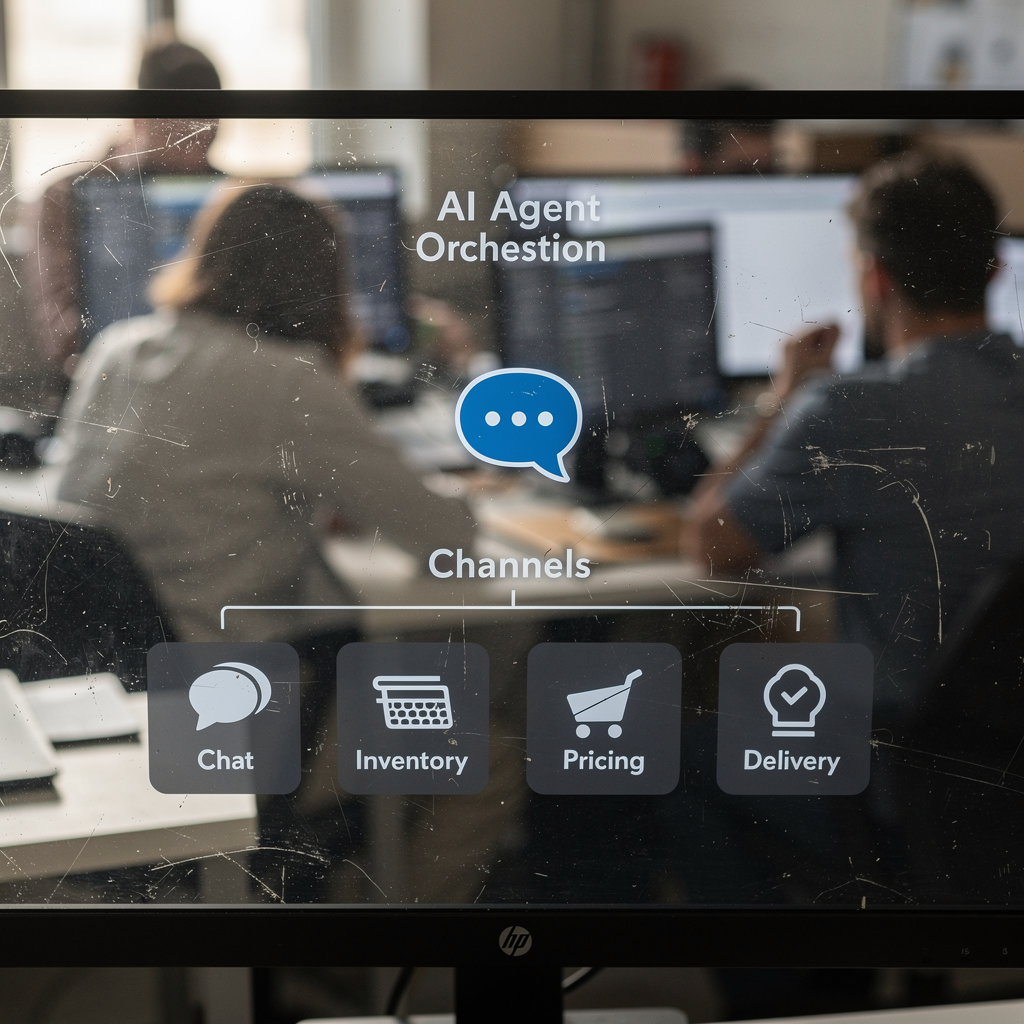
This chapter lists ten specialised agent types that e-commerce teams should evaluate. Each subsection names the agent, explains what it does, and highlights an impact metric. Use this as a quick map to plan pilots and scale successful pilots later. These ecommerce ai agents span front-end shopping to backend operations and link to partner systems.
1) Personalisation / Recommendation agent — Agents that offer tailored product suggestions based on browsing, purchase history and context. Product recommendations often lift conversion rate and Average Order Value. Metric: conversion uplift and AOV increase.
2) AI concierge / Conversational shopping agent — An AI concierge assists shoppers via chat or voice, guides selection and completes orders. It reduces time-to-purchase and frees human agents for complex queries. Metric: chat-to-order conversion and handle time.
3) Visual search and image-matching agent — Agents based on computer vision let shoppers find products from photos. They improve discoverability and decrease bounce. Metric: search conversion and session length.
4) Pricing and promotion optimisation agent — These agents monitor price elasticity and adjust offers in real-time to capture sales opportunities while protecting margin. Metric: margin improvement and promotional ROI.
5) Inventory / demand-forecasting agent — Forecasting agents reduce stockouts and carrying costs by predicting demand from historical sales and signals. Metric: forecast accuracy and stockouts avoided.
6) Fulfilment & logistics orchestration agent — These agents coordinate carriers, schedule pickups and manage order tracking. They link the e-commerce platform to warehouses and couriers so orders ship reliably. Metric: on-time delivery and fulfilment cost per order.
7) Fraud-detection and risk agent — Fraud agents analyse payments and behaviours to block risky transactions while keeping legitimate shoppers flowing. Metric: fraud rate and false positives.
8) Merchandising and catalogue tagging agent — Automated tagging and product description creation speed catalogue updates and improve search. Metric: time-to-publish and organic search uplift.
9) Retention / lifecycle marketing automation agent — These agents automate personalised email and SMS sequences to win repeat purchases. Metric: retention lift and CLTV.
10) Analytics & attribution assistant agent — Analytical assistants surface insights and suggest actions so teams can make informed decisions fast. Metric: decision latency and attribution accuracy.

Metric to measure: choose one pilot KPI per agent and run a short A/B test to validate impact.
Drowning in emails?
Here’s your way out
Save hours every day as AI Agents label and draft emails directly in Outlook or Gmail, giving your team more time to focus on high-value work.
use cases: personalise, automate and scale with agentic commerce and automation
Use cases show how agents turn theory into measurable outcomes. Below are focused examples you can apply right away. They map to commercial goals like reduce costs, increase sales and improve customer engagement. This section also describes agentic commerce where multiple agents coordinate to complete tasks end-to-end.
– Personalise product pages to raise conversion. For example, a recommendation agent shows complementary items. As a result conversion rate and AOV rise. Metric: conversion rate uplift over a control group.
– Auto-chat to reduce support load and shorten time-to-purchase. An ai concierge handles routine customer inquiries and hands complex issues to human agents. That lowers support volume and improves CSAT. Metric: support tickets reduced and resolution time.
– Demand forecasting to cut stockouts. Inventory management and forecasting agents use historical sales and external signals to predict demand. Typical pilots reduce stockouts by double-digit percentages within weeks, saving lost sales and rush-shipping costs. Metric: stockouts and forecast accuracy.
– Orchestrated transaction flow: In agentic commerce an autonomous shopper agent finds a product, a pricing agent negotiates a discount, and a fulfilment agent books a courier. Together they complete a purchase without human handoffs. This workflow shortens purchase time and boosts conversion.
– Email automation for operations: virtualworkforce.ai automates the full email lifecycle for ops teams, turning unstructured messages into structured tasks and replies. Teams often reduce email handling time dramatically and maintain traceability. Learn more about how to scale logistics operations with AI agents here.
Practical KPI framework: measure adoption rate, conversion delta, cost-per-order, tickets reduced and forecast accuracy. Run incremental lift tests for confident attribution. Metric to measure: cost-per-order and forecast accuracy over 30–90 days.
choose the right ai: pick the right ai agent for e-commerce brands and shoppers
This chapter helps you choose the right ai for your team. First decide business priorities: revenue growth, margin protection or better customer experience. Next check data readiness and integration points. Finally test a short pilot that proves value.
Decision checklist
– Business goal first: clarify whether you want to increase sales, improve margin or reduce support load. That goal should guide agent selection and pilot metrics. For example, choose a recommendation agent to increase sales and a forecasting agent to protect stock levels.
– Data readiness and integrations: ensure your e-commerce platform, ERP and warehouse systems can connect. Integrate customer data, order history and fulfilment feeds so agents have reliable inputs.
– Compliance and privacy: confirm GDPR or other regional rules. Use vendors that support clear data governance and audit trails.
Selection criteria
– Measurable ROI in a pilot and the ability to A/B test outputs. – Latency and reliability for real-time decisions. – Explainability so teams can audit how an agent makes choices. – Multilingual support for global shoppers. Also check vendor lock-in and portability across AI platforms.
Quick pilot plan: run a one-month proof of concept, A/B test with clear metrics and rollout gating. If you need to automate logistics emails, see our guide to automating logistics correspondence here. Metric to measure: pre-defined ROI and conversion delta at the end of the pilot.
Drowning in emails?
Here’s your way out
Save hours every day as AI Agents label and draft emails directly in Outlook or Gmail, giving your team more time to focus on high-value work.
ai agents in e-commerce: implement, measure ROI and how ai-powered systems help e-commerce businesses
Implementing AI agents requires a practical plan. Start small, instrument thoroughly and scale with evidence. This chapter outlines steps, measurement approaches and examples of how ai-powered systems help e-commerce businesses.
Implementation steps
– Map user journeys and identify high-impact touchpoints where agents can automate work. – Choose the specialised ai agents you need, for example a support agent for order enquiries or a forecasting agent for inventory management. – Run small pilots, instrument metrics and iterate quickly. Virtualworkforce.ai shows how automating email triage can restore time to teams and reduce errors; teams typically cut handling time and increase consistency (virtualworkforce.ai example).
Measurement
– Use incremental lift tests or holdout groups to attribute results accurately. – Expect to see measurable lift within 4–12 weeks for many pilots. – Track conversion rate, time-to-fulfilment, support tickets and cost-per-order. – Tie performance to business levers like customer engagement, retention and CLTV.
How AI-powered agents help
– They reduce manual work and let teams focus on strategic tasks. – They provide personalised shopping experiences around the clock, improving customer experience. – They increase conversion and average order value and enable scalable personalization across multiple channels. For logistics teams, deploy agents that draft emails from operational systems to cut email load; see our guide on automated logistics correspondence here. Metric to measure: payback period and incremental revenue or cost savings over 90 days.
agentic ai future: from first ai agent to best ai agents and responsibilities for commerce leaders
Agentic AI will evolve from the first ai agent to multi-agent systems that coordinate and make decisions. Leaders need to plan for both opportunity and risk. This roadmap helps commerce leaders act now and govern responsibly.
Evolution roadmap
– First AI: simple chatbots and basic recommendation engines. – Next stage: specialised ai agents that automate inventory, pricing and marketing tasks. – Future: agentic systems where agents negotiate and transact on behalf of shoppers and retailers using autonomous software. These agent platforms will orchestrate workflows across systems and suppliers.
Risks and governance
– Control hallucinations and require grounded responses by tying agents to operational data. – Mitigate bias in recommendations and protect customer data. – Maintain customer trust by logging decisions and offering clear escalation to human agents. Leaders should build governance checklists that include audit trails, explainability and privacy controls.
Responsibilities for leaders
– Prioritise 2–3 high-impact agent pilots and measure with rigorous A/B tests. – Invest in data hygiene and integrations so agents can make informed decisions. – Balance innovation with controls that protect customers and brand reputation.
Final note for action: pick the right ai agent for your business needs, adopt pilots with clear metrics and scale the best performing agents. As agentic commerce grows, the best ai agents will be those that deliver measurable ROI while preserving trust.
FAQ
What is an AI agent in e-commerce?
An AI agent is autonomous software that performs specific tasks like product recommendations, chat support or inventory forecasting. It acts on data and rules to automate work and improve the shopping experience.
How do AI agents improve conversion rate?
AI agents personalise product recommendations and streamline checkout flows to reduce friction. By matching offers to intent and context, they raise conversion and average order value.
Which KPIs should I track during an AI pilot?
Key metrics include conversion delta, forecast accuracy, support tickets reduced and cost-per-order. Also track adoption rates and time-to-fulfilment to judge operational impact.
Are AI agents secure and compliant?
Yes, when configured correctly. Ensure GDPR and local privacy rules are respected, that data access is governed, and that agents have audit trails and explainability controls.
What is agentic commerce?
Agentic commerce refers to multiple agents coordinating to complete tasks autonomously, such as finding a product, negotiating price and booking fulfilment. It reduces human handoffs and speeds buying.
Can AI agents replace human agents?
AI agents handle routine tasks and free human agents for complex issues. They complement humans rather than replace them entirely, and they improve consistency and speed.
How long does it take to see results from a pilot?
Many pilots show measurable lift in 4–12 weeks depending on scope and data readiness. Short, focused A/B tests will give clear signals quickly.
What integrations do agents need?
Common integrations include your e-commerce platform, ERP, WMS and carrier systems for order tracking. Good integrations let agents act on real-time data and reduce manual lookups.
How do I choose the right ai agent?
Start with business goals and data readiness. Choose agents that map to your top priorities, run a short proof of concept and measure ROI before scaling.
Where can I learn more about automating logistics emails?
If your operations team faces heavy email volume, resources on automated logistics correspondence and logistics email drafting explain how to reduce handling time. See practical guides at virtualworkforce.ai for concrete next steps.
Drowning in emails?
Here’s your way out
Save hours every day as AI Agents label and draft emails directly in Outlook or Gmail, giving your team more time to focus on high-value work.