


Why AI matters: ai, commodity and trade in the commodities industry
AI is changing how commodity markets operate, and trading teams must pay attention now. First, AI speeds data handling. For example, S&P Global reported AI‑ready pipelines can extract market data up to 95% faster. That speed shortens analysis cycles, and it helps teams react to price shocks and news faster. Second, AI improves transparency. Regulators use AI models to identify anomalies in trading records, which supports stronger market oversight and better risk detection, as discussed by ISDA and related reports (ISDA).
Plainly, AI converts complex inputs into actionable signals. It reads unstructured reports, normalises fundamental data, and feeds price forecasts into trading systems. As a result, commodity traders can focus on strategy rather than routine parsing. The benefits apply across physical commodity desks and systematic trading teams. For instance, a commodity desk that uses AI for real‑time news scanning gains speed and precision when identifying opportunities.
AI also supports audit trails and traceability. When an AI model flags an outlier, the system records the source and rationale. That record aids compliance and helps with model governance. Furthermore, AI brings long‑term productivity gains by automating repetitive tasks and improving decision quality. Taken together, these effects give a competitive edge to trading companies that invest early in AI technology.
Finally, practical adoption requires clear steps. Trading managers should map high‑value workflows, assess data sources, and plan pilots with measurable KPIs. For teams focused on logistics or email‑driven workflows, tools like virtualworkforce.ai offer no‑code AI email agents that reduce handling time and improve consistency; see their logistics assistant for more detail (virtual assistant for logistics).
Core use cases: ai agent, commodity trading and automate workflow
AI agents deliver value across the trade lifecycle. Below are concise use cases that traders will recognise and that show practical impact.
1. Price forecasting — A trained model provides short‑term price signals for hedging and execution. The forecast feeds execution algorithms to reduce slippage and improve P&L. This complements algorithmic trading and systematic trading approaches.
2. Automated document extraction — An AI agent scans contracts and invoices, extracts payment terms, and triggers settlement workflows. This reduces clerical errors and speeds reconciliations; it also decreases manual invoice handling by operations teams. For logistics‑centred workflows, see the automated logistics correspondence use case (automated logistics correspondence).
3. Supplier negotiation — Procurement pilots show cost savings of up to 40% through AI‑powered benchmarking and price recommendations. That helps trading companies reduce operational costs on routine buys and freight contracts.
4. Real‑time risk monitoring — AI monitors positions, counterparty exposure, and market moves in real‑time. Alerts surface unusual patterns and support faster response to operational risk and market stress.
5. Trade execution and routing — Trading agents that balance price, liquidity, and logistics can automate execution and optimise routing for physical commodity shipments. These agents coordinate with logistics systems to time vessel bookings and lower storage fees.
6. Data enrichment and analytics — AI tools convert unstructured data into structured feeds for CTRM and OMS systems. That creates actionable intelligence for research and trading strategies. Together, these use cases streamline workflows, improve efficiency, and help traders focus on higher‑value decisions.

Drowning in emails?
Here’s your way out
Save hours every day as AI Agents label and draft emails directly in Outlook or Gmail, giving your team more time to focus on high-value work.
Platforms and deployment: ai platform, deploy and implement ai
Choosing an AI platform and deployment pattern matters. Firms typically pick cloud, hybrid, or on‑prem options. Each choice affects latency, security, and integration with market data vendors. Crucially, success depends on AI‑ready data and clear apis to market data. Poor data quality is a common reason projects do not scale; academic reviews note integration and data issues in financial AI projects (systematic review).
Here is a short checklist to deploy and implement AI effectively. First, data readiness: ensure clean, labelled feeds and provenance for proprietary data. Second, vendor selection: choose providers with connectors to exchanges and market data. Third, security and governance: run role‑based access, audit logs, and model validation. Fourth, pilot to scale: start with a low‑integration pilot and then extend to CTRM and OMS.
For example, an S&P‑style NLP pipeline ingests news and analyst reports, extracts sentiment, and supplies structured signals into trading desks (S&P Global case study). That pipeline requires an intelligence platform that handles unstructured data and gives data scientists tools for rapid iteration. When firms deploy, they should ensure scalability and a path to production monitoring. Also, include human oversight in any decision loop to manage operational risk.
Finally, integration benefits operations directly. No‑code solutions can help back office teams automate emails and update systems without long IT projects. For example, virtualworkforce.ai connects ERP, TMS, and email history to draft replies and update records, which helps streamline operations and improve response times (ERP email automation for logistics).
Automation at scale: automate, automation, commodityai and workflow optimisation
Automation and orchestration of agents reduce friction across trading operations. When multiple bots coordinate, they can handle pricing, hedging, and logistics together. This coordination cuts manual handoffs and reduces errors. For energy markets, agent‑based models already help test scenarios and model logistical constraints (agent‑based models review).
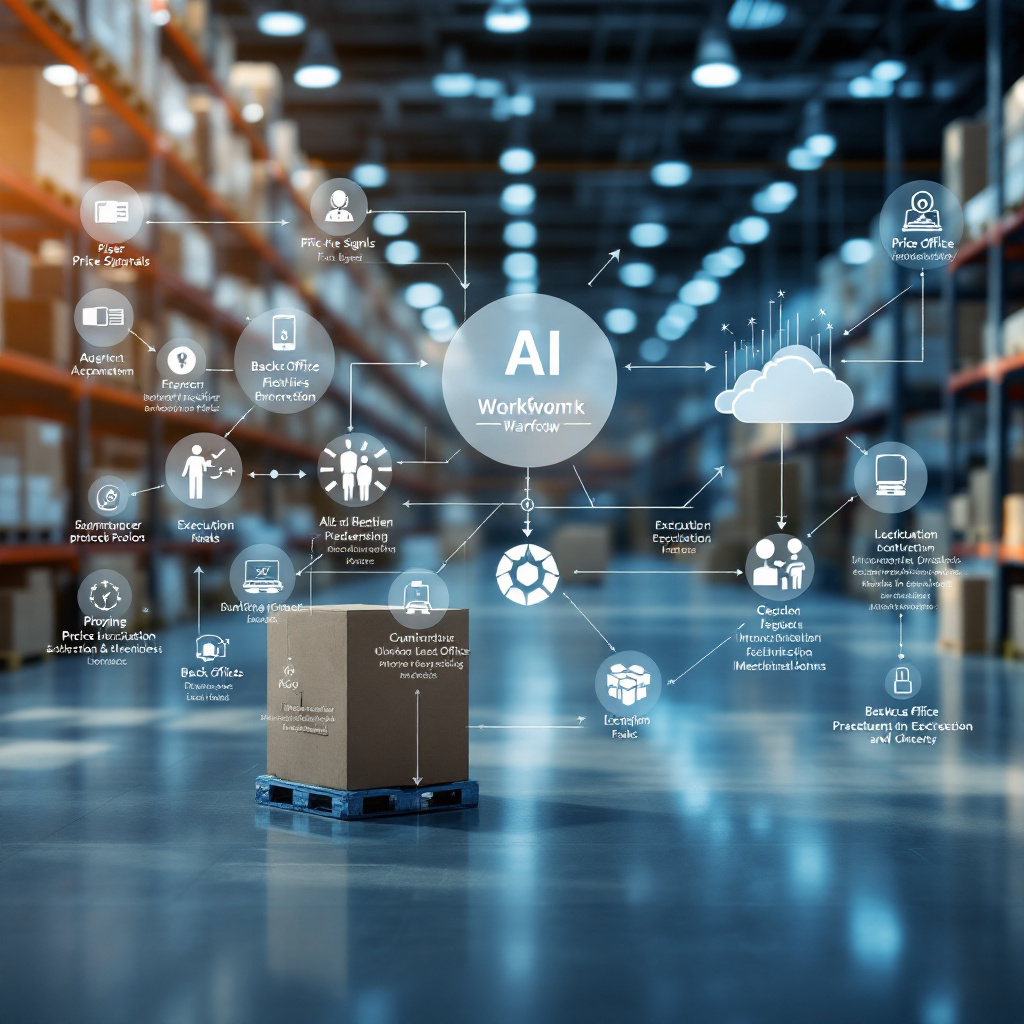
Think of a simple workflow diagram in plain language. First, a price forecasting agent creates a signal. Next, a trading agent evaluates execution against liquidity. Then, a logistics agent books transport and updates a CTRM. Finally, a back office bot reconciles invoices and posts entries. This chain removes repeated human lookups and speeds settlement.
Practical benefits are clear. Teams report fewer settlement errors, faster vessel booking decisions, and lower storage costs. Automation frees traders to refine trading strategies rather than fix paperwork. Also, commodityai platforms can be customizable and scalable for different asset classes, from metals to energy and commodity cargoes.
To operate at scale, orient systems toward traceability and audit. Each agent should log decisions for an audit trail and enable quick incident reviews. Use AI‑based monitoring to surface performance drifts and trigger human escalation. In this way, ai that automates tactical work supports higher‑value strategy and reduces operational costs for trading businesses.
Drowning in emails?
Here’s your way out
Save hours every day as AI Agents label and draft emails directly in Outlook or Gmail, giving your team more time to focus on high-value work.
Measuring value: roi, trade decisions and powerful ai risks
Measuring ROI requires clear inputs and straightforward metrics. Start with baseline KPIs: manual hours, error rates, settlement time, and slippage. Then model gains from improved trade capture rate, fewer compliance fines, and P&L uplift from better timing. For instance, procurement pilots reported up to 40% cost savings, which directly improves ROI.
Here is a simple ROI template to use. Inputs: annual manual hours saved, average hourly cost, reduction in slippage as a percentage of traded volume, and decrease in compliance incidents. Calculate net savings, subtract initial capital and ongoing model maintenance, and include projected uplifts from improved price forecasting. That yields a payback period and a multi‑year ROI.
Balance gains with risks. Powerful ai can concentrate capability and raise costs for smaller players. Also, model drift, data poisoning, and vendor lock‑in create operational risk. Mitigations include model governance, data lineage, human oversight, and regular audits. Maintain a pre‑built runbook for incident response and model rollback.
Finally, track qualitative benefits. Faster replies to counterparties, improved traceability, and better team morale matter. For logistics‑heavy desks, automating email workflows with a copilot reduces handling time and delivers measurable ROI; a virtualworkforce.ai ROI guide explains how to quantify these gains (virtualworkforce.ai ROI for logistics).
From pilot to production: use case selection, deploy, implement ai and scaling in the commodities industry
Moving from pilot to production requires discipline. Start with high‑impact, low‑integration pilots such as price signal feeds or document extraction. Next, validate metrics and prove the model under live stress. After that, phase integration with OMS, CTRM, and logistics systems. Align early with compliance and security teams to avoid late blockers.
Follow these six next steps for trading managers. First, pick a clear use case with measurable KPIs. Second, secure data and connectors to market data and proprietary sources. Third, run a focused pilot with human oversight and short feedback loops. Fourth, measure ROI and revise models. Fifth, harden models with governance, audit trails, and role‑based controls. Sixth, scale by integrating with trading systems and automating repeatable workflows.
When you implement ai at scale, design for scalability and traceability. Use modular agents that expose apis for easy orchestration, and standardise data schemas for faster integration. Also, include data scientists in early stages but keep business users in control of behaviour through no‑code tools where possible. This approach reduces the reliance on long IT projects and speeds time to value.
Finally, remember that AI adoption is a journey across trading operations. Generative AI and conversational AI add value to research and emails, while systematic trading and algorithmic trading benefit from cleaner inputs and faster execution. For teams focused on freight and customs emails, tailored guides explain how to automate logistics communication and scale without hiring (how to scale logistics operations without hiring).
FAQ
What is a commodity AI agent and how does it help traders?
A commodity AI agent is a software agent that analyses market signals, automates routine tasks, and recommends or executes trades. It helps traders by freeing time from clerical work, improving price forecasting, and by supplying actionable intelligence for better decisions.
How quickly can AI extract market data?
AI pipelines can dramatically accelerate extraction. For example, S&P Global reported up to 95% faster extraction with AI‑ready data. Faster extraction shortens reaction time to market events.
Which workflows should I automate first?
Start with high‑value, low‑integration workflows: document extraction, invoice reconciliation, and price signal generation. These use cases deliver measurable ROI and simplify later integration with trading systems.
Can AI agents handle unstructured data like contracts?
Yes. Modern natural language systems extract terms from contracts and invoices and populate ERP or CTRM fields. This reduces manual entry and lowers settlement errors.
What are the main risks of deploying AI in commodity trading?
Main risks include data quality issues, model drift, vendor lock‑in, and operational risk from automated actions. Mitigations include governance, audit trails, human oversight, and regular model validation.
How do I measure ROI for an AI pilot?
Measure saved manual hours, reduced slippage, fewer fines, and uplift in trade capture. Use a simple template that totals annual savings and compares them to implementation and maintenance costs to calculate payback.
Do smaller trading companies have a chance against AI‑enabled rivals?
Smaller firms can compete by focusing on specific workflows and using no‑code AI tools to automate emails and operations. These targeted solutions reduce operational costs and improve response times.
What role do APIs and market data connectors play?
APIs connect AI agents to exchanges, pricing feeds, and proprietary data. Reliable market data and clean data sources are essential for accurate forecasts and for enabling scalable deployments.
Is generative AI useful in trading operations?
Generative AI helps with summarising research, drafting emails, and creating structured reports from unstructured inputs. It should operate with governance and fact‑checking to avoid hallucinations.
How can I get started with AI for logistics‑heavy trading desks?
Begin with an email‑automation pilot that integrates ERP, TMS, and email history to draft replies and update records. Resources on automating logistics correspondence and AI for freight communication can guide the rollout (automated logistics correspondence, AI for freight forwarder communication).
Drowning in emails?
Here’s your way out
Save hours every day as AI Agents label and draft emails directly in Outlook or Gmail, giving your team more time to focus on high-value work.