


How ai is transforming warehouse and logistics
AI is shifting warehouses from manual, static operations to data-driven, adaptive sites that cut costs and speed fulfilment. First, AI reduces repetitive work. Second, it brings fast insights that improve decisions. For example, PwC-style surveys show broad AI adoption. A recent industry summary reports that about 79% of businesses use AI agents, and many teams can quantify gains in efficiency. As a result, warehousing leaders treat AI as an operational lever, not a lab experiment.
The impact shows in clear metrics. Research finds AI lowers logistics costs by roughly 15% and can lift service levels by as much as 65% after rollout (source). In practice, companies such as Amazon and UPS test agentic systems and robots for routing, order picking, and inventory visibility, which speeds delivery windows and reduces errors (case examples). Warehouse managers see faster cycle times, improved pick accuracy, and fewer stockouts.
Operationally, AI integrates with warehouse management systems and management systems to coordinate tasks. For example, a warehouse management system can feed historical data to an AI model that predicts demand and suggests dynamic slotting. Then, robots and human pickers follow optimized routes. In addition, AI provides predictive alerts for equipment maintenance and capacity planning. Importantly, humans and AI collaborate on exceptions and escalations.
Finally, teams should focus on measurable pilots. Start with picking or inventory management and measure orders per hour and pick accuracy. Then scale. If you run ops and need faster responses to email-based exceptions, our product virtualworkforce.ai drafts context-aware replies and ties replies to ERP/TMS/WMS sources. That saves time and reduces errors while keeping human oversight.
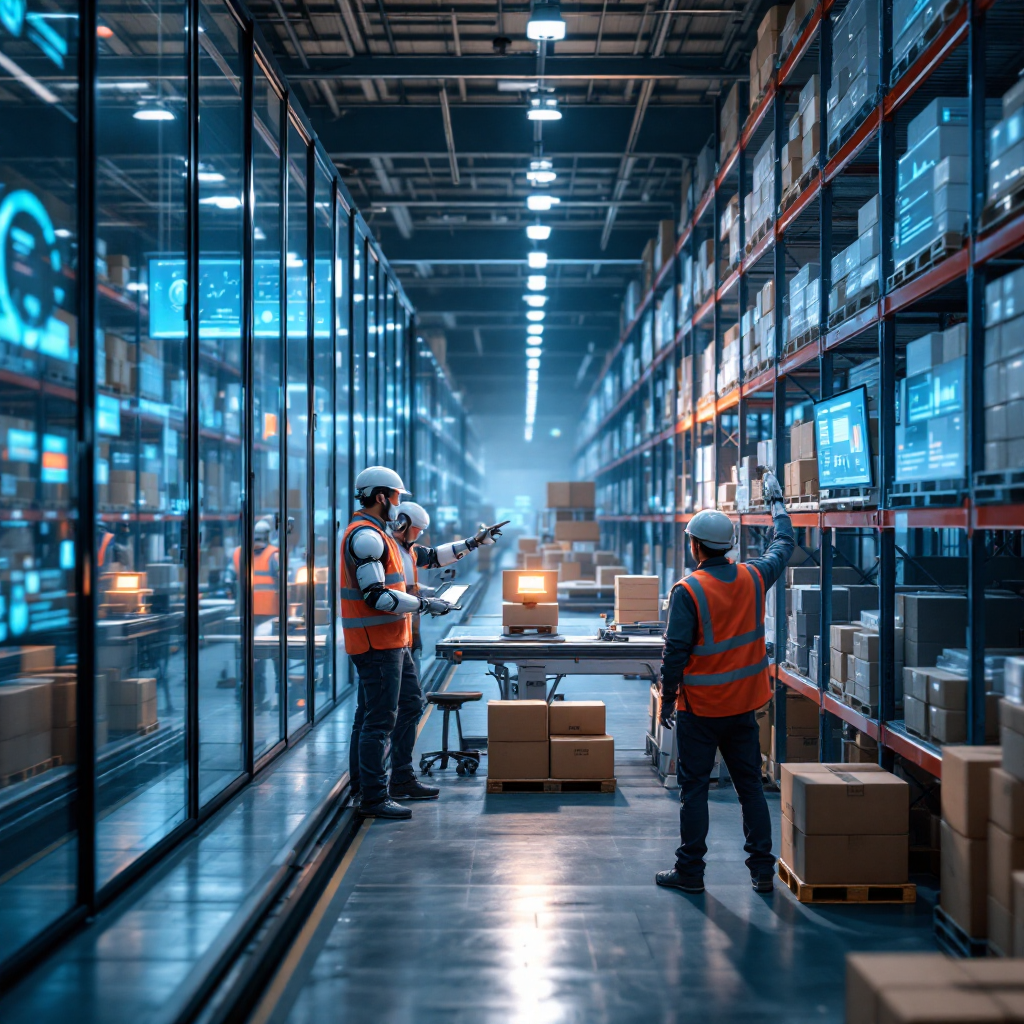
Key uses: ai agents in warehouse management, warehouse operations and supply chain management
AI agents focus on core workflows that yield quick returns. Top use cases include automated order picking, real-time inventory, dynamic slotting, demand forecasting, and predictive maintenance. For instance, order-picking agents combine computer vision, optimisation and route planning to cut travel time and errors. In addition, IoT plus AI provides continuous stock updates and enables dynamic replenishment to reduce stockouts and overstock. That improves inventory management and order fulfilment.
Specifically, AI in warehouse operations streamlines picking and packing. Robots navigate optimized warehouse layouts while vision systems confirm SKUs. Meanwhile, cloud models use historical data to forecast demand and tune staffing. Also, predictive maintenance models analyse sensor streams and flag machines before failures happen, which increases MTBF and lowers downtime.
Fast ROI appears where manual work is repetitive and error-prone. Picking zones, returns processing, and email-based exception handling often show gains within months. For email exceptions, integrating AI tools that draw on ERP, TMS and WMS cuts handling time and improves reply quality. For example, virtualworkforce.ai connects to core systems and drafts accurate, context-aware replies for ops teams, which typically reduces reply time from about 4.5 minutes to 1.5 minutes per email (example integration).
Furthermore, agents also support inventory management by recommending replenishment and by tracking units in real-time. That allows AI agents to rebalance stock across zones and to suggest transfers between distribution centres. Therefore, warehouse managers can lower carrying costs while keeping service levels high. Finally, agents play well with WMS and with warehouse inventory management software, so you can phase implementation with minimal disruption.
Drowning in emails?
Here’s your way out
Save hours every day as AI Agents label and draft emails directly in Outlook or Gmail, giving your team more time to focus on high-value work.
ai systems and ai technologies: advanced ai, agentic ai and ai solutions for warehouse management
Technology choices matter. Successful deployments mix supervised models, reinforcement learning for routing, computer vision for item recognition, and agentic AI for coordination between robots and software. For example, reinforcement learning can optimise pick routes over time. At the same time, computer vision confirms SKU identity during picking. Combined, these ai systems reduce errors and increase throughput.
Integration points include WMS, TMS, ERP, robotics controllers, and edge IoT layers. A typical pattern sends real-time sensor feeds to an edge device. Then, edge inference handles instant checks while cloud services do aggregate forecasting and heavy data analysis. This split supports both low-latency actions and long-horizon planning. Also, integrating AI requires open APIs and robust data pipelines for reliable data processing.
Data quality remains a top blocker. Teams must clean records, harmonize SKU identifiers, and set governance for retraining. Without robust data, advanced ai algorithms degrade quickly. Therefore, data quality and API stability deserve early attention. In practice, many projects begin with an ai model that consumes historical data to forecast demand, then expand to operational agents that act on those forecasts.
When choosing ai solutions, decide between off-the-shelf and custom AI. Off-the-shelf tools accelerate pilots. Custom AI fits unique workflows and warehouse layouts. For email and exception work, no-code options let ops teams configure behavior without heavy IT involvement; virtualworkforce.ai is an example of this approach, connecting to ERP/TMS/WMS and providing thread-aware context so teams keep control while agents deliver consistent answers (example).
Quantified benefits from ai agents for logistics and ai agents for warehouse: ai in logistics performance and savings
Measured benefits drive budgets. Industry studies show AI adoption in logistics can cut costs by roughly 15% and lift service levels by up to 65% after full integration. You can read a summary of these impacts and industry statistics from market write-ups that document real deployments (metric source). Additionally, SMBs that embrace AI report strong revenue growth in recent surveys (SMB data).
Cost savings arise from lower labour hours per order, fewer picking errors, and reduced downtime through predictive maintenance. For example, a pilot that reduces error rates by 30% also lowers returns and rework costs. Moreover, predictive maintenance can extend equipment life and cut emergency repairs. Combine those effects and you see sizable op-ex reduction.
Key KPIs to monitor include orders per hour, pick accuracy, mean time between failures (MTBF), and inventory turns. Use these benchmarks to build a business case. Then, estimate payback based on labour savings, error reduction, and improved service levels. For email-heavy exception workflows, estimate time saved per email and multiply by mail volumes. Our internal ROI pages show concrete math for logistics teams measuring email automation benefits and agent-driven handling improvements (ROI guidance).
Finally, track soft benefits such as faster decision cycles, better supplier coordination, and higher customer satisfaction. These factors compound over time and support further investments in agentic AI and warehouse robots. As you scale, keep measuring so that AI investments remain aligned with business targets.
Drowning in emails?
Here’s your way out
Save hours every day as AI Agents label and draft emails directly in Outlook or Gmail, giving your team more time to focus on high-value work.
Implementing ai agents: using ai and ai agent integration in warehouse management and supply chain
Start small and scale. A recommended path is: pilot on a single use case, measure KPIs, then scale modularly across zones. For example, choose picking or maintenance as the first pilot. Next, measure orders per hour, pick accuracy, and downtime. Then, iterate and expand. This reduces risk and proves value.
Operational checklist: clean data, define KPIs, choose off-the-shelf versus custom AI, and plan integration with WMS and TMS. Also, train staff on new human–agent workflows and update safety rules. For teams handling many email exceptions, integrating AI tools that connect to ERP and WMS reduces context switching. virtualworkforce.ai provides no-code setup so ops teams configure tone, templates, and escalation paths without engineering heavy prompts (ops automation).
Change management matters. Involve operations early to map tasks that agents will take. Then, define escalation rules for exceptions. Also, prepare rollback plans and vendor SLAs for uptime and model retraining. Phased rollouts let teams validate safety and performance before full deployment. Meanwhile, keep monitoring data quality and retrain models on fresh inputs to avoid drift.
Risk mitigation includes phased deployment, clear governance, and retraining schedules. For software integrations, ensure your warehouse management system supports APIs and that management systems expose the right events. Finally, maintain audit trails and access controls so humans review agent decisions when needed. These steps create reliable, repeatable deployments that deliver consistent returns.
future of ai and risks of ai agents in logistics: scaling ai solutions and governance
The future points to greater orchestration and autonomy. Expect more agentic AI coordination between robots and control systems, tighter edge/cloud cooperation, and wider use of autonomous warehouse vehicles. As these trends accelerate, teams will depend more on continuous data flows and on models that learn from real-world feedback. That makes governance, retraining, and safety central to success.
Risks to manage include data bias, cybersecurity, vendor lock-in, regulatory compliance, and workforce impacts. For instance, biased training data can skew demand forecasts. Likewise, weak APIs expose systems to attack. Therefore, implement audit trails for decisioning, specify performance SLAs, and require encrypted links between edge devices and cloud services.
Governance needs include retraining schedules, ethical guidelines, and transparent logging. Also, define how humans and AI collaborate during exceptions. For logistics and supply chain teams, that means clarifying who reviews agent suggestions and who approves transfers. Additionally, prepare workforce plans to reskill staff into higher-value roles.
Finally, plan for continuous improvement. AI delivers gains only with ongoing data, governance, and ops alignment. When you combine tailored AI with practical rollout plans and with strong data quality controls, agents transform routine work and enhance risk management. Use pilots to validate assumptions, and then scale while preserving safety and auditability.
FAQ
What is an AI agent in a warehouse context?
An AI agent is software that performs specific tasks autonomously or semi-autonomously inside a warehouse. It can coordinate robots, suggest pick routes, or draft email replies tied to ERP and WMS data.
How quickly do AI pilots deliver ROI in warehouse operations?
Pilots focused on picking, returns, or email exceptions commonly show measurable ROI within months. Time to payback depends on baseline error rates, labour costs, and the scale of deployment.
Can AI integrate with my warehouse management system?
Yes. Most AI solutions connect to a warehouse management system through APIs or middleware. For email and exception handling, no-code connectors speed setup and reduce IT demand.
What data is required for successful AI deployments?
High-quality SKU records, historical data, and sensor telemetry are essential. Also, clean transaction logs and consistent identifiers improve model accuracy and avoid drift.
Are there security concerns with AI in logistics?
Yes. Edge devices, cloud services, and APIs must use encryption and access controls. Vendor SLAs and audit logs help mitigate cybersecurity and compliance risks.
How do AI agents affect warehouse staff?
AI can reduce repetitive tasks and move staff to higher-value roles like exception handling and strategic planning. Proper change management and training are critical to a smooth transition.
What KPIs should we track when implementing AI?
Track orders per hour, pick accuracy, mean time between failures, and inventory turns. Also measure email handling time if agents automate correspondence.
Can small warehouses benefit from AI?
Yes. SMBs often see fast gains from automation of high-volume, repeatable tasks and from email automation that reduces context switching across ERP and WMS systems.
How do we choose between off-the-shelf and custom AI?
Choose off-the-shelf for rapid pilots and for common workflows. Choose custom AI when workflows or warehouse layouts are unique. A hybrid approach often works best.
Where can I learn more about automating logistics emails and ROI?
See practical guides on automating logistics correspondence and on estimating AI ROI. For operations-focused teams, our resources on virtual assistant logistics and ROI modelling explain setup and metrics in detail (virtual assistant), (ROI guide), and on freight-forwarder communication (freight AI).
Drowning in emails?
Here’s your way out
Save hours every day as AI Agents label and draft emails directly in Outlook or Gmail, giving your team more time to focus on high-value work.