


ai and recruit: why staffing firms must adopt agentic ai to transform recruitment
AI is changing how staffing firms operate. First, AI reduces repetitive tasks that waste recruiter time. Reports show AI-driven workflows can handle up to 80% of transactional work, which frees recruiters to focus on judgement and relationships (source). Next, spending on AI in recruitment is growing fast. In fact, industry forecasts put recruitment AI spending at about USD 15.32 billion by 2030, which signals strong commercial momentum (source). Also, firms that adopt AI see measurable shifts in back-office hiring. One study reported teams hiring 89% fewer agents after deploying AI to handle routine recruitment tasks (source). Therefore, the business case is clear: faster time-to-fill, lower operational cost, and fewer full-time staff for low-value tasks.
First, agentic AI matters. An agentic AI approach means autonomous AI agents that act on data, take decisions within rules, and escalate when needed. Second, this approach helps staffing firms transform how they recruit. Third, leaders should consider how AI integrates with current systems. For example, you must connect ATS, CRM, and data sources to let AI automate sourcing, screening, scheduling, and outreach. Senior ops and product leaders must evaluate the ORG-level trade-offs. Thus, the shift requires organizational change, technical work, and clear SLAs. In addition, developing AI competence helps retain top talent. Finally, forward-thinking staffing firms will combine human judgement with AI accuracy to attract and place the right talent faster.
For teams that manage operational email and candidate communication, platforms like virtualworkforce.ai show how AI agents can automate end-to-end email workflows, increase consistency, and reduce handling time dramatically; this ties directly into how staffing firms manage candidate pipelines and client correspondence learn more. Also, agentic AI supports talent acquisition by surfacing talent insights, improving candidate profiles, and enabling recruiters to spend more time on relationship work. Finally, adopting agentic AI helps recruiting teams scale without linear hiring, which improves ROI and competitive advantages for leading organizations.
ai agent and ai recruiter in action: end-to-end integration with ATS and CRM for placement
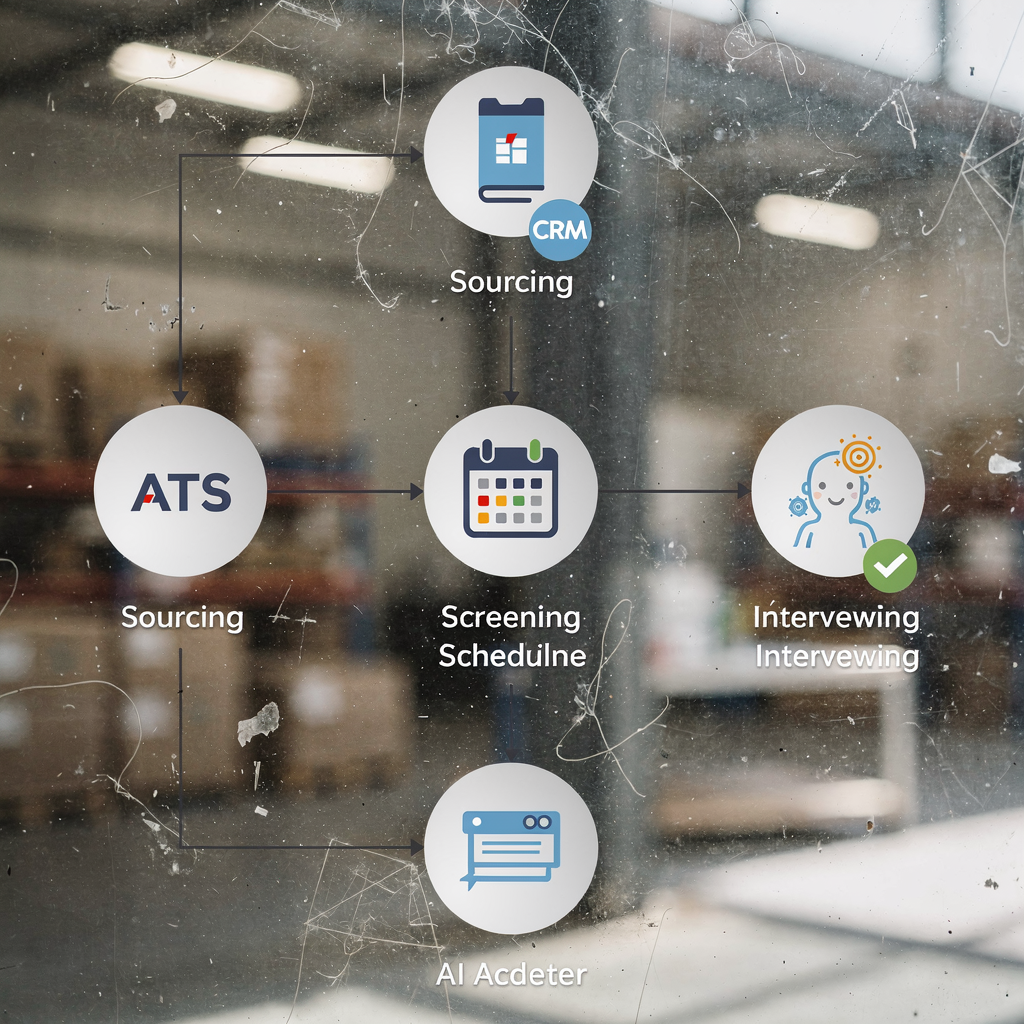
AI agents and an AI recruiter can plug into an end-to-end recruitment flow. First, the flow looks like this: sourcing → screening → scheduling → interviewing → placement. Next, each step connects to your ATS and CRM so data stays in sync. For example, the AI agent can ingest job description text, parse résumés, and create candidate profiles inside the ATS. Then, the AI recruiter sequences outreach messages and triggers calendar webhooks to schedule interviews in real-time. Also, the same agents update the CRM with client notes and placement milestones so hiring managers see progress.
Concrete integrations matter. You need API sync between the ATS and AI, secure webhooks for calendar and interview confirmations, and a data pipeline to feed candidate scoring back to the CRM. Additionally, an audit log preserves decisions and content from AI systems so compliance teams can evaluate automated choices. The technical slice includes OAuth-secured APIs, encrypted data transfer, role-based access, and rate-limited webhook endpoints. For calendar sync, use two-way webhooks that confirm times and send reminders. For resume parsing, integrate machine learning models that tag skills and flag the best-fit candidates.
Outcomes include higher client loyalty and faster placements. Staffing firms report around a 25% higher client loyalty when they use AI recruitment software (source). Also, studies link shorter process times to better placement success; delays can reduce placement success by nearly 24 percent, which AI can help avoid by accelerating screening and scheduling “Delays in recruitment can pull down placement success by nearly 24 percent;”. In practice, integrate the ATS (for candidate status), the CRM (for client context), and the AI agent (for automation). If you want to see how email and candidate correspondence automation fits operational workflows, check an example using our virtual assistant approach for logistics-style communications here.
Drowning in emails?
Here’s your way out
Save hours every day as AI Agents label and draft emails directly in Outlook or Gmail, giving your team more time to focus on high-value work.
team of ai and tools you use: how a team of ai automates sourcing, interviewer and follow-up
Design a team of AI that maps to roles in your recruiting process. First, create specialised AI agents: a sourcing agent, a screening agent, an AI interviewer, a scheduling agent, and a followup agent. Second, coordinate them with orchestration logic so duties never overlap. The sourcing agent looks for candidates in databases and external job boards. It tags relevant profiles and moves them into the ATS. The screening agent scores résumés, validates skills, and removes obvious mismatches. Next, the AI interviewer conducts structured conversational screens and records answers as structured data. Finally, the followup agent sequences outreach to keep candidates warm and reduces drop-off.
Tools you use make this possible. Use candidate databases with searchable skill tags, conversational AI for initial interviews, ATS connectors to update status, and analytics dashboards to monitor outcomes. For email-heavy candidate communication, platforms like virtualworkforce.ai handle end-to-end email lifecycle, which reduces manual triage and keeps context in long candidate threads see an example. Also, include a CRM integration so client feedback feeds back to the recruiting agents.
Operational benefits appear quickly. Automated screening raises response rates because candidates get timely replies. Followup automation reduces drop-off by ensuring consistent outreach cadence. For hiring managers, the AI interviewer returns structured answers and candidate profiles that surface the best candidates. Additionally, the recruiting team can configure prompts and evaluation rubrics so the AI adapts to role seniority and skill priorities. In parallel, analytics track pipeline velocity and conversion rates. Finally, keep humans in the loop: recruiters review AI shortlists, reconfigure rules, and handle negotiation. This approach combines AI-powered automation with recruiter judgement, which improves placement outcomes and candidate experience.
recruiter, recruiting agencies and staffing firms: new roles, talent management and roi
Staffing firms and recruiting agencies face a people shift. Recruiter responsibilities will move from manual data entry to high-value relationship and decision work. For example, recruiters will focus on negotiation, client consulting, and candidate coaching. Recruiting agents who once owned outreach will now supervise AI sequences and refine prompts. Also, agencies can scale without linear headcount growth because AI handles routine volume.
Talent management must change. Upskilling programs should teach recruiters how to manage AI, read model outputs, and correct biases. Training should cover prompt design, how to evaluate candidate profiles, and when to escalate complex cases. In addition, create a certification path so recruiters prove competence with AI tools. For organizational governance, assign AI owners who manage vendor relationships and monitor ai systems performance.
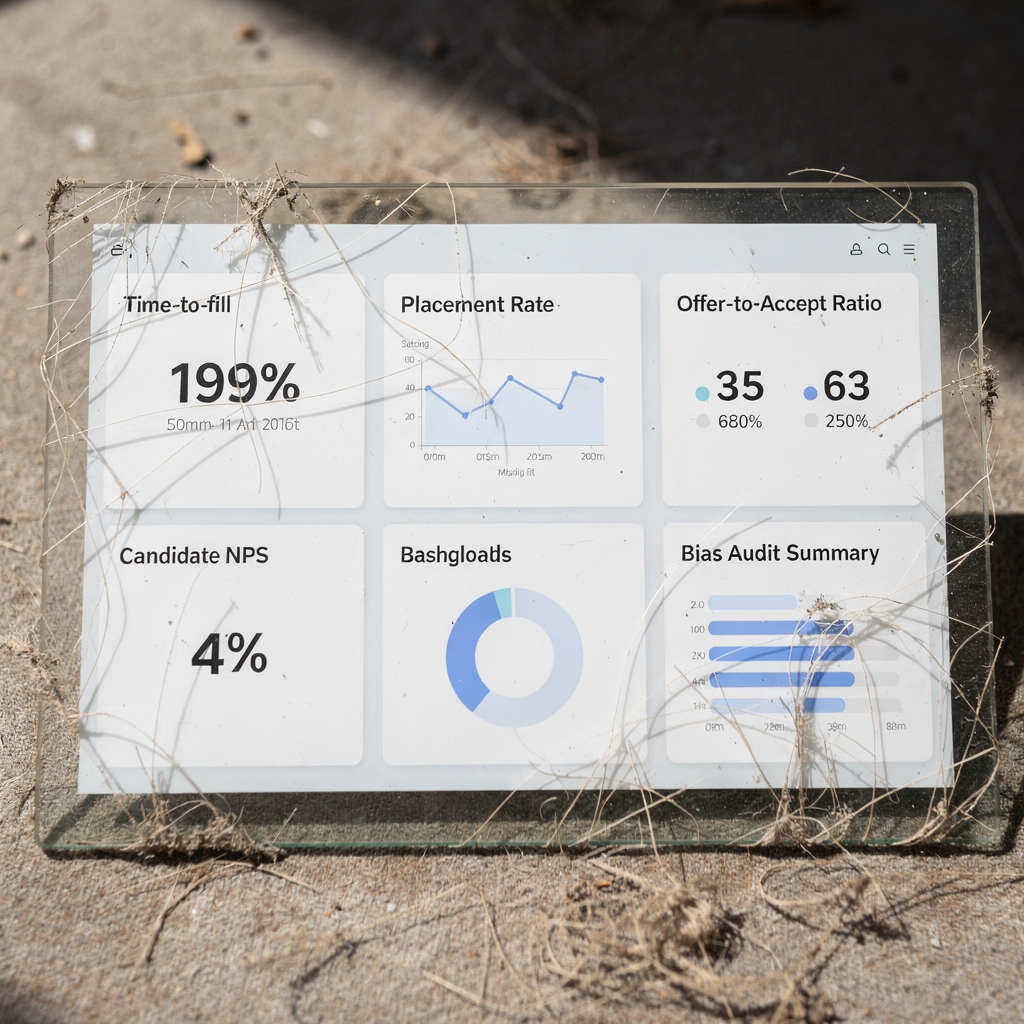
ROI shows quickly when you measure the right metrics. Time-to-fill, placement rate, client retention, and recruiter productivity matter most. For example, over 93% of agency recruiters reported a positive impact from AI tools, which supports adoption and ROI expectations (source). Also, a 25% lift in client loyalty is reported where AI recruitment software is in use (source). Build KPI dashboards that show time-to-fill, offer-to-accept ratio, candidate NPS, and ROI: cost-per-placement and time saved per recruiter. For logistics or operations-heavy recruiting, you can reference ROI specifics from our logistics ROI playbook to guide metrics and dashboards see the playbook.
Finally, track adoption and tune incentives. Reward recruiters for high-value activities like client consultation and complex fills. Incentives should reflect the new hybrid model where AI and humans collaborate. This creates competitive advantages for forward-thinking firms that combine AI capabilities with recruiter expertise.
Drowning in emails?
Here’s your way out
Save hours every day as AI Agents label and draft emails directly in Outlook or Gmail, giving your team more time to focus on high-value work.
placement, customizable workflows and ai capabilities: measuring performance and compliance
Placement quality depends on customisable workflows and measurable AI capabilities. First, configure templates by vertical and role seniority. Then, A/B test scripts and evaluation rubrics to find the best approach. Customizable templates help teams reuse workflows and speed up onboarding for new roles. Also, use conditional branching to match client SLAs and candidate availability.
Measure AI capabilities with focused metrics. Track precision of shortlist, the interview-to-offer ratio, false positives in screening, and candidate NPS. For each metric, set clear thresholds and a review cadence. In addition, monitor model drift and refine models with fresh data. Use a small holdout set to evaluate how the screening agent ranks best candidates over time. To evaluate fairness, run bias checks across gender, ethnicity, and age segments. Keep an audit trail so every automated decision links back to input data and the evaluation rubric.
Risk and compliance are non-negotiable. Implement privacy-safe data handling and role-based access. Also, maintain logs so auditors can trace automated decisions. For regulatory environments like the EU, ensure data subject rights are respected. In practice, a short how-to checklist helps pilots. First, configure a template for a single vertical. Next, set up API integration to the ATS and CRM. Then, monitor shortlist precision and the interview-to-offer ratio for four weeks. Finally, run a bias and privacy audit before scaling. If you need examples for automating correspondence in regulated operations, see how AI frameworks apply to logistics communications example.
ai revolution, transform and end-to-end rollout: risks, governance and a 90‑day pilot plan for staff
The AI revolution demands careful rollout. First, acknowledge workforce concerns. Surveys show about 52% of workers worry AI agents collecting job-specific data could replace their roles (source). Therefore, communicate transparently and offer reskilling programs. Second, mitigate model drift and over-automation by keeping humans in the loop and staging deployments.
Governance must cover data ethics, SLAs, vendor due diligence, and change management for staff. Assign clear owners for AI models and integrations. Also, require vendor evidence of bias testing and security controls. In addition, document escalation paths so staff know when to step in. For auditability, capture decision logs and maintain explainability records. This keeps legal and compliance teams confident as automation grows.
Run a focused 90-day pilot to transform a single process. First 30 days: set objectives, integrate an AI agent with ATS and CRM, and configure templates. Next 30 days: automate selected tasks such as sourcing and screening, run parallel human reviews, and measure core metrics. Final 30 days: expand to scheduling and followup, run bias and privacy audits, and collect stakeholder feedback. Choose three core metrics to measure at the pilot gate: time-to-fill, placement rate, and candidate satisfaction. If those metrics meet targets and compliance checks pass, scale in stages.
Finally, balance ambition with care. Use human oversight and clear governance. Also, provide staff training to manage AI and refine prompts. If you want help scaling operations with AI agents for email-heavy workflows and operational correspondence, contact us to discuss a pilot or to see specific templates for logistics-style email automation contact us. Run the 90-day pilot, measure the three core metrics, and then decide to scale or refine.
FAQ
What is an AI agent in staffing?
An AI agent is an autonomous software component that performs recruitment tasks such as sourcing, screening, scheduling, and followup. It connects to systems like ATS and CRM to act on candidate data while escalating complex cases to human recruiters.
How does an AI recruiter differ from traditional automation?
An AI recruiter uses machine learning and conversational models to evaluate candidates and conduct structured interviews, rather than only running rule-based scripts. It adapts over time, refines prompts, and provides data-driven candidate profiles for recruiter review.
What integrations are required for an end-to-end AI recruitment flow?
You need API sync to the ATS, secure webhooks for calendars, and CRM connections for client context. In addition, a secure data pipeline and audit logs enable compliance and evaluation.
Will AI replace recruiters?
AI will automate transactional tasks but not replace the judgement and relationship work recruiters provide. Recruiters will shift to coaching candidates, negotiating offers, and handling complex client cases.
How do you measure AI capabilities in recruitment?
Track shortlist precision, interview-to-offer ratio, false positive rates, and candidate NPS. Use these metrics to refine models and to run bias and privacy audits.
What is a safe pilot plan for AI recruitment?
A 90-day pilot with staged objectives works well: integrate systems in month one, automate sourcing and screening in month two, and expand scheduling and followup in month three. Measure time-to-fill, placement rate, and candidate satisfaction as gate metrics.
How do I ensure compliance and mitigate bias?
Implement bias checks, maintain audit trails, and restrict data access via role-based permissions. Also, run periodic evaluations of model outputs and document remediation steps.
What tools you use for an AI recruiting stack?
Use candidate databases, conversational AI for interviews, ATS connectors, and analytics dashboards. For heavy email workflows, consider AI agents that automate the full email lifecycle for operational teams.
How can recruiting agencies see ROI quickly?
Measure reduced handling time, improved placement rate, and higher client retention. Many agencies report fast wins in productivity and client loyalty after deploying targeted AI tools.
How do I get started with a pilot?
Start by choosing a single role or vertical and configuring a template. Integrate the ATS and CRM, run the pilot for 90 days, and measure the three core metrics before scaling.
Drowning in emails?
Here’s your way out
Save hours every day as AI Agents label and draft emails directly in Outlook or Gmail, giving your team more time to focus on high-value work.