


ai and airport: how ai agents work to transform airline operations
First, a short definition. An AI agent is software that perceives inputs, reasons, and acts to achieve goals. In airports the term covers chatbots, virtual assistants and back-end decision engines. These systems work together to automate tasks and improve airport operations.
Next, architecture matters. Front-end AI chat interfaces handle passenger queries and bookings. Back-end decision engines process sensors, flight messages and operational databases. Data sources include flight feeds, baggage handling sensors and maintenance logs. Then, real-time data moves between systems so decisions stay current. For example, a virtual assistant can answer a booking question while a separate AI engine optimises turnaround time.
Also, AI agents for airport often split into two layers. The customer-facing layer uses natural language to handle enquiries and rebook travellers. The operational layer uses predictive analytics and machine learning to reduce delays and unscheduled events. These layers share data via a common message bus and a central operational database. This design lets teams scale functions without duplicating integrations.
For quick facts, AI can cut flight delays by around 20–30% through better scheduling and turnaround optimisation, and predictive maintenance can reduce unscheduled maintenance events by up to 40% (source). Also, airports report improved baggage handling efficiency by roughly 25% after deploying AI-driven logistics (source). These numbers show why airports and airlines invest in AI.
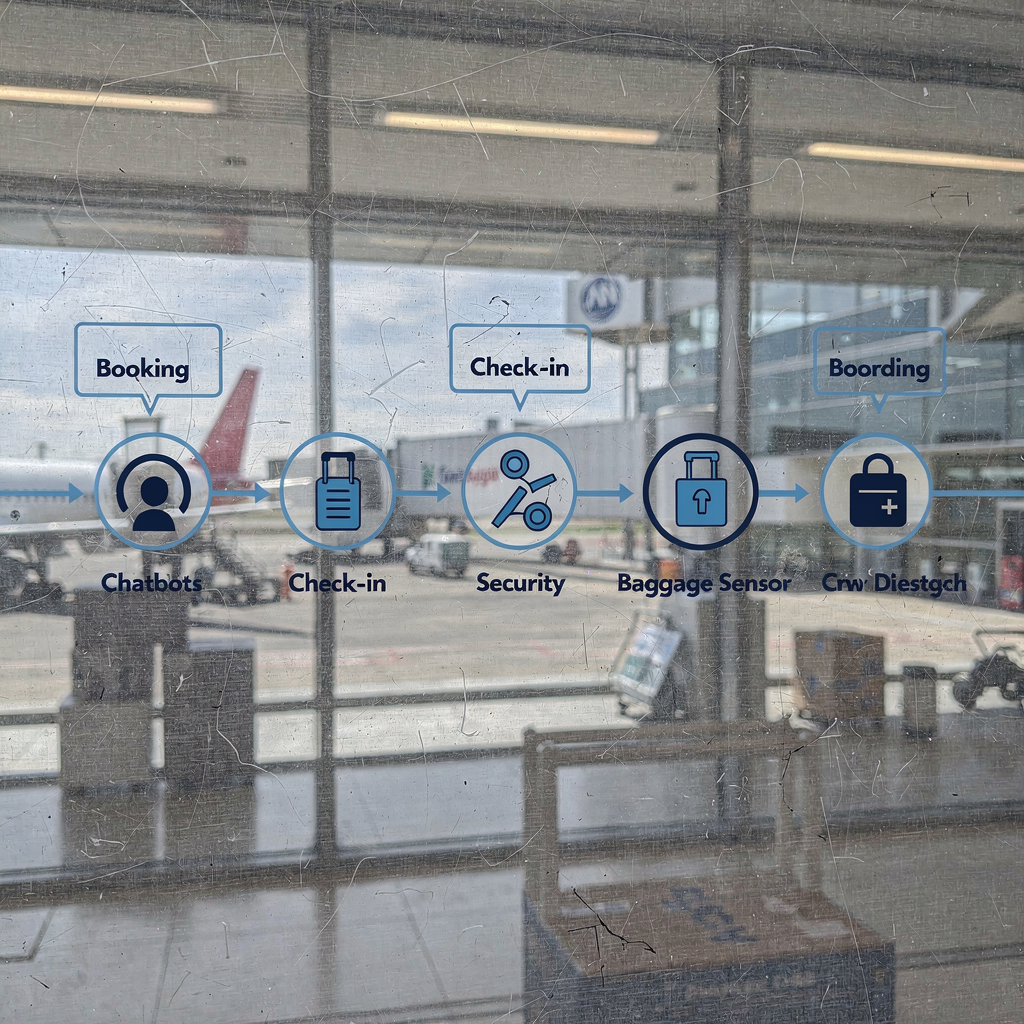
For example, United Airlines has introduced generative AI in its control centre to improve customer communications and operational responsiveness during peaks (source). IATA stresses data quality as a foundation for these systems (source). Finally, a simple diagram of the passenger journey highlights touchpoints where AI assists: booking, check-in, security, boarding and post-flight services.
ai agents for airport and ai chatbots: reduce customer service costs and improve passenger experience
First, frontline AI brings measurable savings. AI chatbots and virtual assistants now handle a large share of customer queries at major hubs. For instance, virtual assistants manage over 60% of inbound enquiries at some airports, which reduces queues and phone loads (source). This reduces customer service costs and improves passenger experience.
Next, typical use cases are clear. Chatbots answer flight status queries, help passengers rebook flights and provide wayfinding. They also send disruption alerts and offer multilingual support. Because they operate 24/7, they cut waiting times and free human agents for complex tasks. A good handover policy sends unresolved cases to human agents with full context. That way the customer avoids repeating their query.
Also, KPI sets matter. Teams track first-contact resolution, cost per contact and average handling time. For email-heavy operations, solutions like virtualworkforce.ai automate the full email lifecycle. In practice, teams cut email handling time dramatically, routing or resolving messages automatically and drafting accurate replies grounded in operational systems like ERP or TMS. See a related guide on automated logistics correspondence for more detail Automated logistics correspondence.
Then, operational rules ensure quality. AI systems must include QA checks, escalation rules and tone settings. Human agents review exceptions and train models on edge cases. Also, AI chatbots collect travel history and preferences to personalise replies, which improves customer satisfaction and reduces repeat contacts. For teams thinking about pilots, start with flight-status automation and rebook flows, then extend to multilingual and complex disruption handling.
Finally, AI chatbots integrate with mobile apps and kiosks to create seamless omnichannel service. For deeper automation of email and operations, readers can explore how to scale logistics operations without hiring, which discusses role-based routing and governance Scale logistics operations. In short, AI agents reduce customer service costs while improving consistency and speed.
Drowning in emails?
Here’s your way out
Save hours every day as AI Agents label and draft emails directly in Outlook or Gmail, giving your team more time to focus on high-value work.
ai agents in travel, automation and use cases that transform travel experiences
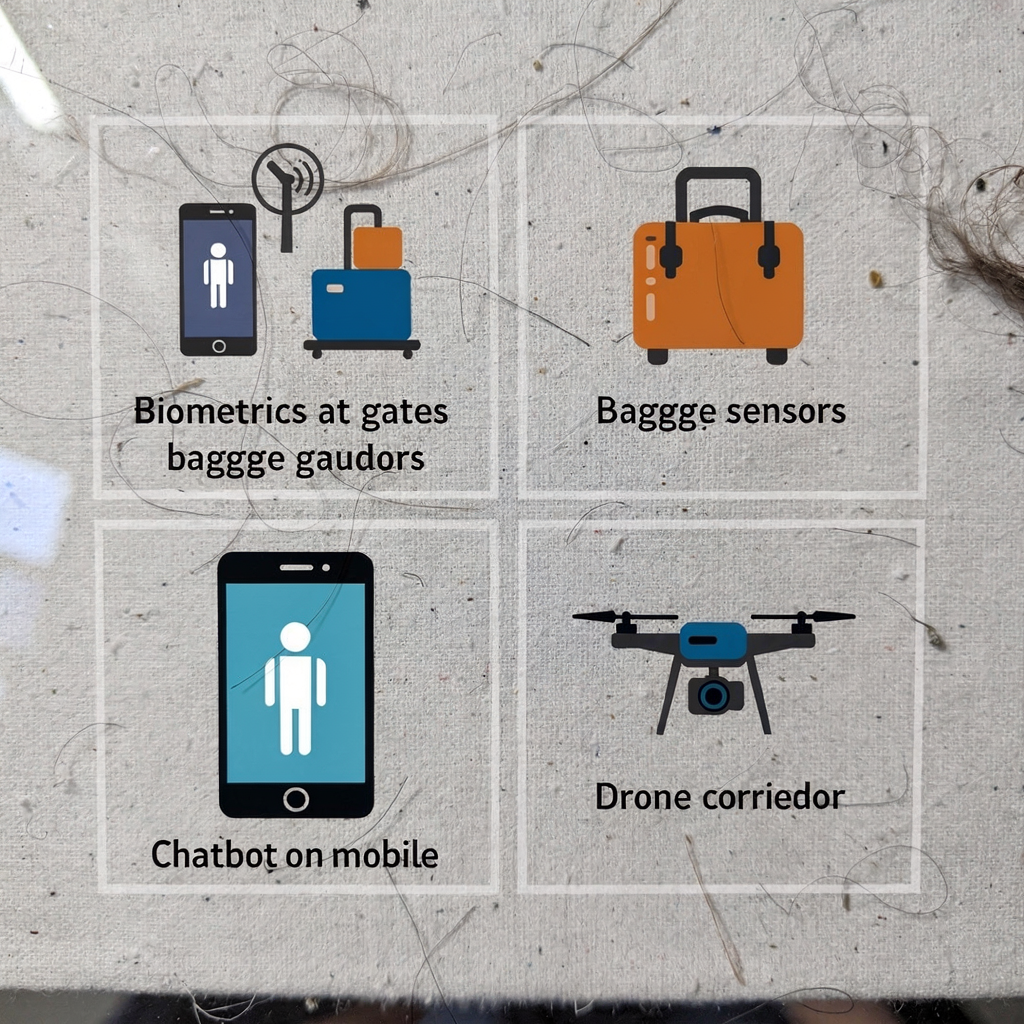
First, practical use cases show where AI adds value. Airports use AI to automate check-in, run biometric gates and optimise baggage routing. These applications reduce friction and help staff focus on exceptions. Below are concise, evidence-based use cases with impact notes.
1) Automated check-in and biometrics: Speeds processing and reduces queuing. Impact: faster lane throughput and higher customer satisfaction.
2) Smarter baggage handling: Sensors and AI route bags and detect jams. Impact: about 25% improvement in baggage handling efficiency (source).
3) Gate allocation and turnaround optimisation: Predictive analytics reduce delays and speed boarding. Impact: 20–30% reduction in delays with better scheduling (source).
4) Predictive maintenance: Machine learning detects component wear before failures. Impact: up to 40% fewer unscheduled maintenance events (source).
5) Personalised messaging and itineraries: Virtual assistants tailor communications to passenger profiles. Impact: improved passenger experience and fewer support contacts.
6) Security screening assistance: AI helps flag high-risk items and speeds human review. Impact: higher throughput with maintained safety standards.
7) Dynamic pricing and retail personalisation: AI suggests offers in airport apps. Impact: higher ancillary revenue and better passenger engagement.
8) Baggage claim matching and alerts: Automated alerts reduce lost-luggage calls.
9) Wayfinding and accessibility services: AI-powered directions improve flow for mobility-impaired travellers.
10) Real-time disruption messaging and rebook flows: Integrates with airline operations and customer channels to rebook passengers automatically.
For more on AI-driven logistics and communications in travel, see our guide on improving logistics customer service with AI how to improve logistics customer service with AI. These use cases help transform travel experiences through targeted automation and personalised services.
airports and airlines: using ai to optimize airline operations and reduce delays
First, back-office AI focuses on scheduling, crew planning and disruption management. AI ingests flight plans, AODB entries and ATC updates to propose reschedules. As a result, teams resolve conflicts faster and keep flights on time.
Next, core benefits are measurable. Improved scheduling and turnaround AI have been credited with a 20–30% reduction in delays and a roughly 15% increase in on-time departures at airports that adopt these tools (source) (source). Predictive baggage routing and maintenance lower operational risk and improve reliability.
Also, implementation requires data integration. Teams must connect AODB, AML and maintenance feeds. Real-time data processing is essential for timely decisions. For email-centric workflows, integrating AI to triage ops mailboxes can remove friction. Our platform virtualworkforce.ai automates operational email triage and drafting, which helps control centres respond faster to flight disruptions and vendor queries virtual assistant for logistics.
Then, change management matters. Start small with a pilot on a single route or terminal. Measure KPIs such as delay minutes saved, on-time departure rate and reduction in manual interventions. Scale successful pilots across gates and carriers. Common pitfalls include poor data quality, weak governance and insufficient human oversight. To avoid these, apply clear escalation rules and continuous audits.
Finally, a short checklist helps teams kick off pilots. Checklist: 1) Identify high-impact pain points (turnaround, baggage). 2) Secure access to AODB and maintenance logs. 3) Define KPIs and SLA thresholds. 4) Run a 6–12 week pilot with human-in-the-loop. 5) Review and scale. For practical steps on scaling without hiring, our how-to guide outlines roles, integrations and governance how to scale logistics operations with AI agents. Using AI in operations reduces delays and creates more predictable schedules for both airports and airlines.
Drowning in emails?
Here’s your way out
Save hours every day as AI Agents label and draft emails directly in Outlook or Gmail, giving your team more time to focus on high-value work.
ai and agentic ai: agentic ai at airport ai interfaces for drones and sky taxis
First, agentic AI refers to autonomous decision-making systems that act under defined goals and constraints. At airports, agentic AI coordinates vehicles in complex airspace, including drones and eVTOLs. Systems such as UC3 explore supervised agentic coordination for urban air mobility and manage high-density traffic corridors (source).
Next, safety and human oversight are non-negotiable. Agentic AI must operate with meaningful human control. For UAM, controllers need tools that show intent, recommend deconfliction and allow quick override. These systems use layered controls: tactical agents handle immediate separations while strategic agents manage flows and slots.
Also, regulatory readiness is evolving. Authorities require rigorous validation, traceability and fail-safe behaviours. Airports must coordinate with air navigation service providers and local regulators to test corridor operations. For example, research on AI in aviation safety highlights deep learning models that can analyse many variables to predict hazards, but stresses validation before real-world deployment (source).
Then, technical topics include secure ground–air interfaces and dynamic airspace allocation. Agentic AI systems must ingest radar, ADS-B and UTM feeds and integrate with airport surface movement guidance. Security considerations include authentication, redundancy and cyber-resilience. Teams should design end-to-end simulations before live trials and incorporate stakeholders such as airport authorities, ATC and local communities.
Finally, practical steps for testing agentic AI at airports start with constrained corridors and daylight operations. Run phased trials, gather metrics on separation incidents and operator workload, and iterate. Using agentic AI for UAM promises efficient urban mobility, but it demands strict validation, clear governance and continued human oversight to keep air travel safe and predictable.
transform travel: benefits of ai, improve passenger experience and next steps to reduce customer service costs
First, the business case is straightforward. AI reduces delays, cuts customer service costs and improves passenger experience. Measured results include a 20–30% reduction in delays, a 15% rise in on-time departures and roughly 25% better baggage handling after AI adoption (source) (source). Predictive maintenance can lower unscheduled events by up to 40% (source).
Next, a phased roadmap helps teams act. Quick wins in 0–6 months include deploying AI chatbots for flight-status and check-in and automating routine emails. Medium projects at 6–18 months add predictive maintenance and baggage optimisation. Longer-term plans at 18–36 months involve agentic AI trials for UAM and integrated control-centre AI. This phased approach balances impact with operational risk.
Also, governance and data quality are essential. Define data access rules, privacy controls and human-in-the-loop policies. AI systems must log decisions and allow audits. Teams should select KPIs such as reduced delay minutes, response time and customer satisfaction. For operations teams overwhelmed by email, automating the full email lifecycle can yield fast ROI. Our virtualworkforce.ai platform automates intent detection, routing and reply drafting, reducing handling time and improving traceability virtualworkforce.ai ROI.
Then, three practical next steps are clear. First, pilot a customer-facing chatbot tied to live flight data and your mobile app. Second, run a predictive maintenance pilot on a small fleet or set of assets. Third, automate operational email triage to reduce service load and speed decisions. These steps lower customer service costs and free staff for higher-value work.
Finally, address regulatory compliance and human oversight upfront. Set escalation paths and transparency rules. By following a measured roadmap, airports and travel companies can harness the power of AI to improve safety, reliability and passenger satisfaction while controlling cost.
FAQ
What are AI agents and how do they work in airports?
AI agents are software systems that perceive inputs and act to meet goals. In airports they include chatbots for passengers and decision engines for operations, connected to flight feeds, sensors and databases.
Can AI really reduce flight delays?
Yes. Studies and industry reports show AI-driven scheduling and turnaround tools can cut delays by around 20–30% (source). That happens through better prediction and real-time rescheduling.
How do AI chatbots improve passenger experience?
Chatbots provide 24/7 support for flight status, rebookings and wayfinding. They handle routine queries, reduce queue times and free human agents for complex situations, which improves customer satisfaction.
What is agentic AI and is it safe for drones and sky taxis?
Agentic AI autonomously makes decisions within constraints. For UAM it can manage traffic but requires rigorous validation, human oversight and regulatory approval before widespread use (source).
How does predictive maintenance work with AI?
Predictive maintenance uses analytics and machine learning to detect wear and forecast failures. Airports and airlines reduce unscheduled maintenance by acting before faults occur, sometimes by up to 40% (source).
What data do AI systems need to operate well?
AI systems need high-quality data: AODB entries, ATC feeds, sensor streams and maintenance logs. Good data governance and integration are critical to reliable outputs and regulatory compliance.
How should airports start with AI pilots?
Start with high-impact, low-risk pilots such as chatbots for flight status or email automation for ops teams. Define success metrics, secure data feeds and keep humans in the loop for escalation.
Can AI reduce customer service costs quickly?
Yes. Deploying chatbots and automated email agents can cut contact volumes and handling time, lowering customer service costs almost immediately while improving response consistency.
How do airports maintain safety with AI systems?
Maintain safety via human oversight, redundant systems and continuous validation. Log decisions, run simulations and ensure operators can override AI agents when needed.
Where can I learn more about automating ops emails and logistics?
See resources on automating logistics correspondence and scaling operations without hiring for practical guides and use cases Automated logistics correspondence and Scale logistics operations.
Drowning in emails?
Here’s your way out
Save hours every day as AI Agents label and draft emails directly in Outlook or Gmail, giving your team more time to focus on high-value work.