


ai agent, ai capabilities, ai system
An AI agent in the context of a platform for audit is a software component that acts on data, rules and goals. For example, an agent extracts invoices from PDFs and flags exceptions. First, a clear definition helps teams choose the right ai system. Second, it helps set expectations for the audit process and for auditors. Third, it clarifies how agents fit with human review.
Core ai capabilities drive value. Data ingestion brings financial data into a single view. Natural language processing turns contracts and emails into structured fields. Anomaly detection spots unexpected patterns. Planning lets agents sequence checks and tests. Provenance captures who did what, so work is verifiable. These five capabilities make ai agents for audit useful in busy teams.
One short example ties capability to impact. An agent reads 10,000 invoices. Then it matches suppliers to payments. Next, it flags a mismatch as an anomaly for the auditor. The human auditor reviews the flagged items and decides. This workflow reduces manual sampling. It also speeds up auditors without removing judgement.
Industry adoption is high. A 2025 survey found that 79% of businesses currently use AI agents, with many reporting measurable benefits (PwC 2025 survey). At the same time, research defines agentic behaviour as systems that plan and act across tools, then refine results with human feedback (SSRN agentic auditing). In practice, a purpose-built agent will combine machine learning with connectors to ERP and ledger systems. For finance teams, this means faster reconciliations and better traceability.
What to do next:
1. Map the top five processes where agent capabilities can reduce time-intensive work. 2. Run a short pilot with an ai system that connects to your ERP or email systems. 3. Define provenance and transparency requirements before you scale.
audit, auditor, automation
AI agents change daily audit work by taking over repetitive checks. For example, agents can automate reconciliations and sampling. That saves auditors time. It also lets auditors focus on judgement, not data wrangling. Auditors report that generative AI tools help draft memos so they can review conclusions faster. The CPA.com report puts this plainly: “AI is not replacing practitioners; it is amplifying their potential” CPA.com 2025 report.
Concrete before/after: before automation, an auditor sampled 200 vendor payments by manual selection. After agents, the auditor reviewed 50 system-identified high-risk items and validated patterns. Time per engagement dropped. Errors fell. Some firms report reduced compliance-related budgets by over 40% when they automate routine checks (compliance cost study). This drop helps firms meet tight fee pressures without cutting quality.
Use cases are practical. An agent drafts the first version of an audit memo. Then the auditor edits and signs off. An agent runs continuous control tests and alerts on deviations. The auditor receives concise evidence packets instead of raw logs. These shifts let audit teams spend more hours on risk assessment and client advice.
Internal systems matter. Connectors to ERP and email help agents ground claims in source records. For teams that handle logistics or operations emails, email automation is a stepping stone to wider audit automation. See an example of ERP email automation for logistics that shows grounding in operational data ERP email automation.
What to do next:
1. Identify three routine tasks to automate and measure current time spent. 2. Pilot an agent that drafts memos and runs reconciliations. 3. Track error rates and hours saved to prove ROI to audit leadership.

Drowning in emails?
Here’s your way out
Save hours every day as AI Agents label and draft emails directly in Outlook or Gmail, giving your team more time to focus on high-value work.
workflow, agentic workflows, agentic
Agentic workflows chain multiple specialized agents to complete complex tasks. In an audit workflow, a planner agent breaks the audit planning into steps. Then execution agents run sampling, test internal controls and fetch supporting documents. Finally, a summarizer agent drafts the working papers for review. This pattern is what academic work terms agentic systems and agentic auditing (SSRN).
A brief flow diagram concept works well in meetings. Human request → planner agent → multiple specialized agents → evidence store → auditor review. Each arrow is a handoff with governance hooks. For example, an execution agent might call an ai tools connector to pull trial balance data. Then it writes results to the evidence store with cryptographic provenance so the auditor can verify changes. This creates a traceable chain for every decision.
Agentic workflows promote iterative testing. First, an agent runs a rule. Next, it refines the rule based on feedback. Then the planner updates the sequence. This loop reduces false positives. It also improves detection of subtle risk patterns that static scripts miss. Importantly, auditors remain in control. Human auditors approve rules and validate anomalies before conclusions are signed.
Governance is essential. You need runtime oversight, rollout gates and audit logs. Systems that support audit planning and review must show who changed a test and why. For firms that want a platform for audit with built-in connectors, consider tools that support complex workflows and verifiable evidence. For teams wanting to automate email-driven evidence collection, see an example that ties operational emails to records virtual assistant for logistics.
What to do next:
1. Map a single agentic workflow for a common test and define approval points. 2. Add provenance and audit logs for each handoff. 3. Run a short human-in-the-loop cycle to refine the planner and execution agents.
compliance, audit trail, financial statements
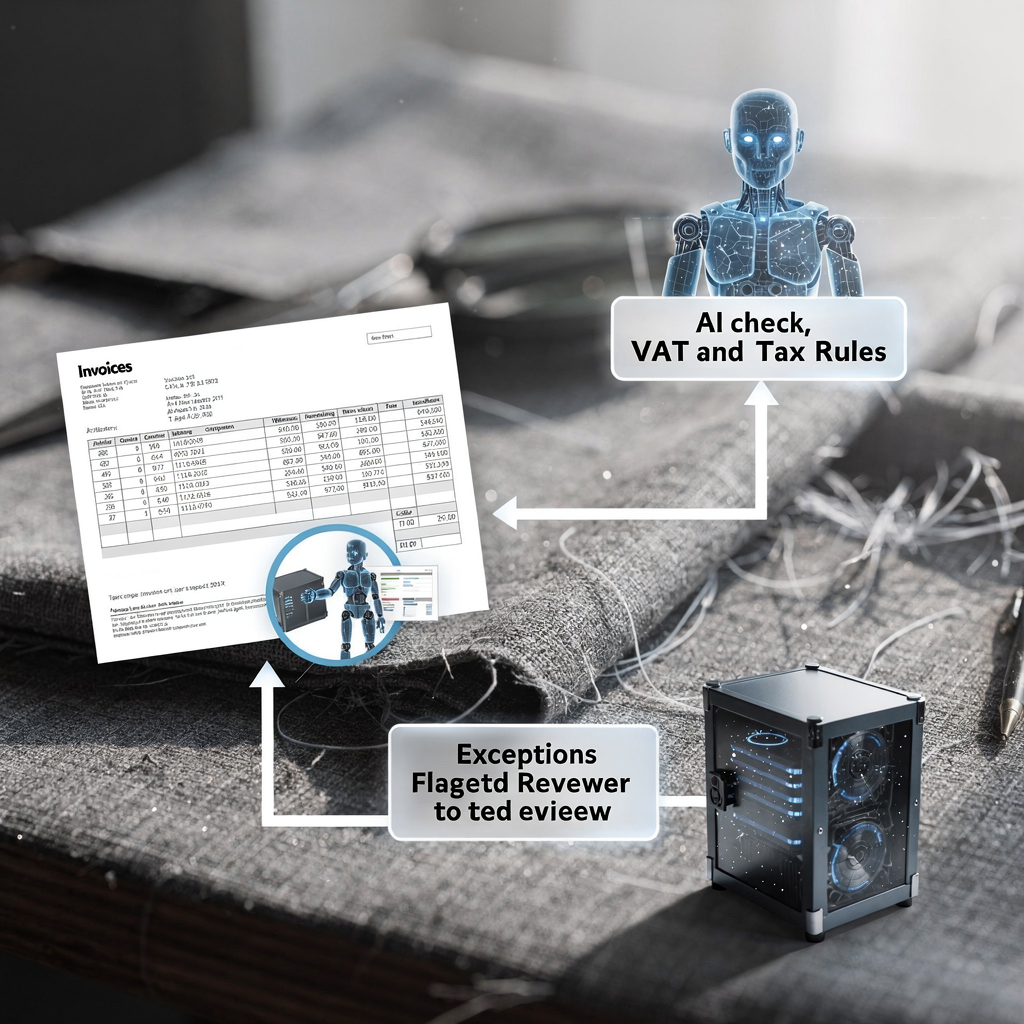
Agents help enforce compliance and produce a tamper-evident audit trail that supports assurance over financial statements. For example, an agent can run VAT and tax filing checks nightly. It can then escalate exceptions for a reviewer. The result is a documented path from raw ledger entries to audit conclusions. This audit trail is crucial for regulators and for external assurance.
Automation of regulatory checks reduces manual burden. Studies show significant budget savings when firms automate compliance. One source notes reductions of over 40% for compliance-related operational budgets (cost study). That saving includes fewer manual reconciliations and faster submission cycles. Agents create logs that are verifiable and traceable, which helps when regulators request evidence.
Example end-to-end scenario: an agent checks VAT rates on sales invoices. It flags mismatches and assembles an evidence pack. Then the auditor reviews the pack and signs a memo that attaches to the financial statements. The audit trail shows who reviewed the exceptions, when they were fixed, and what the final amounts were. This level of traceability supports SOC 2 type reviews and regulator inquiries.
Security and compliance matter for sensitive data. Many firms require that data never leaves secure boundaries. Agents designed for this must run in approved environments and log every action. Ensuring ai governance and access controls reduces the risk of leaks. For finance teams that handle high volumes of operational email evidence, integrating agents with secure stores streamlines control while protecting sensitive data scale logistics operations.
What to do next:
1. Define compliance mandates and map them to agent checks. 2. Require verifiable audit logs and an audit trail for each automated step. 3. Test an end-to-end scenario for one area of financial reporting before wider rollout.
Drowning in emails?
Here’s your way out
Save hours every day as AI Agents label and draft emails directly in Outlook or Gmail, giving your team more time to focus on high-value work.
automate, analytics, use cases
High-value use cases show measurable benefit. Agents detect fraud through pattern-based anomaly detection. They automate accounts payable and receivable processes. They structure unstructured data, such as email attachments, and draft audit memos with context. These use cases combine automation with analytics and reduce time on time-intensive tasks.
Short case-study snippets clarify impact. A vendor payment anomaly was detected by an agent that scanned payments and supplier histories. The agent flagged a discrepancy and saved the auditor four hours of manual work. A second case used a custom ai agents setup to extract shipping invoices and reconcile them to contracts. That agent saved both time and errors in the vendor reconciliation process.
Adoption stats matter. Seven out of ten companies now consider AI agents their primary automation lever (industry report). That shift reflects confidence in ai-driven audit automation and in analytics that scale across ledgers. Firms that adopt intelligent automation often report faster close cycles and better control coverage.
Examples of use cases include continuous control testing, fraud detection based on patterns, accounts payable automation and generative drafting of working papers. Each case benefits from multiple specialized agents and from machine learning models that learn patterns over time. For teams handling high email volumes, automated logistics correspondence examples show how email can feed audit evidence and reduce manual triage automated logistics correspondence.
What to do next:
1. Choose two use cases that will yield clear hours or cost savings. 2. Measure baseline performance and detection rates. 3. Run pilots and capture analytics to prove value and to refine models.
next for ai, future of audit, learning agents
Scaling remains a challenge. About 90% of organizations report difficulty scaling AI agents effectively (industry stat). Therefore, the next phase for ai in audit focuses on learning agents, governance and ROI measurement. Learning agents will adapt based on feedback and improve detection without constant reprogramming.
Risks require controls. You need an ai governance framework, evaluation metrics and clear audit logs. The EU AI Act and other rules will affect audit teams. Audit teams should plan for compliance mandates and for security and compliance reviews. A governance checklist must cover model validation, access controls and traceability.
Key recommendations are practical. Start with purpose-built, specialized ai agents that integrate with your systems. Measure accuracy, time saved and audit trail completeness. Use a pilot-to-scale roadmap: prove the model on one process, add provenance and then expand. Capture KPIs for audit planning, detection rates and reviewer time.
Final action items for a finance leader:
1. Build agents that run in a controlled environment and log audit logs for review. 2. Define KPIs for the pilot and track them closely. 3. Create a roadmap to build agents, add learning agents and then scale with enterprise governance.
FAQ
What is an AI agent in auditing?
An AI agent is a software component that performs tasks such as data ingestion, analysis and drafting. It acts on rules and models to assist auditors while keeping humans in the loop.
How do agents improve audit efficiency?
Agents automate repetitive work like reconciliations and sampling. As a result, auditors spend more time on judgement and complex risk assessment.
Are auditors at risk of being replaced by AI?
No. Leading reports say AI amplifies auditors rather than replaces them. Human auditors still validate conclusions and handle nuanced judgement.
What is an agentic workflow?
An agentic workflow chains planner and execution agents to complete tasks. It includes human feedback and governance points to keep work verifiable.
How do agents support compliance?
Agents run regulatory checks automatically and produce traceable evidence. They create a verifiable audit trail that supports financial statements and regulator requests.
Can agents handle sensitive data?
Yes, when deployed in secure environments with access controls. Firms should require that data never leaves approved systems and that every action is logged.
What metrics should audit teams track?
Track detection accuracy, time saved, and audit trail completeness as primary KPIs. Also measure reviewer time and error reduction for ROI.
How do learning agents work in auditing?
Learning agents refine rules based on feedback and detection outcomes. Over time, they reduce false positives and improve risk assessment.
What governance is needed for AI agents?
Governance must include model validation, access control, provenance and audit logs. Regular reviews and change control reduce risks from emerging ai.
How should firms start with AI agents?
Start with a high-value, time-intensive process and run a short pilot. Define provenance, measure impact and then scale with proper ai governance and controls.
Drowning in emails?
Here’s your way out
Save hours every day as AI Agents label and draft emails directly in Outlook or Gmail, giving your team more time to focus on high-value work.