


fleet: ai agents in fleet management reshaping fleet management systems
AI agents in fleet management are intelligent software actors that sense, infer and act on data from vehicles. First, they ingest telematics and sensor data. Then, they apply machine learning models to predict failures, spot inefficiencies and suggest fixes. Also, these agents can trigger actions, such as creating maintenance work orders or nudging drivers with coaching prompts. For fleets, this flow turns raw inputs into measurable gains. For example, predictive maintenance can cut downtime by about 30% (Springer). Also, route optimization yields 10–15% fuel savings in many deployments (ScienceDirect). These two facts alone drive KPIs that fleet managers and executives track daily.
Next, consider the mechanics. Telematics streams GPS, engine fault codes and idle time. Then, AI models correlate patterns across the entire fleet. As a result, teams see which vehicles need attention. Also, teams learn which routes waste fuel. This process links to uptime, fuel per km and on‑time delivery. Therefore, fleets that embrace AI often report faster deliveries and lower operating expenses. A growing body of evidence shows that AI-driven fleet analytics are reshaping how logistics and public transit operate (ResearchGate).
For instance, a logistics operator used AI agents to reorganize preventive servicing. As a result, the operator reduced unexpected breakdowns and cut repair costs. Meanwhile, a public bus network applied AI to balance routes and schedules. Consequently, buses used less fuel and stayed on time. Also, these projects highlight how AI-powered fleet solutions produce tangible outcomes. To help you focus, measure uptime, fuel per km and on‑time rate first. Finally, track maintenance cost and customer satisfaction after you deploy agents.
Importantly, to transform fleet systems you must connect data sources early. Also, define clear KPIs before you automate. If you do, AI agents will turn telematics and fleet data into predictable improvements. Lastly, discover how AI agents can automate operational email workflows with contextual data to speed decisions and reduce manual triage by linking to practical tools such as our logistics email AI resources logistics email drafting AI and the virtual assistant for logistics page virtual assistant for logistics.
ai: agentic ai and ai agent roles in fleet operations
Agentic AI means systems that act autonomously within guardrails. First, an AI agent monitors telematics and performance. Next, it recommends fixes and, when authorized, acts. For example, agents in fleet management can monitor engine fault codes and then create a repair ticket. Also, they can reroute a vehicle when a road closure appears. In practice, roles split into three clear functions: monitor, recommend and act. Monitor gathers real-time signals. Recommend proposes actions and priorities. Act executes low-risk operations under policies. This split helps fleet managers keep control while gaining speed.

Agentic AI supports autonomous functions like dynamic routing, automated dispatch and real‑time anomaly detection. Also, generative AI can draft messages and notifications when human review is needed. For instance, agents can do dynamic route planning to avoid delays and reduce fuel consumption. Also, agents can assign a nearby mechanic if a sensor flags an imminent failure. When deployed well, AI improves response times and frees teams to focus on strategy.
However, risks exist. Data privacy must remain central. Also, transparency and audit trails are required so humans can review decisions. Therefore, keep a human-in-the-loop for high‑impact actions. For governance, document thresholds, escalation rules and access controls. In addition, design fallback behaviors for edge cases. To simplify adoption, automate low-risk tasks first. A quick checklist: first automate alerting and scheduling. Next automate low-risk rerouting and routine dispatch. Finally, add automated drafting for customer emails by leveraging tools that ground replies in operational systems, such as our automated logistics correspondence workflows automated logistics correspondence.
Also, agents can make decision-making faster. They act on structured data from telematics and ERP systems. As a result, operations become consistent and auditable. Agents in fleet management need clear SLAs. Also, they require versioned models and continuous validation. To avoid vendor lock-in, choose platforms with open APIs and defined data export paths. In short, agentic AI can reshape operations while keeping humans firmly in control.
Drowning in emails?
Here’s your way out
Save hours every day as AI Agents label and draft emails directly in Outlook or Gmail, giving your team more time to focus on high-value work.
fleet solutions: telematics, predictive maintenance and actionable insights to transform fleet operations
Telematics is the foundation for predictive maintenance and actionable insights. First, telematics captures GPS, engine fault codes and driver behavior. Then, AI analyzes those signals to predict failures before they happen. As a result, teams reduce downtime and lower maintenance cost. In fact, predictive maintenance can reduce downtime by up to 30% and cut maintenance costs by roughly 20% (Springer). Also, companies that apply route optimization report fuel savings of 10–15% (ScienceDirect).
Next, practical outputs matter. AI produces maintenance windows, parts inventory alerts and driver coaching prompts. Also, it generates automated work orders that integrate with maintenance systems. For example, an agent spots a rising coolant temperature. Then, it creates a prioritized service ticket and reserves the needed part. As a result, MTTR falls and uptime rises. These actions create actionable insights that work teams can act on immediately.
Also, prioritize signals that give the biggest ROI. Start with engine fault codes, idle time and harsh braking events. Next, add fuel efficiency metrics and route deviation. If you focus on high‑value signals first, you see savings faster. Additionally, ensure your telematics platform supports data export and API access. For instance, fleet management platforms such as Geotab provide robust device integration and open connectors that many teams use to enable analytics (LeewayHertz). Also, combine telematics with ERP and spare‑parts data to avoid stockouts and reduce lead time.
To streamline operations, integrate AI agents that surface actionable insights in dashboards and email workflows. For example, virtualworkforce.ai can convert operational emails into structured data and route them to the right team, which complements telematics-driven alerts and reduces manual triage ERP email automation for logistics. Finally, measure impact with clear KPIs: downtime, maintenance cost, arrival variance and fuel per km. These metrics prove how telematics plus AI transform fleet operations into predictable, measurable processes.
fleet technologies: automate workflows with agents in fleet management and fleet management systems
Map the technology stack to see where to automate. First, vehicles send sensor data to telematics modems. Next, telematics streams feed a cloud data lake that stores structured and semi-structured records. Then, AI agents consume that data to generate alerts, predictions and automated tasks. Finally, fleet management systems receive the outputs and enforce actions. This pipeline shows how AI integrates end to end. Also, it highlights why APIs and data standards matter.
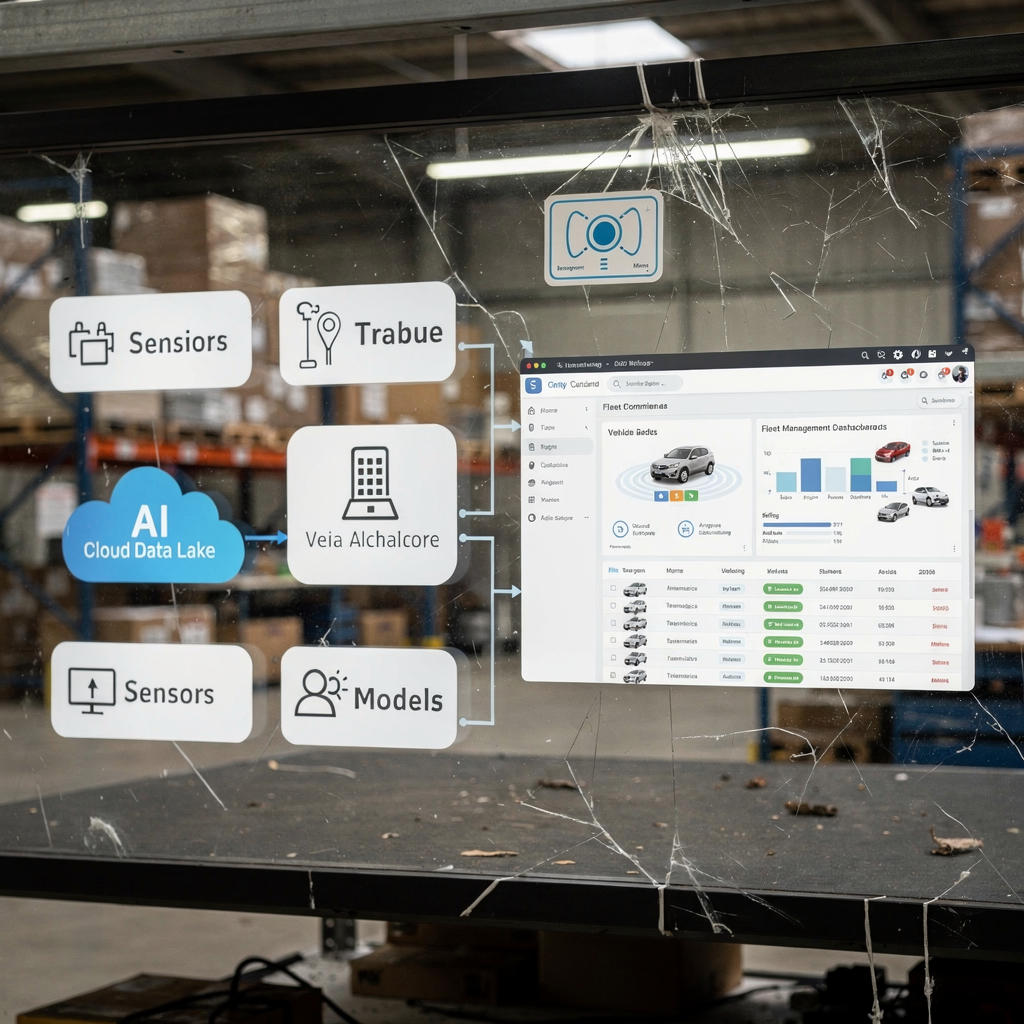
Also, automation examples are concrete. AI agents can auto‑create service orders when predictive models flag failures. In addition, agents can generate compliance reports and populate hours‑of‑service logs automatically. Next, they can reassign trips if a vehicle becomes unavailable. These automations reduce manual work and enforce consistency. To integrate, use APIs and middleware that translate protocols between telematics vendors and fleet management systems.
Edge vs cloud processing is a key design choice. Edge processing reduces latency and keeps sensitive data local. For example, anomaly detection at the edge can stop a vehicle from continuing on a risky path. However, cloud processing enables large‑scale model training and historical analytics. Therefore, use a hybrid design: run lightweight models at the edge and heavy analytics in the cloud. Also, ensure data governance and encryption across both layers.
Implementation follows stages. First, pilot a single use case with a small fleet. Next, measure outcomes and iterate on thresholds and actions. Then, scale to the entire fleet and add continuous learning cycles. Also, maintain a clear rollback plan. Finally, train operators, document SOPs and set guardrails for any autonomous agents. For email and operational communications, pairing AI agents with tools that automate the full email lifecycle can simplify how teams handle exceptions; see advice on scaling logistics operations with AI agents how to scale logistics operations with AI agents.
Drowning in emails?
Here’s your way out
Save hours every day as AI Agents label and draft emails directly in Outlook or Gmail, giving your team more time to focus on high-value work.
ai in fleet management: cost, safety and compliance — real-world KPIs for fleet operators
Track the right KPIs to show value. First, measure downtime and MTTR. Next, track fuel per km and accidents per million km. Also, monitor on‑time rate and regulatory violations to evaluate compliance. These metrics tell a complete story about cost, safety and compliance. For many operators, AI adoption reduces downtime by up to 30% and cuts maintenance costs around 20% (Springer). In addition, companies report fuel savings via route optimization of 10–15% (ScienceDirect).
Also, safety improves through continuous monitoring. AI systems flag risky driving and predict failures before they occur. As Dr. Karmakar notes, “AI-powered solutions are enabling more efficient traffic management systems that minimize delays and optimize routes” (ScienceDirect). In practice, driver coaching prompts and automated alerts reduce accidents and violations. For compliance, automated hours‑of‑service tracking and audit trails make inspections simpler and faster.
A simple ROI framework helps justify projects. First, calculate payback time from reduced downtime and fuel savings. Next, add cost avoidance from prevented failures and regulatory fines. Also, include productivity gains when agents automate routine emails and dispatch tasks. For instance, operations teams using email automation cut handling time dramatically and improve response accuracy automate logistics emails with Google Workspace and virtualworkforce.ai. Finally, present net savings over 12–24 months and set target KPIs for each deployment.
Also, track implementation metrics such as model accuracy, false positive rate and time to resolution. These metrics keep agents aligned with human expectations. Importantly, balance automation with oversight. For compliance-heavy tasks, use human review for edge cases. Overall, AI in fleet management helps reduce costs, improve safety and maintain compliance while delivering measurable business impact.
ai fleet management: steps to reshape operations, deploy ai agents and deliver actionable change
Start with a clear roadmap. First, assess data readiness. Check telematics coverage, data quality and integration points. Next, choose a pilot use case that targets high ROI, such as predictive maintenance or alert automation. Then, deploy an AI agent in a controlled environment. Measure outcomes, iterate on thresholds and expand coverage. Also, set change management plans so staff adopt new processes smoothly.
Also, train teams and update SOPs. Provide role‑based training for fleet managers and technicians. Next, define escalation rules and set thresholds for agent actions. For example, allow agents to create work orders for low-risk faults but require human approval for major repairs. In addition, map how agents will escalate customer notifications and create structured data that feeds back into ERP and TMS systems. If you need help with automating customer or operations emails, our guide on improving logistics customer service with AI shows practical steps how to improve logistics customer service with AI.
Also, mitigate common barriers. For poor data quality, build cleansing pipelines and add sensors where gaps exist. For integration gaps, use middleware and standard APIs. For vendor lock‑in, insist on data portability and export formats. Finally, monitor model drift and retrain regularly. Implement continuous learning so agents adapt to seasonal patterns and vehicle changes.
Quick launch checklist: assess telematics coverage, pick a pilot, define KPIs, deploy agent, measure and iterate. Also, report top metrics to leadership: downtime, MTTR, fuel per km, on‑time rate and safety incidents. These metrics show ROI and support further investment. To transform your fleet effectively, combine AI agents with process automation that simplifies operational email and task workflows. For operational teams buried in emails, consider our resources on scaling logistics operations without hiring to simplify adoption and deliver fast wins how to scale logistics operations without hiring.
FAQ
What are AI agents in fleet management?
AI agents in fleet management are software systems that monitor vehicle sensors, analyze data and take predefined actions. They can alert teams, recommend repairs or automate routine tasks while keeping humans in control.
How much downtime can predictive maintenance save?
Predictive maintenance can reduce downtime by about 30% in many studies. Savings depend on data quality, coverage and how quickly teams act on agent alerts (Springer).
Can AI improve fuel efficiency?
Yes. Route optimization and driver coaching typically yield 10–15% fuel savings. Combined with idle reduction and better routing, these measures lower fuel consumption and costs (ScienceDirect).
What is agentic AI and why does it matter?
Agentic AI refers to systems that act autonomously under defined rules. It matters because it lets fleets automate decisions like creating work orders or rerouting, while maintaining governance and human oversight.
How do telematics and AI work together?
Telematics provides GPS, engine codes and driver behavior data. AI uses that input to produce predictions, alerts and automated actions. This combination drives actionable insights for maintenance and operations.
How should I start an AI pilot for my fleet?
Begin by assessing data readiness and choosing a high‑ROI use case such as predictive maintenance or alert automation. Then pilot with a small segment, measure outcomes and iterate before scaling.
How do AI agents affect compliance?
AI agents automate hours‑of‑service logging, generate compliance reports and create audit trails. They reduce manual errors and help fleets meet regulatory requirements more consistently.
What are common implementation barriers?
Common barriers include poor data quality, integration gaps and resistance to change. Mitigate these by improving data pipelines, using middleware and running targeted training for staff.
Can AI help with operational emails and tasks?
Yes. AI platforms can automate email triage, route messages and draft context‑grounded replies by pulling data from ERP and TMS. This reduces manual triage and speeds resolution for logistics teams virtual assistant for logistics.
What KPIs should I report to leadership?
Report downtime, MTTR, fuel per km, on‑time rate and safety incidents. Also include ROI metrics like payback time and cost avoidance from prevented failures to show clear business impact.
Drowning in emails?
Here’s your way out
Save hours every day as AI Agents label and draft emails directly in Outlook or Gmail, giving your team more time to focus on high-value work.