


AI and AI agent: clear roles for gas distribution today
AI means software that learns from data to make decisions. An AI agent acts as an autonomous worker inside that software. Together they monitor, decide, and act across a gas distribution network. First, they gather SCADA values, pressure and flow sensor data, and smart meter reads. Next, they combine market prices, weather data and CRM records to form a single view for planners.
In gas distribution a clear split appears. Some systems focus on monitoring and alerts. Others act on those alerts and recommend fixes. An AI agent can flag a pressure drop and then propose a valve action. Then it can create a maintenance ticket or draft an operational email. This workflow reduces human triage and speeds up response.
Targets matter for a gas distributor. Industry pilots in oil and gas show measurable outcomes. Enterprise projects report efficiency gains of 15–25% and annual cost savings above 10% (source). For gas distribution companies, those targets translate into fewer emergency buys, fewer late deliveries, and improved service quality. Useable metrics include cuts unplanned downtime, percentage accuracy in demand plans, and time to resolve customer issues.
Data sources decide how well any AI system performs. SCADA, GIS, ERP, and historical incident logs feed models. Also, high-quality labels and frequent retraining improve anomaly detection. For safety-critical pipelines, explainability and audit trails are essential. An enterprise AI governance program helps here. It sets data management rules, access control, and model validation steps.
Operational teams need clear checklists. First, map data endpoints and latency needs. Second, pilot an AI agent on one feeder or a single city zone. Third, measure baseline downtime and forecast accuracy. Finally, expand in phases with governance and security controls. For teams that want to automate routine tasks such as email triage or dispatch notes, tools like virtualworkforce.ai can automate the full email lifecycle and reduce handling time substantially. See how to automate logistics emails with Google Workspace and virtualworkforce.ai for practical setup and integration.
automation and agentic AI across gas operations and supply chain
Automation reduces repetitive overhead and improves consistency. Agentic AI takes this further by running multi-step actions without human prompts. For gas operations, that combination covers leak detection alerts, supplier reorder triggers, and routing suggestions for crews. Also, agentic AI can manage reorder cadence based on pipeline pressure forecasts and supplier lead times.
Supply chain use cases grow quickly. An AI agent can match demand and supply by reading meter patterns and market signals. Then it can suggest optimized delivery routes and generate purchase orders. This reduces emergency procurement and lowers operational costs. For routing, AI gives route maps that cut miles and time. It helps pipeline crews reach sites faster and reduces idle time.
KPIs improve with targeted pilots. Right‑sizing inventory yields fewer emergency buys. Improved delivery reliability raises customer satisfaction and reduces complaints. An AI-powered IVR and AI chatbot can reduce long wait times for routine queries, which elevates customer engagement and service quality. Use IVR to route callers to the right team, and integrate the bot with CRM to pull account context. Learn more about improving logistics customer service with AI by reviewing implementation patterns.
Technical leads should follow a simple checklist. First, map end-to-end workflows that cause the most manual work. Second, pick a high-value feeder or supplier lane to pilot intelligent automation. Third, ensure the pilot ties into ERP and a GIS for accurate routing. Fourth, measure time saved on each workflow and calculate ROI.

Drowning in emails?
Here’s your way out
Save hours every day as AI Agents label and draft emails directly in Outlook or Gmail, giving your team more time to focus on high-value work.
generative AI, analytics and predictive maintenance for safer networks
Generative AI and analytics change how teams spot faults. Combined, they detect anomalies faster and summarise root causes. A typical flow runs real-time sensor streams through analytics models. Then, a generative model drafts succinct maintenance plans and parts lists. That saves time for technicians and reduces miscommunication during shift handovers.
Predictive maintenance has a proven impact. When models flag wear and predict failure windows, teams plan work before outages occur. Predictive maintenance can reduce unplanned outages by up to ~30% (source). Also, improved demand forecasting can raise accuracy by about 20% (source). These numbers translate into lower emergency dispatch spending and fewer customer interruptions.
Implementation requires discipline. First, ensure sufficient sensor density on the pipeline or compressor station. Second, validate labels for failure modes and maintain a retraining cadence. Third, demand explainability for all actions that affect safety. Regulatory audits require traceable reasons for a control change or a shutdown.
Operators should use a checklist. First, baseline current maintenance spend and outage frequency. Second, instrument the highest-risk assets and run analytics in parallel with standard monitoring. Third, assess the benefits of AI-driven root-cause summaries and adopt them if they increase mean time between failures. For proof points, consider examples such as Chevron’s work using AI to manage reliable energy flows to sensitive facilities (source).
AI-powered ai platform and ai solutions to automate inventory and workflow for gas companies
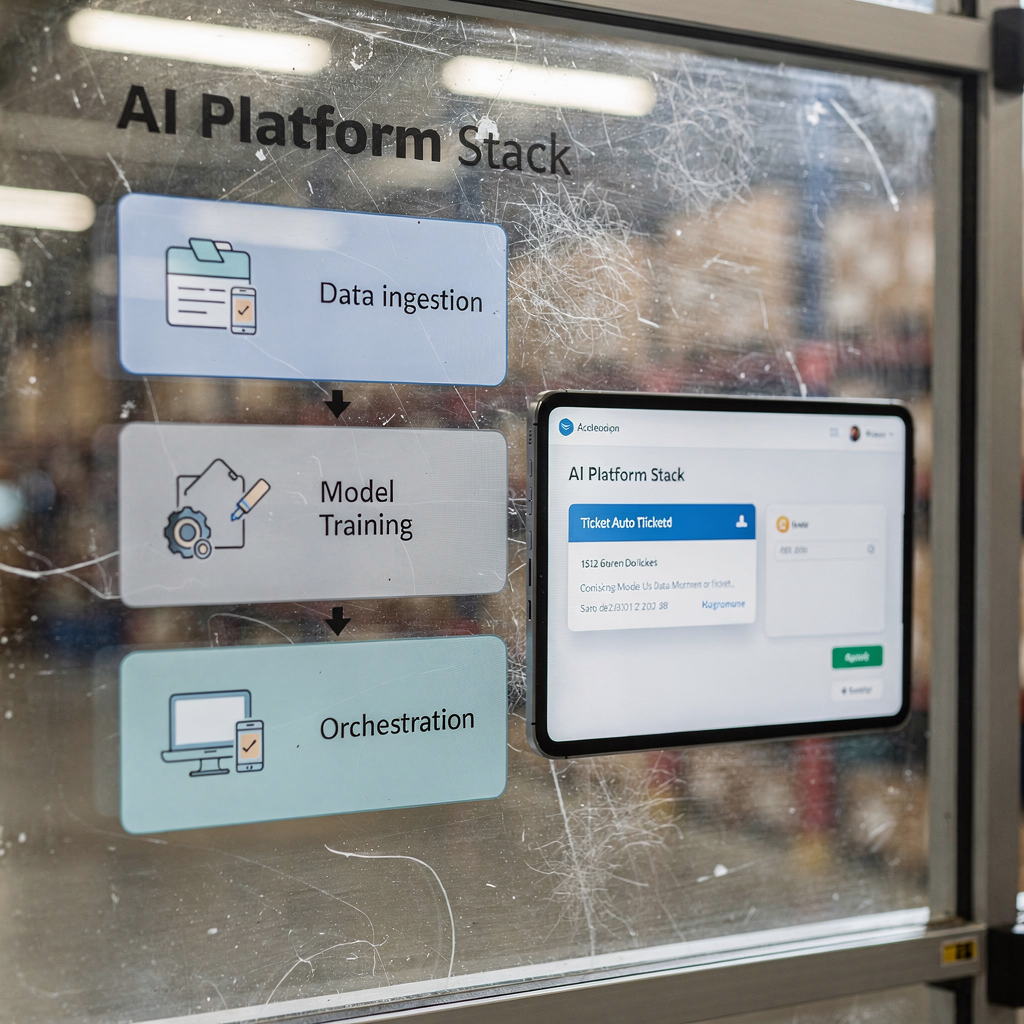
An effective AI platform unites data ingestion, models, orchestration, and a user interface. It connects ERP, TMS and GIS feeds. Then it runs models and pushes results into operational dashboards. An ai platform should respect governance and make it simple for business users to configure rules and escalation paths.
Packaged ai solutions for gas companies include inventory optimisation, automated dispatch, and policy-driven workflow approvals. These solutions can automate routine tasks such as drafting supplier emails, creating purchase orders, and updating inventory counts. For email-heavy teams, an AI agent can manage the full lifecycle of operational email. virtualworkforce.ai provides a no-code setup that links ERP, TMS, WMS and SharePoint to automate email handling and reduce manual triage. Explore the virtual assistant logistics page for more detail on mailbox automation and workflows.
Integration matters. Tie the AI platform into existing systems and validate end-to-end flows. Start with a pilot on high-value feeders. Then expand to other zones. Use a staged rollout to test security and compliance. Also, implement logging for audits and change control. If you want to automate routine tasks without replacing human oversight, configure escalation thresholds and quality gates.
Checklist for technical teams: first, define integration points with ERP and your CRM. Second, choose a pilot workflow and measure baseline cycle time. Third, design automated approvals and routing for exceptions. Fourth, measure ROI and user satisfaction. For practical tools, see guidance on automated logistics correspondence that shows how AI can draft and route messages reliably.
Drowning in emails?
Here’s your way out
Save hours every day as AI Agents label and draft emails directly in Outlook or Gmail, giving your team more time to focus on high-value work.
benefits of ai, roi, enterprise ai and ways to transform customer service with IVR
The benefits of AI for gas distribution are measurable and fast to materialise. For example, demand forecasting improvements near 20% reduce fuel balancing costs. Similarly, center-led pilots show cost savings greater than 10% per year for some deployments (source). Together these gains increase operational efficiency and lower operational costs.
ROI math is straightforward. Measure baseline costs, then measure time or money saved after automation. For an email-heavy operations team, typical handling time drops from about 4.5 minutes to 1.5 minutes per message when an AI agent automates triage and drafting. That frees staff to focus on exceptions and strategic work. For mailbox automation guidance, review automated logistics correspondence to see real examples of gains in throughput.
Customer-facing benefits also add value. An AI-powered IVR or ai chatbot trims long wait times, and improves first-contact resolution. A streamlined IVR routes callers to the right team, which reduces repeat contacts and enhances customer satisfaction. Use personalised outage notifications to keep customers informed. That improves customer engagement and reduce complaint volumes.
Enterprise AI requires governance to scale. Set up model ops, security reviews, and change management. Monitor models for drift and ensure compliance. When scaling, align IT and operations around data contracts and access rules. Energy companies should apply strict security and safety validation. For learning from peers, read Infor’s perspective on autonomous digital workers and design patterns for AI agents (source).
advanced ai technology, industry leaders and gas today — risks, regulation and next steps
Advanced AI technology brings clear promise. It also carries risk. Cyber threats, model failure modes, and regulatory scrutiny need attention. For gas distribution, a faulty recommendation could interrupt supply or cause safety incidents. Therefore, implement rigorous testing, redundancy, and human-in-the-loop controls. Ask whether the agent can explain its recommendation and whether audit logs exist for every action.
Industry leaders already show how to operationalise AI. Chevron’s example of managing reliable energy flows to a data centre is a practical proof point that advanced ai technologies can support critical services (source). Likewise, vendor analyses demonstrate how autonomous agents transform inventory and supply chain tasks (source). These case studies highlight staged rollouts, safety validations, and data governance as keys to success.
Next steps for a gas distribution company are practical. Prioritise pilots with clear ROI and safety margins. Require data governance, including retention and access controls. Conduct security penetration tests and safety validation before any live deployment. Scale incrementally and capture metrics on downtime reduction, forecasting accuracy, and cost savings. For operational email workflows specifically, consider virtualworkforce.ai for automating email triage and response and to streamline handoffs between teams.
Checklist for leadership: first, pick one high-impact workflow to automate. Second, assign data owners and set governance. Third, require external security reviews. Fourth, track ROI and service metrics. Finally, plan for continuous retraining and monitoring. Done well, intelligent agents and agentic AI can elevate service, reduce inefficiency, and help energy companies meet stricter compliance and safety demands.
FAQ
What is an AI agent in the context of gas distribution?
An AI agent is an autonomous software worker that performs tasks such as monitoring sensors, recommending repairs, or drafting supplier emails. It combines models, data feeds, and rules to act or to escalate when human oversight is needed.
How much can predictive maintenance reduce unplanned outages?
Predictive maintenance with AI can cut unplanned outages by up to about 30% according to industry findings (source). That leads to fewer emergency repairs and lower maintenance spend over time.
What data sources do AI systems need for gas operations?
Key sources include SCADA, pressure and flow sensors, meter reads, ERP, GIS and market price feeds. Also, historical incident logs and CRM records improve situational context and model accuracy.
How can gas distributors automate email workflows safely?
Start by mapping frequent email types and then pilot a solution that reads intent, ground replies in ERP data, and routes exceptions to people. virtualworkforce.ai offers a no-code way to automate the full email lifecycle while keeping control and traceability.
Are there examples of energy companies using AI in operations?
Yes. Chevron used AI to manage energy supply reliably for data centres, showing how models can manage demand spikes and energy flows (source). These projects illustrate staged testing and strong governance.
What governance is needed for enterprise AI in gas?
Governance should cover data management, model validation, access control, audit logs, and retraining schedules. It must also include security testing and compliance checks before models act on live systems.
Can AI improve customer service for gas consumers?
Yes. AI-driven IVR and ai chatbot systems can reduce wait times and provide personalised outage notifications. That improves customer satisfaction and lowers repeat contacts for simple issues.
How do I measure ROI for an AI pilot?
Measure baseline metrics such as downtime, manual hours per workflow, and wrong-order rates. After the pilot, measure the change in those metrics and translate time saved into cost savings to calculate ROI.
What are the main risks of deploying agentic AI in gas networks?
Risks include cyber attacks, incorrect recommendations, model drift, and lack of explainability. Mitigate them with human-in-the-loop checks, redundancy, strict access controls, and continuous monitoring.
Where can I learn more about automating logistics communications with AI?
Explore our resources on automated logistics correspondence and how to automate logistics emails with Google Workspace and virtualworkforce.ai for hands-on guides and deployment examples. Also see guidance on how to improve logistics customer service with AI for customer-facing use cases.
Drowning in emails?
Here’s your way out
Save hours every day as AI Agents label and draft emails directly in Outlook or Gmail, giving your team more time to focus on high-value work.