


hospitality — What AI agents mean for guest service and the guest journey
Hospitality and modern guest service increasingly depend on AI agents to manage routine interactions and to shape the guest journey. An AI agent is a software assistant that answers questions, handles booking requests, and routes tasks to staff. These assistants operate 24/7 and can reduce response times by up to 50%, which lets hotel staff focus on higher‑value work rather than repetitive tasks (AI For Hospitality: Balancing Automation with Human Touch). Use of AI search and virtual assistants has risen fast; roughly 15% of US travellers relied on AI platforms for travel planning in 2025, reflecting growing consumer trust (5 key steps to optimize your hotel website for AI search). Hotels that combine AI agents with revenue management tools report uplifts in revenue that typically range from 5% to 20% (Top 10 AI Tools Revolutionizing Revenue Management). The 2025 State of Hotel Guest Technology report notes that AI agents increase direct bookings by converting visitors during the browsing session (How Hotels Use AI Agents to Increase Direct Bookings). In short, hospitality leaders now deploy AI to streamline operations, to enhance guest experience, and to grow direct sales while keeping staff focused on the personal touches that matter.
ai agent / ai agents in hospitality — Core use cases that automate booking and guest service
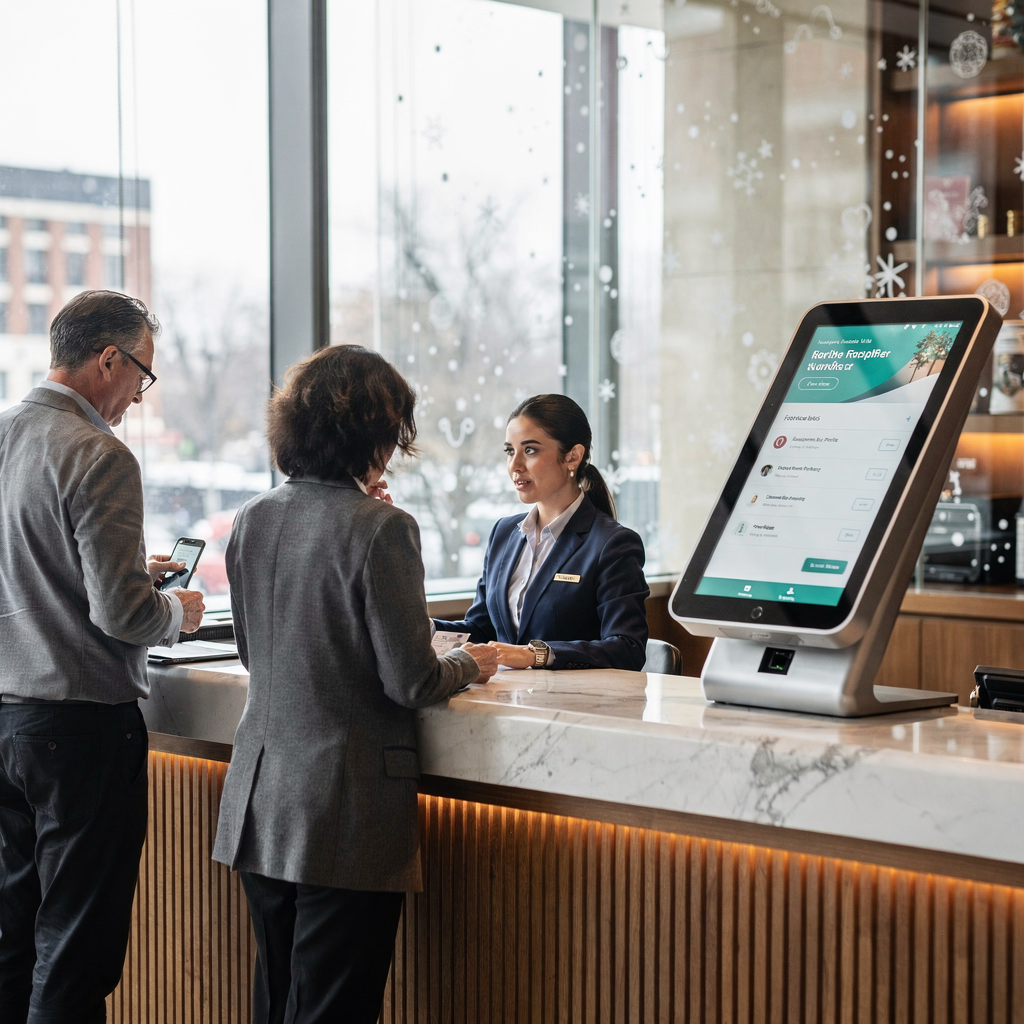
AI agents in hospitality handle multiple tasks that once required human time. First, they engage website visitors to boost direct booking conversion. Second, they provide personalised recommendations before and during a stay. Third, they answer common guest inquiries so staff can tackle complex issues. Fourth, they assist with smart booking and travel changes across airline and hotel ecosystems. For example, airlines such as KLM and Emirates use chat systems to smooth passenger interactions and to update itineraries quickly (AI Agents for Smart Booking in Travel & Hospitality). A short list of live use cases shows how these systems work in real time.
– Website chat that converts visitors with targeted offers and instant booking support. This reduces third‑party commission and increases direct bookings. – Personalised pre‑stay upsell that uses guest profiles and past guest history to suggest room upgrades, dining packages, and activities. – Automated check‑in/out messages that confirm arrival times, verify payment, and reduce queues at the front desk. – Itinerary updates and smart booking assistance that rebook flights and notify guests when plans change. – 24/7 digital concierge and multilingual support that answers FAQs, handles basic requests, and escalates when needed.
These examples show how chatbots and voice agents can automate routine touchpoints while preserving personalised service. The benefits extend across the hospitality industry and help hotel operations become more scalable and consistent. The approach requires careful design and integration, but it clearly improves guest service and reduces repetitive tasks for hotel teams.
Drowning in emails?
Here’s your way out
Save hours every day as AI Agents label and draft emails directly in Outlook or Gmail, giving your team more time to focus on high-value work.
use case — Dynamic pricing, revenue management and guest personalisation
Dynamic pricing and revenue management are central use cases for hospitality AI systems. These tools use demand signals, competitor rates, booking pace, and forecast models to adjust prices in real time. That means hotels can improve RevPAR by reacting faster to market changes. Industry studies report revenue uplifts in the 5–20% range for hotels that integrate AI into revenue management systems (Top 10 AI Tools Revolutionizing Revenue Management). Forecast accuracy supports smarter inventory decisions. Forecast and segmentation drive targeted offers. For example, a hotel can give a loyalty guest a personalised service offer at booking that increases conversion and average daily rate.
AI systems ingest channel data and management systems data. Then they recommend price changes and distribution moves. The system can also flag when occupancy trends differ from the expected pattern. That allows staff to react, to add packages, or to reduce rates to protect occupancy. Agents can deliver segmented offers to specific guest profiles. They can automatically present an upgrade at checkout or in a pre‑arrival email.
Personalisation complements dynamic pricing. Guest profiles, guest history, and past guest reviews feed the model. The result is a coherent guest journey from booking to checkout. That journey enhances guest satisfaction and increases direct bookings. Hotels that combine revenue management and personalisation find that automation supports both higher revenue and better guest experience. The approach reshaping hotel operations requires good data hygiene and integration with PMS and CRM systems.
ai agents work / agents work — Tech, integration and agentic AI in operations
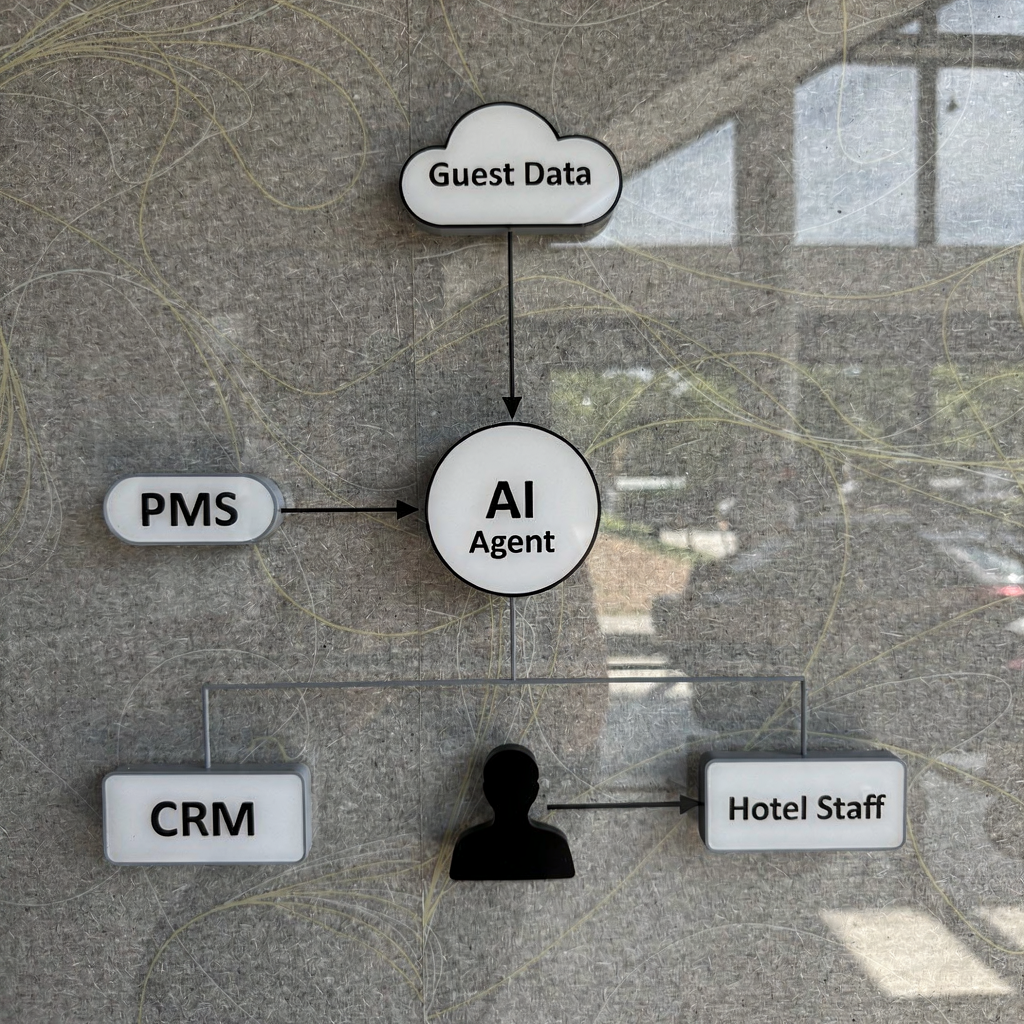
Agents work best when they connect cleanly to core hotel tech. A typical architecture links webchat and voice channels to an agent layer, then to PMS, CRM and channel managers via APIs. Data flows from guest profiles and reservations into the agent. The agent then reads the data and acts. Agentic AI refers to systems that not only assist but also execute multi‑step tasks, such as rebooking and notifying housekeeping. Agentic AI can trigger a workflow that updates the PMS, creates a task for the hotel staff, and sends a confirmation email.
Integration is the practical barrier. Existing systems often include legacy management systems and multiple external channels. Plan for staged pilots and clear escalation paths. Human‑in‑the‑loop escalation ensures agents do not handle complex or sensitive requests without staff oversight. A simple diagram captures the flow: data → agent → PMS/CRM → human. That shows how agents work and how to keep staff in the loop. Interoperability with existing systems is the main adoption hurdle, so choose vendors who understand how to connect to PMS and CRM. Our company helps operations teams automate the email lifecycle, linking ERP and operational docs to replies so that agents can act on ground truth quickly. See how teams can automate emails and reduce handling time in operational contexts like logistics and bookings (ERP email automation for logistics).
In practice, deploy small pilots first. Start with single channels or with common front desk tasks. Measure performance, iterate, and scale. Voice agents and AI phone assistants add further options where people prefer to call. Respect data governance and guest privacy at every step. Overall, agentic ai and well‑planned integration let hospitality teams automate routine work while retaining control and traceability.
Drowning in emails?
Here’s your way out
Save hours every day as AI Agents label and draft emails directly in Outlook or Gmail, giving your team more time to focus on high-value work.
automate — Benefits of AI agents for hospitality professionals and businesses
Benefits of AI agents are measurable and practical. Agents improve response speed, and they cut the load of repetitive tasks for hotel staff. Chat response times and email handling often fall dramatically; some teams report up to a 50% drop in manual response time (AI For Hospitality: Balancing Automation with Human Touch). As a result, staff to focus on more complex guest needs and to deliver personalised service. The benefits include higher conversion on direct booking offers, fewer calls to the front desk, and improved guest satisfaction. In short, these systems support faster, scalable guest service across many channels.
One simple ROI example helps illustrate value. If agents reduce routine queries and email handling hours, the operation saves FTE cost. Combine that with a 5–20% uplift in revenue through better pricing and direct booking optimisation, and the payback period often falls between 6 and 18 months. The math changes by hotel size, but the direction is clear: fewer manual tasks, more direct bookings, and higher yield. Automation also reduces errors by routing requests and by grounding replies in management systems.
AI agents help hospitality businesses scale without a proportional increase in staff. They can offer multilingual support and consistent answers. They create structured data from conversations that improves future interactions and guest history records. These improvements help the hotel chain maintain consistent standards and to enhance guest experiences across properties. If you want to discover how ai agents can cut email handling in operations, see our resources on scaling logistics with AI agents and improving customer service with AI (How to scale logistics operations with AI agents).
hospitality leaders — How hospitality businesses should adopt and scale AI solutions
Hospitality leaders must treat AI projects as operational programmes, not as point tools. First, assess the guest journey to identify repeatable tasks to automate. Next, run a narrow pilot, for example a booking chat or an automated check‑in flow. Measure the pilot with clear KPIs such as response time, conversion on direct bookings, average booking value, and NPS. Focus on tangible outcomes and iterate quickly. Hospitality professionals should select vendors who prioritise integration with existing systems and who can deploy agents safely.
Choose vendors that offer full control and clear governance. Our experience with virtualworkforce.ai shows the value of linking agents to ERP and operational documents, which reduces lookup time and improves accuracy. For practical steps, map processes that cause frequent guest asks and identify emails or messages that can be automated without losing the human touch. Then deploy a pilot, measure effect, and expand. See practical guidance on improving customer service with AI in related contexts (how to improve logistics customer service with AI).
Risks and mitigations are straightforward. Protect guest data and privacy, and comply with regional rules. Preserve human oversight for high‑sensitivity tasks and set escalation rules. Train hotel teams and front desk staff to work with the assistant so that the experience remains personalised. Use a phased rollout and keep analytics visible to hospitality teams. Finally, turning to AI must always prioritise guest experience and measurable outcomes. If you want tools for operational email and task automation that link to hotel workflows, review solutions that automate logistics emails and can be adapted to hospitality operation needs (automated logistics correspondence).
FAQ
What are AI agents for hospitality?
AI agents for hospitality are software assistants that automate routine guest interactions, booking tasks, and operational messages. They connect to hotel systems and can answer queries, book rooms, and update reservations in real time.
How do AI agents improve guest service?
AI agents improve guest service by reducing response times and by providing consistent answers across channels. They free hotel staff to focus on personalised service and complex guest needs.
Can AI agents increase direct bookings?
Yes. AI agents can increase direct bookings by engaging website visitors with personalised offers and immediate booking help. Industry reports show that AI‑assisted engagement improves conversion on hotel websites.
What is dynamic pricing and how do agents use it?
Dynamic pricing is the real‑time adjustment of rates based on demand and market data. Agents work with revenue management tools and forecast models to suggest price moves that protect occupancy and maximise revenue.
Are AI agents a replacement for hotel staff?
No. AI agents aren’t a replacement for staff. They handle repetitive tasks and allow hotel staff to focus on tasks that require human judgement and personalised service.
How do AI agents integrate with PMS and CRM?
Agents integrate via APIs and middleware that link the chat or voice layer to PMS and CRM. This connection enables the agent to read guest profiles and to update reservations with traceability.
What metrics should hospitality leaders monitor?
Measure response time, conversion rate on direct bookings, average booking value, NPS, and tasks automated. Track ROI and staff time saved as well.
Is data privacy a concern with AI agents?
Yes. Data privacy and compliance must guide any deployment. Ensure vendors support data governance and that human oversight exists for sensitive requests.
Can AI agents handle multilingual guest inquiries?
Many agents include multilingual support to serve international guests. They can translate and respond in multiple languages, which improves service for diverse guest profiles.
How quickly can hotels deploy AI agents?
Deployment time varies. Narrow pilots can launch in weeks, and scaled rollouts often take months. Start small, validate results, and then expand based on measured outcomes.
Drowning in emails?
Here’s your way out
Save hours every day as AI Agents label and draft emails directly in Outlook or Gmail, giving your team more time to focus on high-value work.