


ai agent and agentic: clear definitions and why they matter
An ai agent is an autonomous software programme that senses, plans and acts inside a system. It gathers signals, makes choices and takes steps without constant human direction. In plain language, an ai agent is like a factory supervisor that watches every machine, forecasts what will break, and then schedules interventions. An agentic approach means the system can reason across tasks and pursue goals, not just follow fixed rules. The term agentic highlights capabilities where software plans, delegates and adapts rather than merely automating simple tasks.
Traditional automation often follows static scripts. In contrast, an ai agent continually learns from data. It uses models that adapt to new conditions, and so can act autonomously when events change. This difference matters for modern industrial ai because factories and logistics hubs face frequent variability. An agentic system can reroute a shipment or rebalance production on the fly. It can also decide to escalate to a human when necessary, keeping human intervention minimal.
To be practical, an ai agent must integrate with existing systems. It needs access to ERP and MES. It also needs connectors to logistics and warehouse systems. For teams that send and receive many emails about orders, a no-code ai email assistant ties data to replies and speeds responses. Read more about using AI inside email workflows for logistics at our virtual assistant logistics page virtualworkforce.ai/virtual-assistant-logistics/. That integration reduces manual lookups.
Fact: agentic features in enterprise applications are set to grow rapidly. Industry forecasts show a jump in agentic capabilities across software platforms over the next few years, and those shifts will shape how industrial companies adopt AI. For context on expectations versus reality for AI agents, see IBM’s assessment of the space AI Agents in 2025: Expectations vs. Reality – IBM.
Simple analogy: a control agent in a plant is like a seasoned operator who can intervene, communicate and coordinate. That operator uses sensor data, applies an algorithm, and takes corrective action. The metaphor helps teams accept change. It eases the move from rule-based automation to agentic ai approaches. The result is faster responses, fewer defects and clearer audit trails.
supply chain and agentic ai: adoption, impact and forecasts
Adoption of agentic ai across the supply chain is accelerating. As of 2025, roughly 46% of organisations report some AI in their supply chain functions, and that number is trending up AI in Supply Chain: A Strategic Guide [2025-2030] | StartUs Insights. Forecasts show one key shift: by 2028, about one in three enterprise software applications will include agentic AI features. That proportion was under 1% in 2024 and is rising fast, which suggests urgent strategic choices for procurement and IT leaders How AI Helped Regal Rexnord Streamline Global Supply Chains.

Survey evidence backs the forecasts. Seventy-three per cent of respondents believe the use of ai agents will give a competitive advantage within a year, and 75% expect AI to be critical to operations. PwC summarised this outlook precisely when it said the “how organisations use AI agents will be a defining factor in gaining competitive advantage in the coming year” AI agent survey: PwC. Gartner also projects that AI will support the vast majority of data-driven decisions in supply functions very soon, reinforcing the need to prepare data and governance How AI Is Transforming Supply Chain Management – Gartner.
Key metrics to watch are clear. First, reduce lead times and stockouts. Second, lower inventory carrying costs and improve fill rates. Third, increase service levels while trimming logistics spend. When a business seeks to optimize supply chain flows, agentic ai can manage exceptions, route orders and predict demand. It can also optimize inventory using multi-echelon logic. One practical datapoint: some firms report faster onboarding and better forecast accuracy after deploying integrated agentic tools with cloud platforms Regal Rexnord case study.
Short data box: expected impacts include improved decision-making speed, fewer stockouts, and better handling of supplier variance. For teams wrestling with email-based order queries, an ai email agent can cut handling time dramatically. See how to automate logistics correspondence and reduce manual effort at our automated logistics correspondence guide automated logistics correspondence.
Drowning in emails?
Here’s your way out
Save hours every day as AI Agents label and draft emails directly in Outlook or Gmail, giving your team more time to focus on high-value work.
automation and optimization: where AI agents cut cost and time
AI agents reduce manual work by automating repetitive tasks and by running optimisation routines that were once too complex. They can automate procurement approvals, route orders, and schedule production batches. They also manage exception flows in logistics and flag supplier risks. In procurement, an ai agent can analyse purchase histories and propose buy ratios that balance cost and lead time. In logistics, it can reroute shipments to avoid congestion. These capabilities help teams reduce waste and speed throughput.
Specific functions include predictive maintenance and quality control on the shop floor. A specialised ai agent monitors vibration and temperature sensors to predict bearing failure. It then schedules an intervention to avoid unplanned downtime. Such steps reduce downtime and save maintenance spend. Predictive maintenance paired with line balancing also improves overall equipment effectiveness. For targeted guidance on freight and customs communications that link to operational data, explore our pages on ai for freight forwarder communication and ai for customs documentation emails ai for freight forwarder communication and ai for customs documentation emails.
Worked example: a mid-sized factory runs three shifts. Historically, defects rose when a key supplier delayed parts. An ai agent analyses procurement data and machine telemetry. It then recommends a temporary shift in production mix while reordering parts from an alternate supplier. The result: defect rates drop by an estimated 18% and lead time shortens by two days. That outcome came from combining visibility, an optimisation engine, and a decision rule that balances cost and service.
Technical note: agents operate with optimisation algorithms and with rules. They can deploy both heuristics and mathematical solvers. These algorithms let teams optimise inventory, routes and production planning. For supply chain optimization work, agents can analyze data from ERP, TMS and WMS sources. When deployed correctly, these intelligent agents not only automate routine work but also surface actionable insights for planners and operators. The net effect is higher productivity and lower operating cost.
ai agents in manufacturing and industrial ai: use cases and a case study
AI agents for manufacturing focus on use cases that return value fast. These include predictive maintenance, product quality inspection through machine vision, line balancing and supplier risk scoring. In modern manufacturing, an industrial ai agent can watch a line and detect a defect pattern early. It then pauses a machine, notifies operators and records the event. That sequence limits scrap and protects product quality.
Use cases break down by return horizon. Short-term ROI comes from automating email-driven order handling and exception management. For guidance on those tasks, see our logistics email drafting AI resource logistics email drafting AI. Medium-term wins come from improved inventory management and supplier management. Long-term gains appear when agents can autonomously replan networks under stress, which boosts resilience across global supply chains.
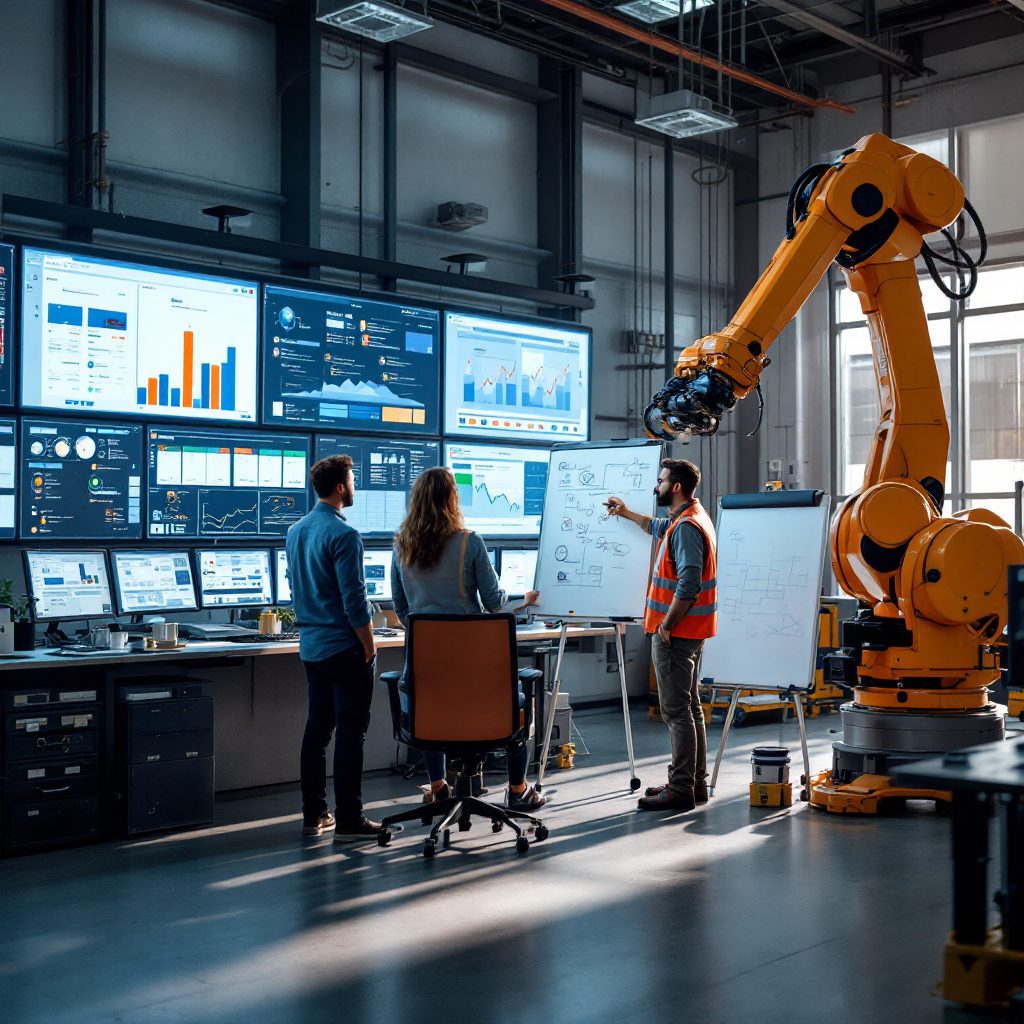
Case study: Regal Rexnord implemented agentic orchestration to streamline forecasting, inventory and order workflows. The company integrated cloud services and AI platforms to tighten forecasting and to speed customer onboarding. That move improved responsiveness during supply shocks and trimmed excess stock across several global sites How AI Helped Regal Rexnord Streamline Global Supply Chains. The case shows how integrating ai agents for industrial tasks can extend from planning systems into execution layers.
Which use cases are high ROI? Start with exceptions that cost time. Next, automate communications that require data lookups across ERP and WMS. Third, apply ai defect detection to quality control to cut scrap. Lower ROI projects tend to be full-blown digital twins or strategic network redesigns, which demand more data and longer timelines. For teams aiming to scale without hiring, our guide on how to scale logistics operations with AI agents offers a practical path how to scale logistics operations with AI agents.
Practical deployment timeline: pilot sensing and monitoring in months 0–3, expand agent scope and add orchestration months 3–9, then scale to other lines or sites months 9–18. This phased plan balances risk and value. Advanced ai agents and digital agents can be trialled on a single line to prove savings before wider rollout. The integration of ai agents into manufacturing systems should be guided by clear KPIs and by a focus on product quality and reduced downtime.
Drowning in emails?
Here’s your way out
Save hours every day as AI Agents label and draft emails directly in Outlook or Gmail, giving your team more time to focus on high-value work.
automate and industrial ai agent: real‑time operations and decision making
Agents operate in real-time to detect events and act. They fuse sensor feeds, logs and logistics feeds to form a live picture. Then they either act autonomously or propose actions for operators. That capability cuts decision latency and helps avoid unplanned downtime. In a typical setup, agents use sensor fusion to identify anomalies. They then run root-cause checks and either trigger a maintenance order or a human review. This closed-loop approach reduces downtime and keeps lines running.
Operationally, agents work inside a framework that balances autonomy and control. Governance matters. Teams should set escalation rules and audit trails. They should also log decisions for traceability and for post-event review. A simple governance checklist helps pilots: define decision boundaries, require sign-off levels, set retraining cadences, and monitor agent performance metrics. These steps make the system safe and explainable.
Key KPIs for operations: decision latency, percentage of decisions supported by AI, system uptime, and error rate. Measure both time and quality. For example, track how often agents intercept anomalies before a defect occurs. Also measure how often a control agent requires human intervention. That metric helps teams balance autonomy and safety. Agents that operate well will reduce both downtime and defect rates.
Risk controls include role-based access, redaction where needed, and clear rollback paths. You want agents to be proactive and to act autonomously within bounds. Yet you also want operators able to override quickly. This hybrid model keeps confidence high and keeps performance predictable. Industrial automation benefits when agents are designed to be auditable, and when their learning loops are monitored.
Finally, remember that agents do not replace good processes. They augment them. Use experimentation to validate impact. Revisit goals if agents drift. With the right governance and retraining pipelines, agents can reduce unplanned downtime, increase throughput, and help teams focus on higher-value tasks.
agentic supply chain and optimization tools: implementation and measuring ROI
Start with a clear pilot. Choose a bounded problem that connects directly to cost or service KPIs. For example, automate exception emails that require multiple system lookups. Then confirm data readiness and integration needs. You will need connectors to ERP, TMS and WMS systems. Decide whether to use a vendor solution or to build in-house. Vendors with purpose-built connectors can compress the timeline. For businesses that want to automate email replies linked to order status, our ERP email automation for logistics page explains how to connect systems quickly ERP email automation for logistics.
Technical stack components include an orchestration layer, optimisation engines, observability tools and retraining pipelines. These pieces let agents analyse large volumes and adjust models. Agents can analyze data from multiple sources and then act. The integration of ai agents into control flows requires APIs, secure authentication and role-based permissions. If you plan to integrate with many systems, a no-code agent platform can free ops teams from engineering overhead. Explore the benefits of such tools in our comparison of best tools for logistics communication best tools for logistics communication.
Measuring ROI starts with a baseline. Capture current lead times, error rates, email handling time and inventory levels. Run experiments with control groups. Short paybacks often appear in operational efficiency and in reduced email handling times. Medium paybacks show up as improved inventory turns and fewer stockouts. Long-term returns arrive from strategic resilience across global supply and from better supplier management. Expect to deploy initial pilots in weeks and to scale over months, not years.
Decision checklist for leadership: pick a clear KPI, confirm data access, decide vendor vs build, map escalation rules, and define retraining frequency. Five quick actions for leaders are: 1) select a pilot use case, 2) ensure data access, 3) set safety and governance standards, 4) measure baseline metrics, and 5) plan scale with change management. These steps help unlock the full potential of agentic ai while keeping risk contained.
Finally, remember that implementing agentic supply chain solutions is as much organisational as technical. Change management matters. Train teams, align incentives and track outcomes. With the right approach, advanced ai agents provide continuous learning, enable dynamic re-planning, and help industrial companies improve overall business performance. If you want to compare vendor choices, our guide on best AI tools for logistics companies gives a practical view of options best AI tools for logistics companies.
FAQ
What is an ai agent and how does it differ from traditional automation?
An ai agent is a software programme that senses its environment, plans actions and executes them with some level of autonomy. Traditional automation follows fixed rules or scripts, while an ai agent learns from data and can adapt its behaviour over time.
Can ai agents help reduce downtime on production lines?
Yes. By using predictive maintenance and real-time monitoring, ai agents can detect conditions that lead to failures and schedule timely interventions. This approach helps reduce unplanned downtime and maintain throughput.
How quickly can a company deploy an industrial ai agent pilot?
Deployment speed depends on data readiness and system integrations. Organisations can often run a bounded pilot in weeks when connectors to ERP and TMS are available. Full scale-up usually takes months.
Do ai agents replace human operators?
No. Ai agents augment human work by handling repetitive tasks and by proposing decisions. Humans remain in the loop for escalation, oversight and complex judgement calls.
What metrics should teams measure to evaluate success?
Key metrics include decision latency, percentage of decisions supported by AI, uptime, error rate and email handling time. These KPIs show both speed and quality improvements.
Are ai agents safe to use in industrial settings?
They can be safe if you implement governance, audit trails and clear escalation rules. Role-based access and retraining pipelines are essential for reliable operation and traceability.
How do ai agents interact with suppliers?
Agents can score supplier risk, automate communications and suggest alternate sourcing paths when disruptions occur. They help teams manage supplier management more proactively.
What is the role of optimisation tools in an agentic supply chain?
Optimisation tools enable agents to compute the best schedules, inventories and routes under constraints. These tools are the heart of supply chain optimization and improve service while lowering cost.
Can ai agents improve customer communication in logistics?
Yes. Agents that draft and send context-aware emails reduce manual lookups and speed responses. They can pull data from ERP, TMS and WMS to produce accurate replies and to update systems automatically.
Where should I start if I want to pilot agentic ai?
Start with a high-frequency, high-cost pain point such as exception handling or order status emails. Ensure data access, pick a vendor or a no-code option, and measure baseline KPIs. For help on automating logistics emails, see our guide on automating logistics emails with Google Workspace and virtualworkforce.ai automate logistics emails with Google Workspace.
Drowning in emails?
Here’s your way out
Save hours every day as AI Agents label and draft emails directly in Outlook or Gmail, giving your team more time to focus on high-value work.