


logistics — Current state and why AI agents matter
The logistics landscape is under rapid change. First, rising customer expectations and tighter margins push logistics teams to find efficiency. Next, digital tools and real-time data give them a way forward. Many logistics companies now combine sensors, telematics and cloud platforms to improve visibility and predictability. For example, carriers use predictive ETAs to cut delays, and warehouses use sensor-driven workflows to speed picking and packing. At the same time, nearly 40% of supply chain organisations are investing in generative AI technology, which shows the urgency to adopt agentic approaches to operations EY reports this shift. Consequently, leaders see AI as a lever to transform logistics management and to optimise supply chain processes.
Industry analysis also highlights the scale of opportunity. McKinsey estimates that AI could unlock between $1.3 and $2 trillion in annual economic value across global logistics and related sectors McKinsey’s estimate. Therefore, investment follows a clear business case. Logistics providers reduce costs, improve fill rates and boost service levels. Supply chain leaders prioritise data, governance and change management as they deploy AI models. However, firms must still manage data privacy and interoperability to turn pilots into production.
Finally, the present state demands action. Logistics operations face intense pressure from fluctuating demand and supply chain disruptions. Now, agentic AI and automation offer practical ways to respond. For teams that want to speed outcomes, a focused pilot on high-volume email exceptions or ETA predictions helps. If you want a starting point for automating email and order communications, see tools for email drafting and automated correspondence that help logistics teams move faster logistics email drafting AI.
ai agent — What an ai agent is and how it works in logistics tech
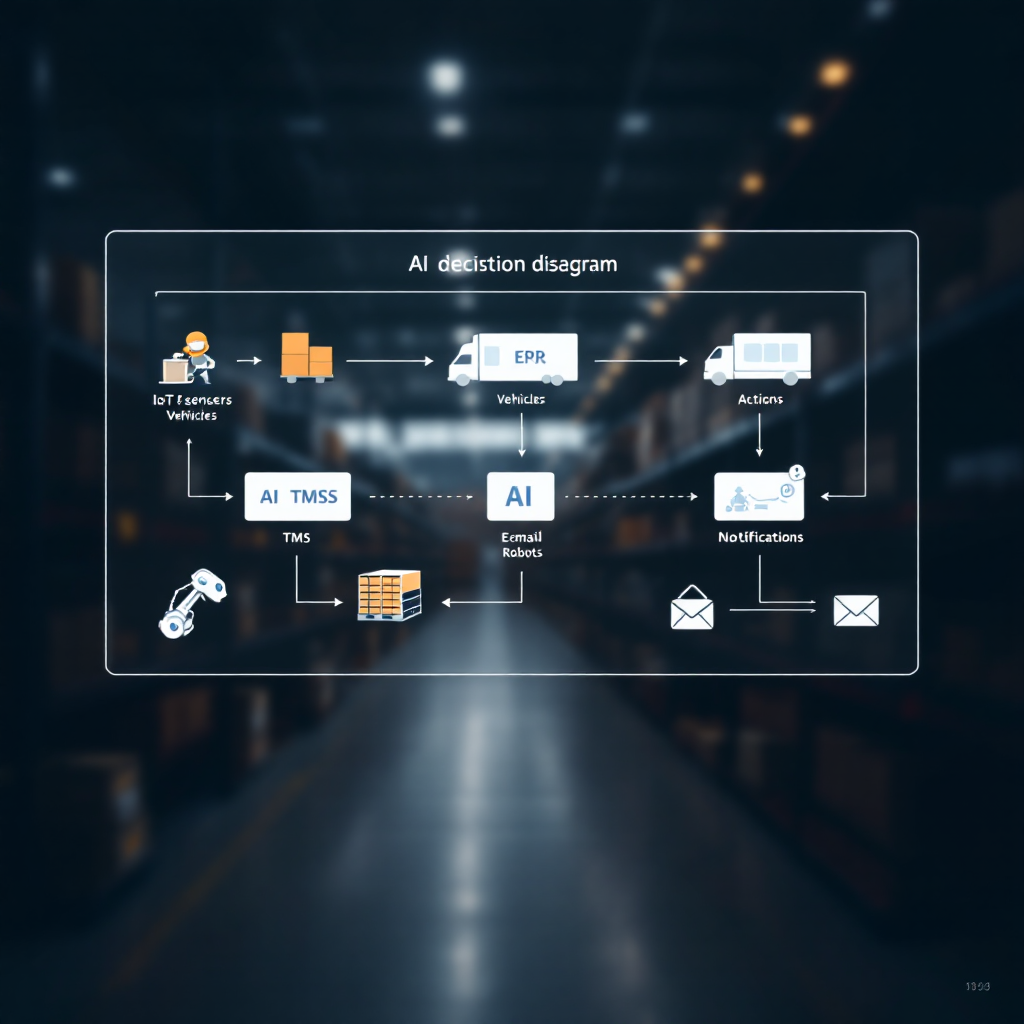
An AI agent is a software entity that senses data, makes decisions and acts. In logistics, an AI agent ingests telemetry from IoT devices, ERP records, TMS feeds and documents. Then it applies ai models and business rules to forecast demand, route vehicles or update inventory. Finally it executes actions through APIs or alerts people. The diagram is simple: data → model → decision → execution. This flow underpins intelligent logistics.
Technically, an AI agent combines machine learning models, rule engines, orchestration layers and connectors. In practice, traditional ML excels at forecasting and optimisation. At the same time, generative AI handles cognitive tasks like drafting replies or summarising documents. The distinction matters: autonomous AI agents act without human intervention in narrow tasks. Semi-autonomous agents propose decisions and wait for human approval in complex cases. For system builders, integration points matter most. High-quality telemetry, reliable APIs and clean master data determine how well an AI agent performs. Good data reduces false alerts and speeds adoption.
AI agent interaction patterns vary. Agents may coordinate as multi-agent AI systems, where each agent focuses on a domain such as transport, warehousing or customer care. Then agents exchange signals to resolve conflicts and optimise the entire flow. Also, agents interact with people via email or dashboards. For email-heavy workflows, no-code AI platforms can connect your ERP/TMS/WMS and draft contextual replies inside Outlook or Gmail, which helps logistics teams handle hundreds of inbound messages per day more quickly virtualworkforce.ai virtual assistant for logistics.
Drowning in emails?
Here’s your way out
Save hours every day as AI Agents label and draft emails directly in Outlook or Gmail, giving your team more time to focus on high-value work.
ai agents for logistics — Practical use cases that cut costs and save time
AI agents for logistics drive measurable savings across the network. First, predictive inventory agents adjust reorder points and safety stock. As a result, companies report fewer stockouts and lower carrying costs. For example, predictive inventory can cut stockouts and reduce inventory by single-digit to double-digit percentages. Next, route optimisation agents lower fuel consumption and shorten transit times. Transport planners use AI to reduce miles and idle time, which leads to a reduction in logistics costs and emissions. In many pilots, route optimisation yields 5–15% fuel and time savings.
Real-time monitoring agents also help. They analyse IoT feeds and detect deviations early. Then they notify planners and trigger contingency plans, which reduces the impact of supply chain disruptions. Additionally, generative AI automates document handling and customer correspondence. That approach trims manual processing time per document or email, often cutting handling time from minutes to seconds. In customer-facing flows, this speeds replies and improves satisfaction.
Choose pilots where data is plentiful, processes repeat and ROI is measurable. Start with high-volume ticket types, returns or ETA exceptions. Then instrument the pilot with clear KPIs such as response time, fill rate and cost per order. Also test an AI solution that integrates into daily tools so teams can act without switching context. For email and exceptions, virtualworkforce.ai demonstrates how a logistics AI agent drafts context-aware replies and updates systems, which reduces handling time dramatically automated logistics correspondence. Use cases of AI agents also include customs documentation, where document automation speeds clearances and reduces delays AI for customs documentation.
agentic ai — Operationalising agentic AI: integration, governance and workforce impact
Agentic AI brings multiple agents together to execute tasks end-to-end. Unlike single models, agentic systems coordinate—so they can manage complex supply chain processes and act on behalf of teams. That capability helps transform supply chain performance. However, operationalising agentic AI requires careful integration. Organisations must connect legacy ERP, TMS and WMS systems, break down data silos and expose APIs. Without that work, agents cannot access the reliable signals they need.
Workforce impact is substantial. Research from MIT Sloan highlights that roughly 1.1 million transportation jobs may feel automation effects, whether through augmentation or role change MIT Sloan’s analysis. Therefore, leaders must plan for reskilling and role redesign. They should introduce human-in-the-loop escalation paths, clear audit trails and role-based access so teams trust automated actions.
Governance matters. Build safety measures such as approval gates, monitoring dashboards and versioned audit logs. Also maintain privacy controls and compliance checks when agents access customer or shipment data. Training and change management must focus on outcomes, not tools. Train operators on how agents make decisions, which increases adoption. For those choosing agentic AI solutions, look for platforms that balance automation with human oversight and that provide transparent decision logs. That mix helps logistics industry teams scale automation while reducing operational risk.
Drowning in emails?
Here’s your way out
Save hours every day as AI Agents label and draft emails directly in Outlook or Gmail, giving your team more time to focus on high-value work.
benefits of ai agents — Quantified business outcomes and sustainability gains
AI agents provide clear, measurable benefits for logistics organisations. First, early adopters often see a 5–15% reduction in logistics costs through better routing, demand forecasting and labour allocation. Next, agents improve fill rates and reduce stockouts, which increases revenue per order. For exception handling, AI reduces manual steps and speeds resolution time, which improves customer satisfaction.
From a sustainability angle, route optimisation and load consolidation cut fuel use and emissions. For many carriers, optimising routes and reducing empty miles produces a quantifiable reduction in carbon output. Also, smarter inventory reduces waste and lowers the need for expedited shipments, which further reduces the environmental footprint. KPIs you can track include cost per shipment, average response time, fill rate, carbon per tonne-km and exception closure time. Use these to build a business case and to measure pilot success.
ROI often appears quickly. With focused pilots on high-volume workflows, teams can see payback within months. For example, automating email replies and document updates often reduces handling time from roughly 4.5 minutes to 1.5 minutes per email, which scales to large savings across staff time ROI case studies. To sustain gains, monitor for model drift, and retrain models as patterns shift. In short, benefits of AI agents include lower logistics costs, improved supply chain efficiency and better sustainability metrics that align with corporate targets.
future of logistics — Roadmap, priorities and recommended next steps for supply chain teams
Supply chain teams ready to adopt AI agents should follow a clear roadmap. First, audit your data landscape and systems. Identify gaps in telemetry, master data and API availability. Next, select one high-value pilot that is high-volume, repeatable and measurable. Then build governance and monitoring well before you scale. Include human-in-the-loop rules and clear escalation for edge cases.
Priorities must include data quality, interoperability and human oversight. Also weigh vendor choice carefully. Decide whether to adopt agentic AI solutions from specialists or to build in-house. For email-heavy workflows and order exceptions, no-code platforms can speed rollout and reduce IT burden. For a practical guide on scaling without hiring, see resources on how to scale logistics operations with AI agents how to scale logistics operations with AI agents.
Mitigate risks. Monitor for model drift and validate outputs continuously. Avoid impersonal customer replies by providing templates and escalation paths. Also adhere to privacy laws and log decisions for audit. Finally, three recommended first steps for leaders: conduct a quick data audit, select one high-value pilot, and define measurement plus governance. By following this roadmap, logistics teams can transform supply chain logistics into a more resilient, efficient and sustainable operation. The future of logistics will become more automated, intelligent and human-centred as teams adopt advanced AI technology and integrate agents across the entire supply chain.
FAQ
What is an AI agent in logistics?
An AI agent in logistics is a software component that ingests data, makes decisions and executes actions. It can automate tasks such as forecasting, routing and email drafting while integrating with ERP and TMS.
How do AI agents improve supply chain efficiency?
AI agents analyse patterns and optimise operations, which reduces waste and speeds decision-making. They lower logistics costs, improve fill rates and shorten response times for exceptions.
Are AI agents safe to deploy in live logistics operations?
Yes, when you deploy with governance and human-in-the-loop controls. Build audit trails, approval gates and monitoring to ensure safe, compliant operation.
What workforce changes should logistics teams expect?
Teams will shift from repetitive tasks to oversight and exception handling roles. Organisations should invest in reskilling and role redesign to capture productivity gains and to support staff.
Can AI agents handle customs and documentation?
They can automate document drafting and validation, which speeds clearance and reduces errors. See examples of AI for customs documentation emails for practical approaches and connectors.
How fast can companies see ROI from AI pilots?
Many pilots, especially in email automation or route optimisation, show payback within months. The timeline depends on data readiness and pilot scope, but focused pilots often return value quickly.
What are common integration challenges?
Legacy systems, data silos and inconsistent APIs commonly slow integrations. Prioritise data connectors and master data clean-up to accelerate deployments.
Do AI agents reduce carbon emissions?
Yes. Route optimisation and load consolidation cut fuel consumption and emissions. Smarter inventory and fewer expedited shipments also lower environmental impact.
How do I choose between in-house and vendor AI platforms?
Consider speed, domain expertise and control. Vendors can deliver faster pilots and pre-built connectors, while in-house builds offer more customisation but need more resources.
Where can I learn more about automating logistics emails?
Explore specialised resources on automated logistics correspondence and virtual assistants for logistics to see examples, ROI studies and implementation tips. These guides help teams move from pilot to scale.
Drowning in emails?
Here’s your way out
Save hours every day as AI Agents label and draft emails directly in Outlook or Gmail, giving your team more time to focus on high-value work.