


AI transforms pharmaceutical supply chain and inventory management to cut stockouts and waste
AI is changing how pharma teams plan inventory. First, AI forecasts demand with higher precision than traditional methods. Then it optimises inventory buffers and automates replenishment across manufacturers, wholesalers and hospitals. In practice, an AI agent ingests sales, production and seasonal data. Next, the agent predicts demand peaks. As a result, hospitals avoid stockouts and manufacturers cut waste. A McKinsey estimate finds that 75–85% of workflows in pharmaceutical companies contain tasks that could be enhanced or automated by AI agents, freeing 25–40% of employee time. That potential drives investment in forecasting engines and predictive reorder systems.
Consider one end-to-end example. A manufacturer updates batch yield and expiry data. The AI agent pulls that data and predicts shipments to wholesalers. Wholesalers synchronise inventory across channels. Hospitals receive planned replenishment and alerts for near‑expiry stock. The flow looks like this: Manufacturer → Wholesaler → Hospital. The manufacturer flags batches, the wholesaler adjusts orders, and the hospital accepts scheduled deliveries. This simple flow reduces emergency orders and lowers expiry waste.
IoT sensors feed cold‑chain readings continuously. AI analyses temperature trends and flags excursions before quality is lost. Predictive reorder engines set reorder points dynamically. Inventory management software links with AI to automate purchase orders and route allocations. These systems cut holding costs and improve service levels. Case studies show AI‑driven inventory can reduce waste and expiry by up to about 20% in specific settings. In parallel, virtualworkforce.ai builds no‑code AI email agents that draft context‑aware supplier and order replies. These agents cut handling time and keep inventory communications accurate. See how our virtual assistant helps logistics teams at virtualworkforce.ai/virtual-assistant-logistics/.
Overall, AI in the pharmaceutical supply chain shortens lead times and improves fill rates. Agents analyse demand patterns and optimise stock positions across nodes. When manufacturers, wholesalers and hospitals share reliable data, AI agents are transforming inventory flows and cutting both stockouts and waste.

AI agent automates compliance, documentation and temperature-sensitive tracking in pharma distribution
AI agents handle routine compliance tasks and keep audit trails tidy. They draft batch release summaries, review regulatory documents and route revised files to the right reviewer. The FDA emphasises lifecycle management, data integrity and a risk‑based approach for AI systems used across the drug lifecycle and distribution, which frames what companies must do for validation and monitoring that guidance. AI agents continuously monitor shipment temperatures. When an excursion occurs, an agent logs the breach, triggers remedial steps and notifies stakeholders. This reduces human delay when time matters for product quality.
Regulators expect explainability, reproducible logs and robust validation. In short, validation must prove the AI does what it is meant to do. Monitoring must run after deployment. Explainable AI helps auditors trace why an agent made a decision. Companies must also keep data integrity and an audit trail that inspectors can review. For many pharmaceutical companies, that means combining traceable workflows with documented test plans and regular revalidation.
Examples are practical. An agent drafts a batch release summary from ERP fields, flags anomalies and routes the file to quality assurance. Another agent watches cold‑chain tags in transit. If temperatures trend toward breach, the agent reroutes shipments or schedules a corrective hold. All steps, times and messages are stored for inspection. These behaviours meet the FDA’s lifecycle and risk‑based expectations and reduce manual record work.
AI tools add speed and consistency. However, companies must validate and monitor AI models, and keep explainable records. For teams that handle many regulatory emails and release notes, our no‑code approach at virtualworkforce.ai speeds routing and ensures replies cite the right data source. Learn how auto‑drafting helps at logistics email drafting. Overall, AI agents automate documentation and tracking, while keeping compliance visible and verifiable.
Drowning in emails?
Here’s your way out
Save hours every day as AI Agents label and draft emails directly in Outlook or Gmail, giving your team more time to focus on high-value work.
Agentic AI speeds drug discovery and links R&D outputs to more efficient distribution
Agentic AI shortens parts of the drug discovery cycle. In labs, agents propose experiments, triage results and free scientists from repetitive tasks. This speeds target identification and candidate selection. When discovery shortens, the distribution pipeline benefits. Faster candidate selection drives different production plans and affects logistics strategies soon after clinical success.
For example, an agentic AI system can propose an optimised experiment plan. It tests ideas virtually and suggests the next lab steps. That reduces time and cost in early phases. When a candidate advances, the AI passes attributes such as stability, cold‑chain needs and expected batch yields to downstream planning agents. This closed‑loop handoff links drug discovery work directly to distribution planning.
As a concrete scenario, faster candidate selection may allow manufacturers to produce smaller, more frequent batches. Distribution then shifts from large, infrequent shipments to agile replenishment. Agents help model those options. They analyse storage needs, shipping frequency and expiry windows. They also recommend container types or specialised carriers for temperature control. Because agentic AI can help quantify such trade‑offs quickly, logistics teams can adapt plans within weeks instead of months.
Agentic AI is transforming how R&D outputs reach patients. It reduces repetitive scientist tasks and speeds decision cycles in pharma R&D. That change lowers time‑to‑market and improves alignment between discovery and delivery. For pharma companies, the result is a quicker feedback loop and a more responsive pharmaceutical supply chain. This link between drug discovery and distribution shows how agentic AI can help both lab teams and logistics teams to act in concert.
Types of AI agents and the best AI approaches for the pharmaceutical industry
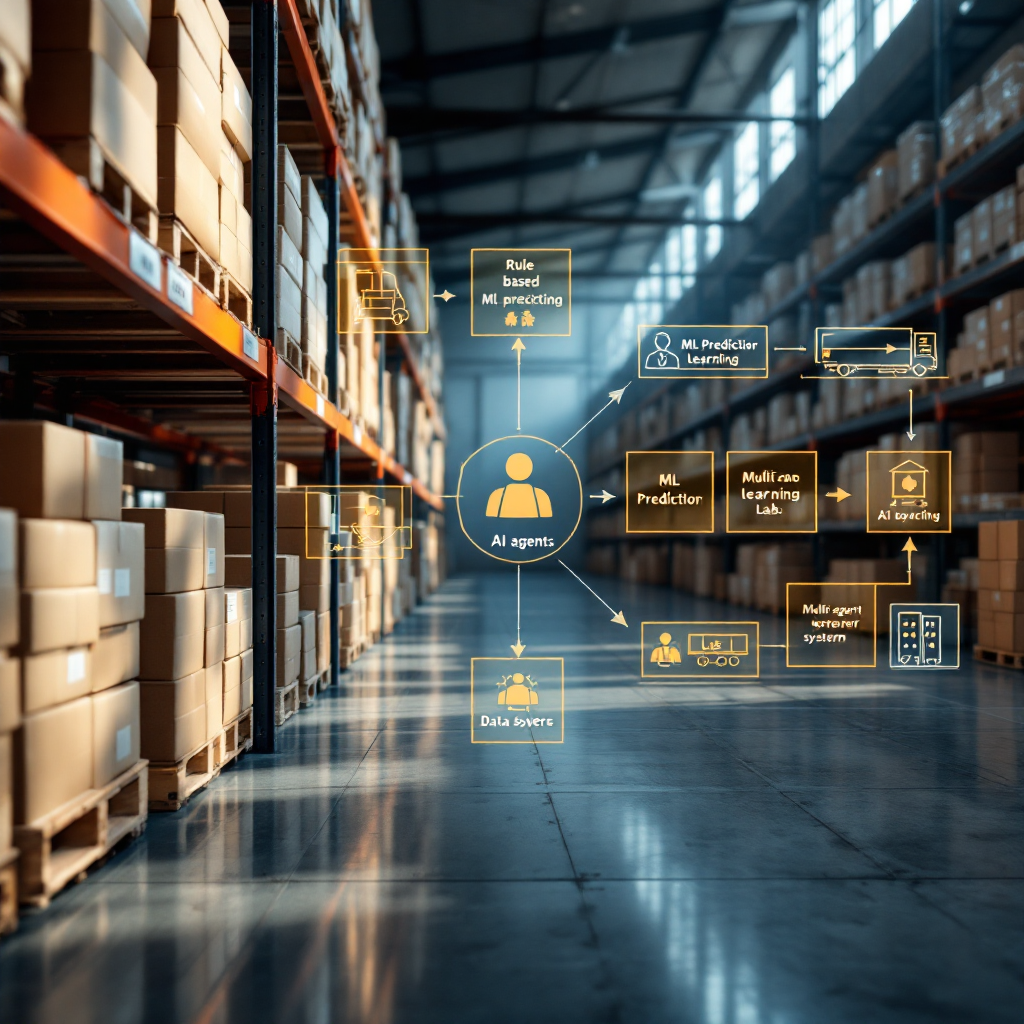
There are several types of AI agents. Rule‑based agents follow if‑then rules for compliance checks. ML predictors forecast demand and quality metrics. Reinforcement learning agents optimise routing and scheduling. Multi‑agent or agentic AI systems coordinate complex, multi‑step workflows. Each class maps to specific pharma tasks.
To simplify, here is a short mapping: rule‑based → compliance checks and document routing; ML predictors → demand forecasting and yield prediction; optimisation agents → route planning and fleet scheduling; agentic AI → experiment planning and multi‑node orchestration. ML models excel at patterns. Goal‑based agents manage objectives such as minimising expiry or cutting cost. Learning agents improve with feedback and data. This taxonomy helps teams choose the right approach for each problem.
Adoption of AI is rising. Enterprise uptake in life sciences is growing, with strong interest across the sector. Companies that start with high‑value, low‑risk pilots see faster wins. Practical examples include ML for demand forecasting, optimisation agents for delivery routes and rule‑based agents for document checks. For distribution, mixing agent types often works best: forecasting agents set orders and optimisation agents schedule carriers.
For teams evaluating tools, consider maturity and fit. ML predictors are mature for demand forecasting. Reinforcement learning is effective for routing in constrained fleets. Agentic AI is evolving fast and shows promise for complex cross‑functional workflows. For more on scaling operations without added hires, read our guide on how to scale logistics with AI agents at how to scale logistics operations with AI agents. In short, matching agent type to task reduces risk and speeds ROI.
Drowning in emails?
Here’s your way out
Save hours every day as AI Agents label and draft emails directly in Outlook or Gmail, giving your team more time to focus on high-value work.
Implementing AI agents in pharmaceutical companies: ai deployment, integration and change management
Successful AI deployment starts with data readiness. Clean, connected data feeds make models reliable. Next, map business processes and KPIs. Define measurable goals like reduced stockouts, lower lead‑time variance and faster audit closure. Start with pilots that are high‑value and low‑risk, such as inventory alerts or cold‑chain notifications. Pilot timelines typically run three to six months. Scale can take six to eighteen months depending on integration needs.
Integration matters. Connect ERP, TMS, WMS and email systems so agents can act on live data. Our no‑code platform links these systems with minimal IT work. That reduces time to value and keeps business users in control. Plan governance early. The FDA expects lifecycle oversight and continual monitoring of AI systems. Build audit trails, explainability features and revalidation schedules into the rollout plan.
Change management is critical. Reskill staff for oversight and exception handling. Measure ai performance with clear dashboards. Track stockouts percentage, lead‑time variance and audit response time. Use a vendor that supports role‑based access, logging and secure connectors. For operator email automation and logistics correspondence, our team recommends looking at practical solutions such as automated logistics correspondence that reduce manual work and improve quality.
Security and privacy cannot be an afterthought. Implement strong encryption, strict access controls and regular audits. Start with an internal governance board to approve models and KPIs. Select pilots that let teams see benefits early. Build feedback loops so agents learn from human corrections. Ultimately, proper ai deployment combines technical integration, staff training and ongoing governance to make AI agents reliable and compliant in the pharmaceutical industry.
Future of AI in life sciences: benefits of AI agents, challenges of compliance and the outlook for pharma
The future of AI brings clear benefits. AI reduces cost, speeds delivery and improves patient access. It also raises R&D throughput and helps teams plan distribution more effectively. Short‑term wins will appear in inventory, cold‑chain and documentation. Medium‑term gains will come from agentic AI coordinating R&D and logistics. Long term, multiple AI agents working together could orchestrate the entire pharma value chain.
Challenges remain. Data privacy and security must be strong. Regulatory frameworks keep changing and require lifecycle governance and explainable AI. Integration complexity and staff transition are real concerns. Adoption of AI needs a measured approach: pilot, evaluate, scale. Pharma leaders are turning to experienced vendors and internal governance to manage risk and speed adoption.
Policy signals to watch include FDA updates and EU AI regulations. These will shape how fast companies can adopt agentic AI in pharma and expand use cases. For C‑suite teams, the recommendation is simple: prioritise pilots that show clear ROI, invest in data foundations, and set a governance board to oversee models. Partner with vendors who understand logistics and compliance, and who can integrate AI into live systems quickly.
Finally, the outlook is positive. With clear governance and focused pilots, AI will transform the pharmaceutical supply chain and drug development timelines. Companies that balance speed with strong controls will capture the benefits of AI while protecting patients and operations. To learn practical steps for automating customs and documentation emails, see AI for customs documentation emails.
FAQ
How do AI agents reduce stockouts in pharma?
AI agents analyze demand patterns and inventory levels. They predict shortages and automate replenishment to keep stock aligned with need.
Can AI handle temperature-sensitive shipments?
Yes. AI agents continuously monitor IoT sensor feeds. They alert teams and log corrective actions when excursions occur.
What regulatory expectations apply to AI in distribution?
Regulators expect lifecycle management, data integrity and explainability. The FDA highlights risk‑based validation and ongoing monitoring for AI used across the drug lifecycle guidance.
Will AI replace quality and compliance staff?
No. AI automates routine work and frees staff for higher‑value tasks. Humans still validate decisions and handle exceptions.
How quickly can pharma companies pilot AI agents?
Pilots can run in three to six months for focused use cases. Scaling typically takes six to eighteen months depending on integration complexity.
What data systems are needed for AI deployment?
Connectors to ERP, TMS, WMS and email systems are essential. Clean, time‑stamped data improves model reliability and auditability.
Are email AI agents safe for regulatory correspondence?
Yes, when they use role‑based access, audit logs and redaction. Our no‑code agents draft replies grounded in ERP and document sources to reduce errors.
How does AI speed drug discovery and affect logistics?
Agentic AI cuts repetitive tasks in early R&D and speeds candidate selection. Faster discovery leads to faster production planning and different distribution strategies.
What are measurable KPIs for AI pilots?
Track stockout percentage, lead‑time variance, handling time per email and audit closure time. Measure cost per delivery and expiry reductions.
How should executives prioritise AI investments?
Begin with high‑value, low‑risk pilots in inventory or cold‑chain alerts. Invest in data foundations and governance to scale with confidence. For practical automation of logistics emails, explore tools that connect to your operational systems ERP email automation.
Drowning in emails?
Here’s your way out
Save hours every day as AI Agents label and draft emails directly in Outlook or Gmail, giving your team more time to focus on high-value work.