


ai agent and drug discovery: speed, examples and hard numbers
AI agent technology now targets early drug discovery with measurable speed gains. First, teams use AI to identify targets and to design molecules. Then, they prioritise candidates for lab testing. This shortens timelines. For example, AI-driven platforms can cut the time to identify viable candidates by about 30–50% (Dataforest). In practice, companies such as Exscientia and Insilico Medicine apply generative models to propose molecules, test virtual chemistry, and select leads faster. For instance, Exscientia reported compressed early discovery timelines, and Insilico Medicine cited similar efficiency in candidate trimming. These case examples show how AI accelerates target ID, molecule design and candidate selection.
Market signals back the technical gains. The sector focused on AI-driven drug discovery reached roughly USD 1.86bn in 2024 and it is growing rapidly. Additionally, pharmaceutical companies report that AI in discovery reduces early-stage attrition and lowers discovery costs. Research estimates show adoption rising year-over-year; the use of AI agents across labs and analytics increased substantially as firms chased speed and accuracy (Zebracat).
To be specific, an AI agent can scan chemical libraries, predict binding, and rank compounds within hours instead of weeks. Next, teams run a focused set of assays. Consequently, these human-plus-agent cycles shrink the lead identification window. Importantly, human scientists still review outputs. They interpret biological plausibility and set experimental priorities. For example, AI analyzes patterns in assay data but molecular biologists confirm which candidates to synthesise. Thus, AI is transforming idea-to-experiment loops while preserving scientific judgment.
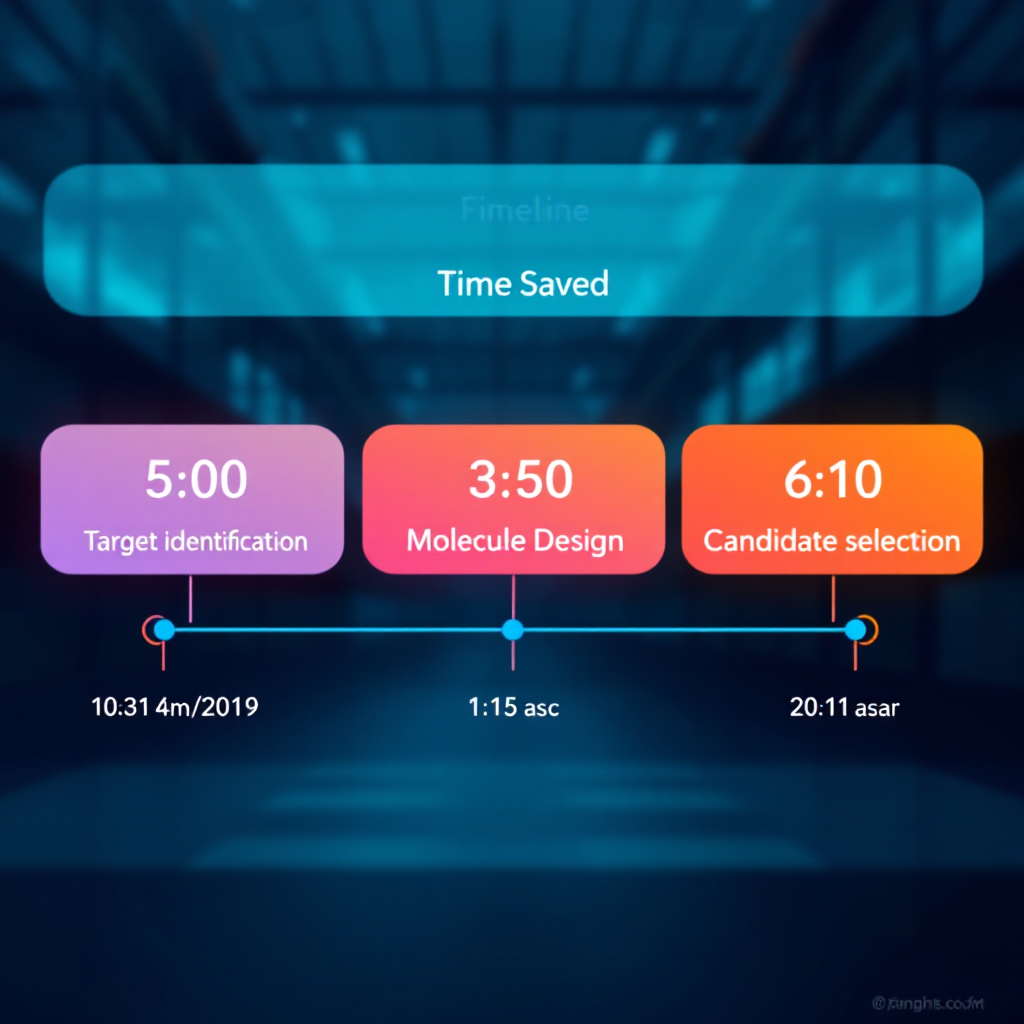
Below is a simple visual timeline that shows approximate percent time saved at each stage: target ID, molecule design, and candidate selection. The chart offers a quick view of typical gains reported by multiple platforms and studies. Use it when you brief stakeholders. Finally, if you want to trial AI agents in lab ops, consider starting with a focused target ID pilot. That keeps scope small and impact visible.
agentic ai to transform pharmaceutical R&D workflows
Agentic AI describes systems that act autonomously to complete multi-step tasks. In labs, agentic AI orchestrates experiment design, schedules protocols, and triages data. First, an agent suggests experimental parameters. Next, it books instruments and prioritises samples. Then, it collects results and flags anomalies for human review. This loop reduces manual hand-offs and helps teams scale routine work. Reported productivity gains approach 30% where agentic agents manage parts of the workflow.
Agentic AI in pharma shifts teams from chasing emails and spreadsheets to focusing on interpretation and hypothesis testing. However, the agent does not replace domain experts. Human oversight remains essential for experiment validation and safety checks. For example, lab directors must approve automated protocol changes and check reagents. In addition, scientists retain final sign-off for any synthesis that proceeds to scale. Therefore, agentic AI complements existing expertise while it helps to automate repetitive decisions.
Agentic AI is transforming life in labs by making data flows faster and more consistent. It can autonomously integrate assay outputs, LIMS entries and instrument logs. At the same time, the agent surfaces contextual summaries for the team. If you are a lab manager, start with a closed-loop pilot. Then, expand the agent’s remit as trust and explainability improve. Tools for this phase must include audit trails, role-based controls and easy rollback.
Virtualworkforce.ai provides a useful lens on no-code, inbox-focused agents that improve operational throughput in other sectors. For example, our company helps ops teams draft data-grounded replies while connecting to ERP and SharePoint. The same no-code principles apply when labs need fast, predictable automation of routine communications and data hand-offs. In short, agentic AI can automate coordination, while humans retain control. This balance both protects quality and helps teams scale.
Drowning in emails?
Here’s your way out
Save hours every day as AI Agents label and draft emails directly in Outlook or Gmail, giving your team more time to focus on high-value work.
pharmaceutical companies: adoption, barriers and the 2025 landscape
Adoption of AI agents varies by definition and by firm size. Some surveys report that roughly 14% of firms had deployed AI agents by 2025, while broader AI use in R&D exceeded 50–60% (Index.dev). In other words, many organisations “use AI” for analytics and for modelling, but fewer deploy autonomous agents that make decisions without constant human prompts. This distinction matters for governance, procurement and change management.
Common barriers slow deployment. First, trust and explainability rank high. Decision-makers want to understand why an agent recommended a candidate. Second, governance and data readiness remain gaps. Firms with siloed data or without clean LIMS records struggle to feed reliable inputs to agents. Third, regulatory concerns also limit scope. Companies need clear artefacts to show regulators how decisions were made and which humans approved them.
To help boards and exec teams, here is a brief checklist for early adoption: define scope and outcomes, assess data quality, pilot with a human-in-loop design, validate model outputs, and document decision trails. Use this checklist as a starting point for funding and oversight. Furthermore, pharma organizations should ensure cross-functional steering between IT, R&D, legal and medical affairs. Doing so reduces friction and speeds scaling.
Surveys show that trust scores remain low in some groups, so governance is not negotiable. Still, the near-term outlook looks positive. Agentic approaches and AI agents in pharma will spread as companies solve data readiness and governance. For those leading programmes, focus on small, high-value pilots. Then, expand after you prove safety, utility and compliance. That pathway helps firms transition from proof-of-concept to enterprise deployment.
enterprise ai and best ai tools for labs and clinical trials
Enterprise AI must integrate with LIMS, EHRs and CTMS to add value. Good integrations reduce manual data handling and speed recruitment, monitoring and reporting for the clinical trial lifecycle. For instance, an AI platform that links to EHRs can screen patient cohorts and suggest matches for a trial protocol. Similarly, a CTMS-connected agent can track visit windows and flag missed milestones. These integrations help accelerate start-up timelines and improve data quality.
Categories of tools matter. Start by mapping needs to five categories: molecule design, real-world evidence analytics, trial optimisation, regulatory monitoring and lab automation. Each category needs secure APIs, model validation, and single sign-on. Also, expect emphasis on explainability. Vendors must show audit logs and model lineage so teams can validate results and support regulatory reviews.
When selecting tools, look for six practical criteria. First, security: end-to-end encryption and role-based access. Second, explainability: clear model outputs and rationale. Third, scalability: ability to handle large datasets and parallel tasks. Fourth, an audit trail: immutable logs of decisions and data lineage. Fifth, certification: evidence of third-party validation where possible. Sixth, vendor support: domain expertise and integration services. These criteria help you choose best ai options for lab and clinical use.
Operationally, enterprise platforms should enable seamless integration and rapid prototyping. If you need an example of operationalising inbox automation, see how teams use no-code mail agents to speed transactional workflows and reporting (automate logistics emails with Google Workspace). For logistics-style correspondence automation in regulated contexts, learn about virtual assistants built for tight audit trails (virtual assistant for logistics). Finally, to scale agentic pilots that touch multiple systems, follow a staged integration plan and validate at each step.

Drowning in emails?
Here’s your way out
Save hours every day as AI Agents label and draft emails directly in Outlook or Gmail, giving your team more time to focus on high-value work.
compliance: regulatory intelligence, FDA/EMA expectations and audit trails
Agents for regulatory intelligence continuously scan public guidance, labeling updates and inspection findings. These agents notify teams faster, helping with regulatory compliance. Reports suggest such systems enable response to regulatory change up to about 40% faster than manual approaches (LinkedIn analysis). That speed matters when submission windows tighten or when safety signals emerge.
Regulators now expect documented validation and change control. The FDA and EMA have published guidance on software of medical device and on AI in regulated contexts. In the EU, the AI Act introduces obligations for high-risk healthcare AI. Thus, teams must prepare artefacts that demonstrate traceability and risk mitigation. Required artefacts typically include validation reports, data lineage, explainability logs and human oversight records. These documents prove that decisions were reproducible and auditable.
To remain compliant, create templates that capture model training details, performance metrics and drift monitoring results. Also, implement role-based approvals for any automated action that could affect patient safety or manufacturing quality. Make sure the system can produce a time-stamped audit trail during an inspection. That trail should link raw input data to the agent’s recommendation and to the human decision that followed.
Practical audit checklist items include: system inventory, validation summary, data lineage maps, model performance and drift logs, access controls, and change-control records. For clinical trial submissions and for drug approval dossiers, preserve provenance and authorisation steps. If you plan to scale autonomous AI agents or agentic ai in pharma, document every step early. That practice reduces rework and supports smoother regulatory interactions.
ai agent governance: explainability, trust and a deployment checklist
Successful governance starts with transparency. Explainable AI helps teams trust agent outputs. In many surveys, trust scores remain low, so firms must prove reliability with metrics and with human-in-loop controls. For example, require an explainability summary for each high‑impact decision. Also, produce validation datasets and retain them for audits. These actions raise confidence and reduce regulatory friction.
Below is an 8-point deployment checklist you can use when you deploy ai agents in labs or trials:
1. Scope: define intended tasks and boundaries. 2. Data quality: verify inputs, mappings and cleaning procedures. 3. Validation: run performance tests on held-out datasets and on synthetic edge cases. 4. Monitoring: set drift detection and alerts. 5. Failover: design human overrides and safe stop behaviours. 6. Roles: assign owners for model, data and oversight. 7. Documentation: keep audit trails, lineage and explainability logs. 8. Regulatory review: map artefacts to applicable FDA/EMA requirements.
After the checklist, plan a pilot that measures both technical metrics and business outcomes. Track productivity gains, time saved and error reduction. Some teams report productivity improvements and operational savings. At the same time, maintain strict access controls and encryption. If you need to automate email-driven operational tasks in regulated logistics workflows, our no-code approach helps teams reduce handling time while retaining audit controls (how to scale logistics operations with AI agents). Also consider APIs and vendor SLAs when you evaluate partners for clinical and lab automation (best tools for logistics communication).
Finally, move from pilot to scale in measured steps. Use small, high-value projects to prove safety and to refine governance. Then, expand carefully. That route balances innovation with compliance and with long‑term trust.
FAQ
What is an AI agent in the context of pharma?
An AI agent is a software entity that performs tasks such as data analysis, scheduling or decision support. In pharma, AI agents can help with target identification, experiment triage and regulatory scanning, while humans validate outcomes.
How do agentic AI systems differ from traditional AI models?
Agentic AI systems act autonomously across multiple steps rather than only making predictions. They plan sequences, trigger workflows and manage hand-offs. Traditional AI models typically provide outputs that humans then act on.
Can AI agents accelerate drug discovery timelines?
Yes. Studies and vendor reports show AI-driven platforms can reduce the time to identify viable candidates by roughly 30–50% (Dataforest). However, outcomes depend on data quality and on the chosen pilot scope.
Are autonomous agents compliant with FDA and EMA rules?
They can be if you document validation, maintain data lineage and keep human oversight. Regulators expect traceability and change control. Firms should map artefacts to guidance and to the EU AI Act where applicable.
What are common barriers to deploying AI agents in pharma?
Key barriers include trust, governance, and data readiness. Companies also face integration challenges with LIMS and EHRs. Addressing these gaps early helps pilots succeed and supports scale-up.
How should a pharma organisation start a pilot?
Begin with a narrow use case and clear success metrics. Validate inputs and outputs, require human review, and capture audit trails. Then, expand scope once you prove safety and value.
Which enterprise integrations matter most for clinical trials?
LIMS, CTMS and EHR/EMR integrations are essential. Secure APIs, SSO and model validation features also matter. These integrations reduce manual data handling and speed recruitment and monitoring.
How do AI agents help with regulatory intelligence?
They scan guidelines and updates continuously and alert teams to relevant changes. Reports indicate these agents can speed responses to regulation by significant margins (LinkedIn), which helps teams stay compliant.
What governance elements are non-negotiable?
Non-negotiable items include validation documentation, audit logs, role-based access and human-in-loop failovers. These elements safeguard quality and support inspections.
How can R&D leaders justify investment in agentic AI?
Leaders can point to measurable time savings, reduced discovery costs and improved trial efficiency. Start with a pilot, measure productivity improvements and then present validated results to stakeholders.
Drowning in emails?
Here’s your way out
Save hours every day as AI Agents label and draft emails directly in Outlook or Gmail, giving your team more time to focus on high-value work.