


ai agents for recruiting: what agentic ai does for recruit and recruiter workflows
AI agents for recruiting describe software that performs repeatable hiring tasks with autonomy. First, define an ai agent: it is a programmable assistant that searches, ranks and engages candidates. Second, define agentic ai for recruitment: it applies models and rules to source candidates, screen resumes, run outreach, schedule interviews and run an ai interviewer for first‑pass assessments. These agents free a human recruiter to focus on relationships and final hiring decisions. For example, sourcing platforms find passive talent across job boards and social networks, while conversational ai handles first touch messages.
Quick facts help set context. An Insight Global survey reports that about 99% of hiring managers now use AI at some stage of the hiring process (Insight Global: AI in Hiring 2025). Also, a 2025 MIT study estimated AI could replace roughly 11.7% of some job functions, including recruitment‑adjacent tasks (MIT study, CNBC). These numbers show both rapid adoption and real operational impact.
Vendor classes include sourcing platforms, talent CRMs, ai recruiting software and recruiting platform products. Tools like hireEZ (formerly Hiretual), SeekOut, and Beamery exemplify sourcing platforms that sit on top of public profiles and internal databases to help teams find top talent. Tools like Fetcher or integrated talent CRMs automate outreach and nurture. agency recruiters and recruitment agency teams use these to scale outreach and track pipelines. The combination of a talent CRM and an ai tool can match candidate profiles to job templates and surface best candidates for a role. These vendors often offer APIs to integrate with your ATS and CRM in order to keep pipelines synced.
Remember that agentic ai does for recruit and recruiter what a junior sourcer would do at volume: it expands boolean strings, checks multiple sources, and drafts personalized first messages. It allows teams to find the perfect match faster and to make better hiring decisions without replacing the human recruiter who interprets culture fit and negotiates offers. In short, AI agents for recruiting accelerate sourcing, improve candidate matching, and automate routine touches so expert recruiters can focus on high‑impact work.
ai recruitment and ai tool selection: how to choose ai-powered platforms that integrate with your existing ats and crm
Choosing an ai-powered platform means balancing accuracy, integration, and governance. Start with a short checklist you can use in vendor calls. First, check sourcing accuracy: ask vendors for precision metrics on candidate matching and examples of candidate profiles returned for your hard‑to‑fill roles. Second, confirm outreach automation and personalization capabilities. Third, verify ATS and CRM integration depth; the tool must integrate with your existing ATS and CRM so data flows without manual export. Fourth, evaluate API access, developer support and SLAs for model updates. Fifth, require data privacy and compliance features, including readiness for EU AI Act implications. Sixth, demand explainability and vendor support for audits.
Practical test: run a 30‑day sourcing pilot. Measure time‑to‑contact, response rate and candidate quality. Use specific KPIs such as contacts/day, replies/day, and rate of interviews scheduled from outreach. Also track time to shortlist and time to fill. A 30‑day pilot forces vendors to prove their match rates and shows how well the tool integrates with calendars and your ATS. During the pilot, choose a representative sample of roles, including at least one high‑volume hiring role to see scalability.
Plain, actionable bullets work best when operational teams evaluate options. For example:
– Test boolean expansion and passive candidate discovery against your existing sourcing methods. – Confirm the tool can push candidate profiles and notes directly into your ATS and CRM. – Ask for a data flow diagram that shows where candidate data lands and how consent is tracked. – Request a bias‑mitigation plan and access to any explainability logs the vendor provides. – Verify vendor uptime and a clear escalation path for support.
Also, consider how the tool will co‑exist with other ai systems you run. Look for an option that can be configured to obey your hiring platform rules and your privacy policies. If your operations run high volumes of email or candidate messages, consider adding email automation for outreach and follow‑ups rather than point solutions that only draft messages. For more on automating message flows in operations, see virtualworkforce.ai’s summary of virtual assistant options for logistics email drafting and how zero‑code setup speeds rollout (virtual assistant logistics).

Drowning in emails?
Here’s your way out
Save hours every day as AI Agents label and draft emails directly in Outlook or Gmail, giving your team more time to focus on high-value work.
source and ai recruiter efficiency: using ai agents and generative ai to speed sourcing, screening and the recruitment process for staffing firms and hiring teams
Staffing firms and hiring teams accelerate sourcing and screening by combining ai agents and generative ai. Typical benefits include faster shortlists, automated outreach, and reduced time‑to‑hire. When AI handles repetitive outreach and initial screening, recruiters reclaim time and can focus on interviews and final selection. Agencies report productivity gains when the ai talent layer automates initial touches and ranks candidate profiles for human review.
Standard workflows look like this: automated boolean expansion runs nightly to widen the net; passive candidate discovery scans across job boards and social profiles; generative ai personalizes outreach at scale; shortlisted candidates are ranked and handed to a human reviewer who finalizes the shortlist. That shortlist then feeds calendars and the ATS for scheduling interviews. Before/after KPIs tell the story: contacts/day can jump from 20 to 80, time‑to‑fill drops by weeks, and the number of qualified interviews per week increases. These numbers vary by role, but many teams see dramatic improvements when they integrate AI to streamline sourcing.
To operationalize, set up a daily cadence: the ai agent finds candidates, drafts messages and populates candidate profiles into your CRM. Your recruiter reviews and sends messages with minimal edits. This model uses ai to streamline the routine while leaving the decision to the human recruiter at critical points. If you want to see examples of how automated correspondence reduces email handling time in operational teams, review virtualworkforce.ai’s case studies on automated logistics correspondence and email drafting where teams cut handling time substantially (automated logistics correspondence).
Also, consider metrics beyond speed. Candidate experience matters: automated messages should feel personal and respectful. Use A/B testing to compare templates and to ensure response rates improve. Finally, use tools that provide clear logging and explainable scoring so recruiters can trust rankings and explain why a candidate moved to a shortlist. In practice, make AI an extension of your team, not a black box. When agents learn from recruiter feedback, they improve matching and help teams find top candidates faster without sacrificing quality.
reduce bias and build trust: ai models, ai-driven screening and ai interviewer design for fair talent acquisition and talent intelligence
Tackling bias and building trust requires deliberate practices and continuous testing. A grounded theory study that interviewed 39 HR professionals and AI developers found persistent concerns about embedded bias in ai recruitment systems and emphasized collaboration, iterative testing and explainability to reduce harm (Reducing AI bias in recruitment and selection). The study suggests that teams must audit models and keep humans in the loop when designing ai-driven screening workflows.
Operational steps are straightforward. First, run bias audits on your datasets and models. Second, curate balanced training data and document limitations. Third, create human oversight checkpoints where a human reviewer evaluates samples from the ai interviewer before candidates progress. Fourth, publish transparent scoring rubrics and use explainability tools so hiring managers and stakeholders can see why a candidate was recommended. These steps improve buy‑in and help teams make defensible hiring decisions.
Trust is low by default. One survey found only about 7% of desk workers trusted AI outputs enough for work tasks (Slack survey). Training is therefore crucial: teach recruiters how to interpret model outputs, how to override suggestions, and how to report errors. Documentation, clear escalation flows, and regular retraining of ai models establish confidence. Use human audits to compare model recommendations against recruiter choices; then adjust thresholds and penalties.
Design an ai interviewer that explains its prompts and scoring. For example, display the factors that led to a rating and provide a short transcript and rationale for automated assessments. That transparency helps talent acquisition managers and fosters talent intelligence across teams. In addition, implement consent flows and allow job seekers to ask for human review. Ethical ai and clear governance create a fairer, more trusted recruitment process.
Drowning in emails?
Here’s your way out
Save hours every day as AI Agents label and draft emails directly in Outlook or Gmail, giving your team more time to focus on high-value work.
automation and staff readiness: how to use ai, ready to transform typical recruiting and equip staff and every recruiter to adopt ai-powered workflows
To use ai effectively, plan a pragmatic change program. Begin with a pilot team that handles a set of roles. Next, create role‑based playbooks that show how every recruiter will work with the tool. Train staff on interpreting outputs, handling exceptions, and escalating when needed. Build playbooks that match your typical recruiting scenarios and include step‑by‑step actions for screening, outreach, and offer management.
Guardrails matter. Set escalation flows, maintain audit logs, and track candidate consent. Use KPIs like recruiter productivity, candidate experience scores and quality of hire to measure impact. Make sure the team understands that automation speeds routine work but that final hiring decisions rest with humans. Frame the technology as an extension of your team so staff see it as an aid rather than a threat. Provide hands‑on sessions where recruiters practice with real candidate profiles and see how the ai tool suggests ranked shortlists and candidate matching.
Practical adoption steps include: start small with one recruiting team, then iterate; create templates for outreach that recruiters can tweak; keep an exceptions list where unusual roles trigger manual flows. Also monitor model drift and schedule regular model recalibration. If your operations include heavy email volumes, consider automating candidate notifications and follow‑ups to free recruiters’ time; tools that automate the full email lifecycle reduce manual triage and improve consistency — our platform shows how email automation helps ops teams reclaim time while keeping control (how to scale logistics operations with AI agents).
Finally, emphasize the human recruiter role: teach negotiation, offer design and candidate care. That approach ensures AI supports real relationships. If teams are ready to transform, they will adopt ai-powered flows quickly while improving candidate experience and quality of hire.
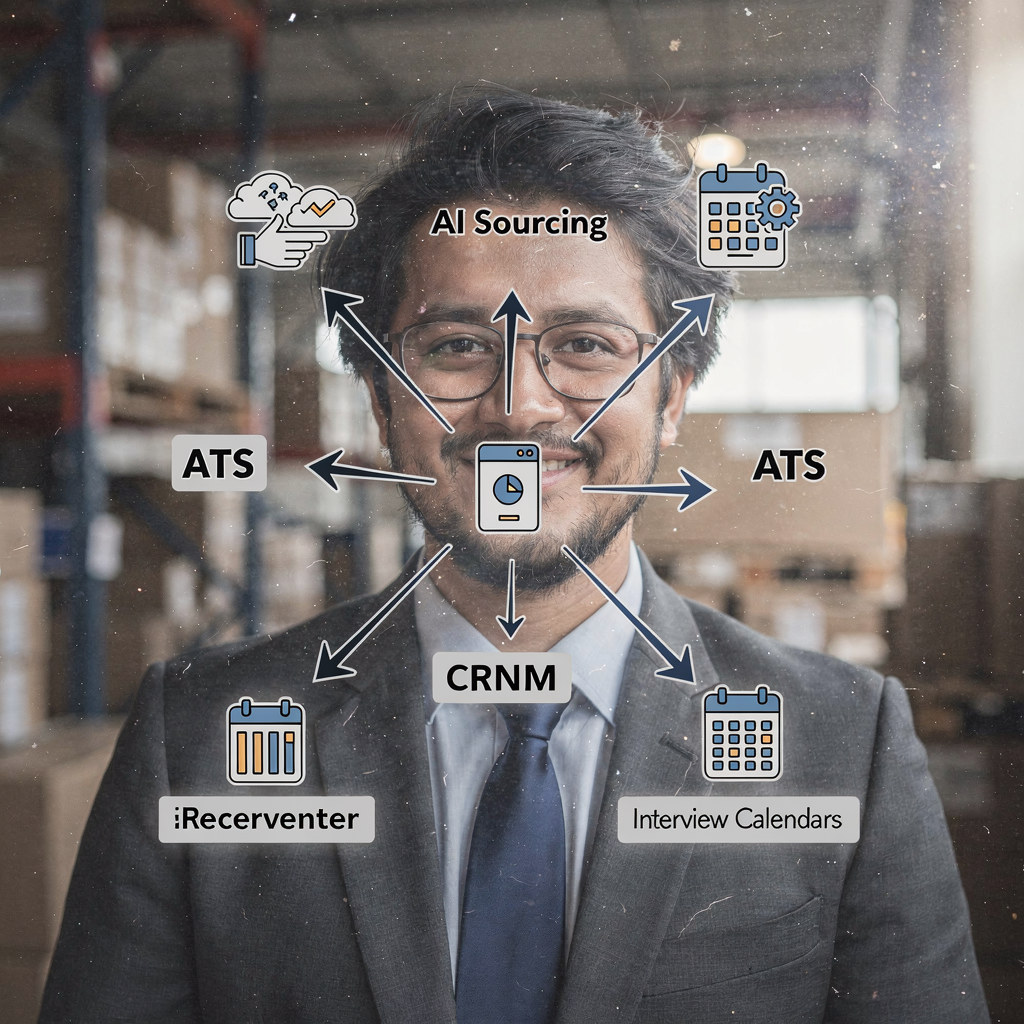
integrate with your existing systems and futureproof hiring: ai in talent acquisition, talent management, ats, crm and next steps for agentic ai in staffing firms
Plan a roadmap that moves from pilot to scale. Start with pilot → measure (quality & compliance) → scale → continuous monitoring. Confirm your vendors can integrate with your ATS and CRM and that they expose APIs for calendar and HRIS sync. Avoid vendor lock‑in by insisting on exportable data formats and migration paths. Procurement should require clear answers on data residency, SLA for model updates and evidence of bias mitigation in published tests.
Agentic ai will expand autonomous tasks, yet humans retain oversight. IBM cautions that expectations often exceed reality; current LLM‑based agents are powerful, but truly autonomous hiring agents are still emerging (IBM: AI Agents in 2025). Monitor regulation, especially EU rules, and track model drift by keeping logs of input, decision factors and outcomes. Make sure your governance process reviews hires for fairness and performance regularly.
Quick procurement checklist for staffing firms: data residency and encryption; SLA for model updates and rollback; integration capabilities with your ATS, CRM and calendar; evidence of bias mitigation; and a plan for human oversight. Also require a roadmap for integrating ai in talent acquisition and talent management workflows so the tool contributes to long‑term workforce planning.
Finally, think about next steps. Run a 90‑day trial that includes at least one high‑volume hiring project. Measure time and resources spent on sourcing and interviewing, compare candidate experience scores, and track quality of hire. Use those results to justify scaling. If you want to automate complex correspondence and reduce manual email handling in operational or candidate communication contexts, explore our guides on ERP email automation and automated logistics correspondence to see how ground‑truth data grounding supports reliable responses (ERP email automation for logistics).
FAQ
What are AI recruiter tools and how do they help recruitment agencies?
AI recruiter tools are software solutions that automate sourcing, screening, outreach and scheduling tasks. They help recruitment agencies by reducing manual work, improving candidate matching, and allowing recruiters to focus on hiring decisions and candidate care.
How do I choose an AI tool that integrates with our ATS and CRM?
Run a 30‑day pilot and check integration depth, API availability and data flow diagrams. Confirm the vendor can export data to your ATS and CRM and provide a clear support and escalation path.
Can AI reduce bias in hiring?
Yes, but only if you audit datasets, use balanced training data and include human oversight checkpoints. The grounded study of HR professionals and developers recommends iterative testing and explainability to manage bias (study).
Will AI replace human recruiters?
No. AI accelerates routine work and acts as an extension of your team. Human recruiters remain essential for assessing culture fit, negotiating offers and making final hiring decisions.
How much time can AI save on sourcing and outreach?
Time savings vary, but teams often report large productivity gains when AI handles repetitive outreach and shortlists candidates. Pilots commonly show faster time‑to‑contact and higher contacts/day.
What is an ai interviewer and should I use one?
An ai interviewer conducts initial assessments and can rate candidate responses. Use it only with transparency and clear scoring rubrics, and always keep a human reviewer in the loop to confirm results.
How do I build trust in AI within my staffing teams?
Train staff on interpreting outputs, maintain audit logs, and provide explainable model outputs. Low baseline trust improves when teams see consistent, documented results and have control over escalation.
What compliance issues should I check before deploying AI in hiring?
Review data residency, consent, and how the vendor handles candidate data. Also confirm the vendor’s readiness for regulations such as the EU AI Act and demand bias mitigation evidence.
How do I measure AI impact on recruiting KPIs?
Track recruiter productivity, time‑to‑fill, candidate experience scores and quality of hire. Compare these metrics during a pilot and after scaling to quantify ROI.
Can AI help with high‑volume hiring?
Yes. AI excels at high‑volume hiring tasks like bulk outreach, initial screening and scheduling. It helps recruitment teams manage volume while maintaining consistency and candidate experience.
Drowning in emails?
Here’s your way out
Save hours every day as AI Agents label and draft emails directly in Outlook or Gmail, giving your team more time to focus on high-value work.