


ai agent: how an ai agent checks room availability and completes reservation in a hotel booking flow
An AI agent checks room availability and completes a reservation by following a short, reliable sequence. First, the AI parses the guest’s request. Then it maps dates, room types and preferences. Next it queries the property management system or booking engine for real-time availability. The core function covers real-time inventory queries, calendar logic, overbooking protection and confirmation flows. For example, the agent reads the calendar, applies business rules, and verifies hold windows to avoid conflicting reservations. The agent also issues a hold token if a room looks available and then prompts for payment and confirmation.
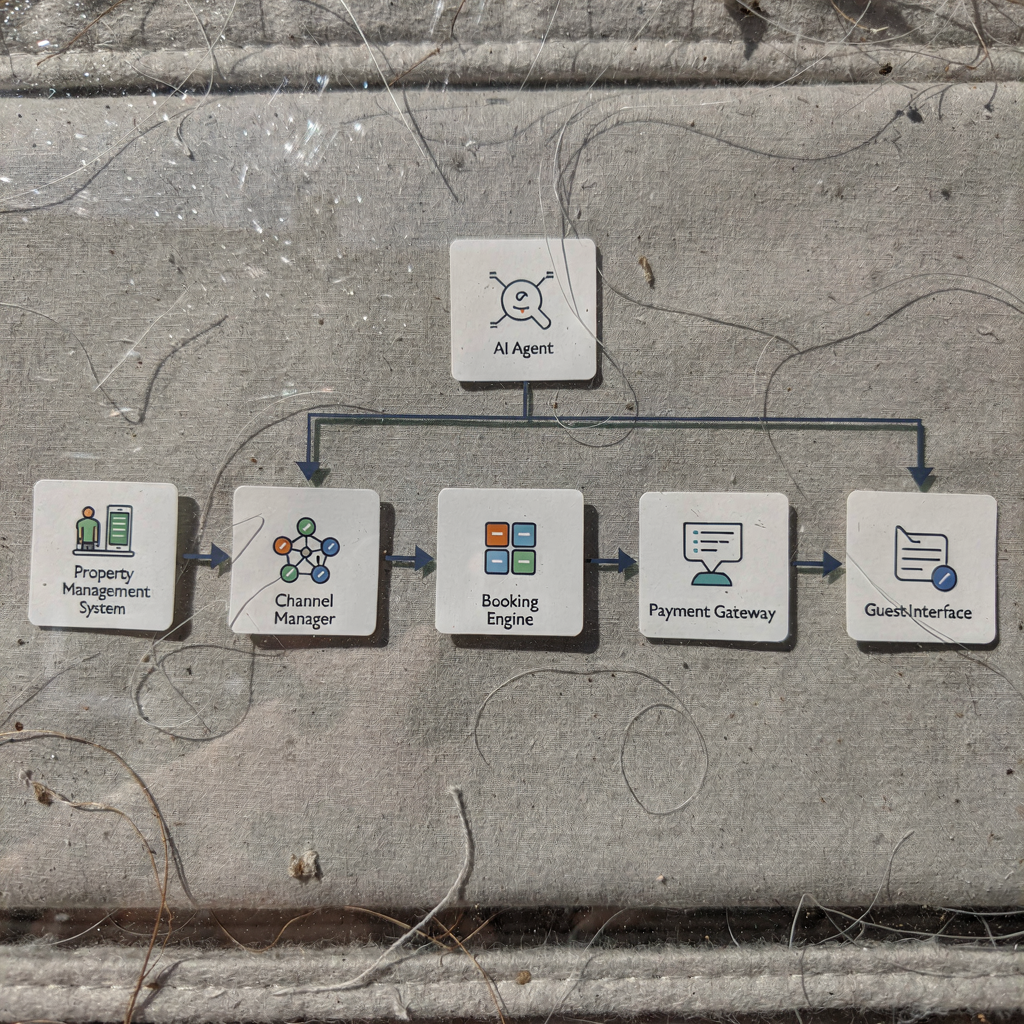
Data flows run between the AI system and existing hotel systems. The agent connects to a property management system or channel manager via API or webhooks. It also checks OTA parity and enforces rate rules. To reduce latency, the AI caches non-critical lookups, while keeping truth-sources for availability in sync. That trade-off prevents stale inventory and reduces false positives. Typical metrics show faster replies and fewer missed calls; reports note response times cut by as much as 60% and higher repeat bookings when accuracy improves (techUK report).
In practice, a short flow looks like this: a conversational query arrives, the AI agent checks room availability, the system places a short hold token, the guest supplies payment, and the agent issues a reservation confirmation. The hold token ties to the booking engine and to the hotel’s management systems. The AI then writes the confirmation email and updates the PMS. Companies such as virtualworkforce.ai show how automation of operational messages reduces handling time and error rates by grounding messages in ERP or booking records (virtualworkforce.ai use case).
Chapter takeaway: the minimal safe sequence is parse → check truth-source → place hold → collect payment → confirm. For complex booking patterns and multi-room bookings the AI agent applies reasoning and planning. This prevents conflicting holds and supports complex booking scenarios. A simple architecture diagram or sequence diagram shows API connections to the property management system, the booking engine, the channel manager, and the payment gateway. This design helps hotels and boutique hotel groups streamline operations while reducing errors and speeding confirmations.
booking and direct booking: using an ai assistant to convert availability queries into direct booking revenue
An AI assistant converts availability queries into direct booking revenue by reducing friction across the booking process. It offers instant offers, personalised upsells and dynamic rates. It also supports one-click checkout and loyalty bundling. When an AI assistant suggests a room upgrade or a package, the guest sees relevant choices and checks out faster. Hotels report higher direct bookings when agents personalize offers and simplify payment flow; pilots show fewer OTA referrals and improved ADR capture (hospitality study).
Revenue impact shows up in measurable KPIs. Direct booking lowers OTA commissions, increases average daily rate (ADR), and lifts conversion from instant replies. A well-tuned AI booking assistant can drive conversion by offering tailored incentives. In one industry trend, adoption of AI voice agents grew sharply and cut contact centre friction, which often translates to higher direct bookings (techUK). Hotels using AI that link offers directly to a booking engine see clearer attribution for revenue. That helps hotel groups and hotel chains capture revenue that would otherwise go to intermediaries.
Practical checklist for revenue-focused deployment: embed direct booking links, include loyalty bundling, show clear cancellation terms, provide instant confirmation receipts, and track conversion events. Also integrate with revenue management and channel managers to keep parity and prevent rate leakage. For operations teams that handle many confirmation emails, tools like virtualworkforce.ai show how automating messages and data updates reduces manual steps and keeps guest data consistent (related workflow reference).
Chapter takeaway: track direct bookings %, conversion rate and ADR uplift. A short KPI dashboard should show conversion, commission saved, and time to confirmation. Use those metrics to decide if the AI assistant should expand offers or tighten guardrails. When done well, an AI booking assistant helps hotels and resorts convert inquiries into revenue while maintaining rate parity and guest trust.
Drowning in emails?
Here’s your way out
Save hours every day as AI Agents label and draft emails directly in Outlook or Gmail, giving your team more time to focus on high-value work.
guest experience and hospitality: personalisation with ai for hotels and hotel ai to improve satisfaction
AI for hotels enhances guest experience by offering personalized options before and during a stay. The AI can recall guest preferences, suggest room types, propose room upgrades, and recommend accessory services. It can also suggest flexible dates when inventory is tight. The goal is a personalized experience that feels effortless. Hotels using these features report stronger loyalty and more repeat bookings. One study links AI-enabled service attributes to higher customer loyalty in hospitality (study).
Personalisation features rely on safe use of guest data and guest profiles. Consent and data minimisation are essential. The AI stores only necessary preferences and lets guests adjust controls at first contact. A hybrid model works best: automate routine replies and simple upsells, and hand complex or emotional guest requests to hotel staff. This preserves empathy. For example, virtualworkforce.ai automates structured messages and routes only the hard cases to humans, which saves time and keeps context for the staff member taking over (automation example).
Measured outcomes include faster responses and higher guest satisfaction. Pilots show improvements in guest satisfaction scores and in certain metrics by 20–30% when personalization and speed combine. Use a template that balances usefulness with privacy. The template should include preference recall, opt-in controls, clear retention policies and an easy way to contact hotel staff. Track guest satisfaction and repeat bookings to validate changes.
Chapter takeaway: adopt a privacy-first personalization template. Include consent at first touch, store minimal guest profiles, enable quick staff handover for complex needs, and measure guest satisfaction. These steps let hotels using AI improve guest interactions while protecting trust and reducing friction in the reservation and stay lifecycle.
voice ai and conversational: deploying voice ai and conversational agents for hospitality contact centres and travel agents
Voice AI and conversational systems provide 24/7 handling for routine inquiries and simple booking changes. They handle multilingual calls, luggage and late-check requests, and simple modifications to reservations. Use cases include voice check-ins, hold extensions, and quick room service ordering. Operational gains include lower wait times, fewer repeat calls, and higher first-contact resolution. Adoption rose sharply in 2024–25 as contact centres modernised (techUK).
Design notes matter. Keep prompts short and give clear confirmation readbacks. Always provide a fallback to a human agent for complex or emotional guest requests. Define clear escalation paths and measure handover rate. A low handover rate may look efficient, but a wrong refusal harms guest satisfaction. For omnichannel operations, integrate session context across chat, voice and app to avoid repeating the same information across channels.
Channel strategy: choose voice when guests expect a conversational flow or when hands-free access helps. Use chat and in-app assistants for visual confirmations and one-click payments. Ensure the system can share context across channels so the guest never repeats the same details across all channels. For contact centre teams, automating routine confirmations and status emails cuts manual work. Virtualworkforce.ai demonstrates how automating operational email flows frees staff to handle the empathetic escalations that matter most (case).
Chapter takeaway: include a voice script checklist and fallback policy that mandate confirmation readbacks, short prompts, clear opt-out phrases, and an escalation path. Track a handover rate metric and aim for safe, timely transfers to human agents to protect guest satisfaction. Also track multilingual coverage and average handle time to quantify value.

Drowning in emails?
Here’s your way out
Save hours every day as AI Agents label and draft emails directly in Outlook or Gmail, giving your team more time to focus on high-value work.
agentic ai and ai solutions: autonomous booking, pricing and the rise of agentic ai in the hospitality industry
Agentic AI acts on behalf of guests to search, negotiate and book with minimal input. It can run price comparisons, request holds, and complete booking transactions. Industry analysis highlights growing consumer readiness for agentic commerce and interest from hotels and travel agents (McKinsey). Agentic AI can revolutionize how guests book hotels by automating repetitive steps and finding better offers.
Market signals show early adoption. Hotels and resorts exploring agentic AI often integrate it with revenue management and channel managers. Integration points include revenue management systems, channel APIs and third-party travel agents. Risks exist. Uncontrolled agentic actions can breach spending limits or cancel bookings. Controls must include guardrails on spending, cancellation policies and audit logs for all actions. Maintain a decision matrix to decide which tasks to automate fully, partially, or not at all.
Practical controls include role-based permissions, transaction logging, human approval thresholds and an audit trail. For instance, allow the AI to suggest upgrades and to place holds automatically, but require human approval for large group bookings. Also track booking opportunities and booking patterns so revenue managers can tune the agentic policies. Hotels using these systems should keep a clear record of each automated action for reconciliation and guest trust.
Chapter takeaway: build a decision matrix that lists routine tasks to automate, partially automate, or keep manual. Link agent actions to revenue management rules. Include emergency stop switches and an incident playbook. These steps help hotels using AI reduce manual work while keeping financial and guest protections intact.
right ai, best ai and risks: choosing the right ai, avoiding hallucinations and securing ai in hotel systems
Choosing the right AI requires clear procurement criteria. Focus on accuracy for availability queries, explainability, ease of integration with existing hotel systems, and compliance with EU and other privacy rules. Also consider vendor lock-in. Test models on realistic booking patterns and inventory scenarios. Ask for explainability and traceable decision logs from vendors claiming to be top AI or best AI.
Common failure modes include stale inventory, conflicting holds, and hallucinated offers. Mitigate these by grounding the AI in truth-sources such as the property management system and the booking engine. Use short hold windows, reconciliation jobs and human review for exceptions. Also require encryption, role-based access and transaction logs. Plan a simple incident playbook for booking errors that includes immediate rebooking options and customer-centred remediation.
Security and trust go hand in hand. Encrypt data in transit and at rest. Define roles for hotel staff that control who can approve refunds or override holds. Use consent and clear opt-outs for guest data collection. Pilot steps should start small: pick one route or one property, measure outcomes, and iterate. Include staff training and adjust SLAs before scaling. Tools that automate email confirmations and operational messages can reduce manual load and improve traceability; virtualworkforce.ai provides examples of how to automate email lifecycle tasks while keeping control and governance in the hands of operations teams (pilot approach).
Chapter takeaway: use a short procurement checklist and an incident playbook. Require integration tests, a fail-safe hold policy, audit logging and human escalation. Start with a pilot, measure conversion uplift and guest satisfaction, then scale. That approach reduces risk and helps hotels using AI preserve guest trust and operational integrity.
FAQ
What is an AI agent for hotel booking?
An AI agent is a software system that handles booking tasks such as checking availability, placing holds and completing payments. It automates routine steps in the reservation flow and hands complex cases to human staff.
How does AI check room availability?
The AI queries a property management system or booking engine for real-time availability and applies calendar logic and business rules. It may place a timed hold while the guest completes payment to avoid overbooking.
Can an AI assistant increase direct bookings?
Yes. By offering instant, personalised offers and simplified checkout, an AI assistant can increase direct booking rates and reduce OTA commissions. Measuring conversion and ADR uplift helps verify impact.
Are voice AI systems reliable for contact centres?
Voice AI systems handle routine inquiries well and reduce wait times, but they must include clear fallbacks. Always provide an easy path to a human agent for sensitive or complex guest requests.
What is agentic AI in hospitality?
Agentic AI acts on behalf of the guest to search, negotiate and book with minimal input. It can automate entire booking opportunities but should operate behind guardrails and audit logs to prevent errors.
How do hotels avoid AI hallucinations?
Ground the AI in authoritative sources like the property management system and the booking engine. Use reconciliation checks, short hold windows and human review for exceptions to avoid hallucinated offers.
What privacy controls should hotels use with AI?
Use consent, data minimisation and clear retention policies. Give guests simple controls to edit preferences and opt out, and restrict staff access with role-based permissions.
How should a hotel start an AI pilot?
Scope a single use case, integrate with one property or channel, define KPIs and train staff for handovers. Measure results, iterate, and then decide go/no-go based on defined metrics.
What KPIs should hotels track for AI booking agents?
Track response time, conversion rate, direct bookings %, ADR uplift, handover rate and guest satisfaction. These KPIs show both revenue and service impacts.
How do AI solutions integrate with existing hotel systems?
AI solutions connect via APIs, webhooks and channel manager integrations to the property management system and booking engine. They must sync rates and availability to preserve parity and avoid conflicts.
5-step pilot plan: 1) Scope the use case and property, 2) Map integrations with property management and booking engine, 3) Define KPIs and guardrails, 4) Train hotel staff and run the pilot, 5) Review metrics and decide go/no-go.
Drowning in emails?
Here’s your way out
Save hours every day as AI Agents label and draft emails directly in Outlook or Gmail, giving your team more time to focus on high-value work.