


AI and textile: how ai agents help optimize textile production with fabric inspection and quality control
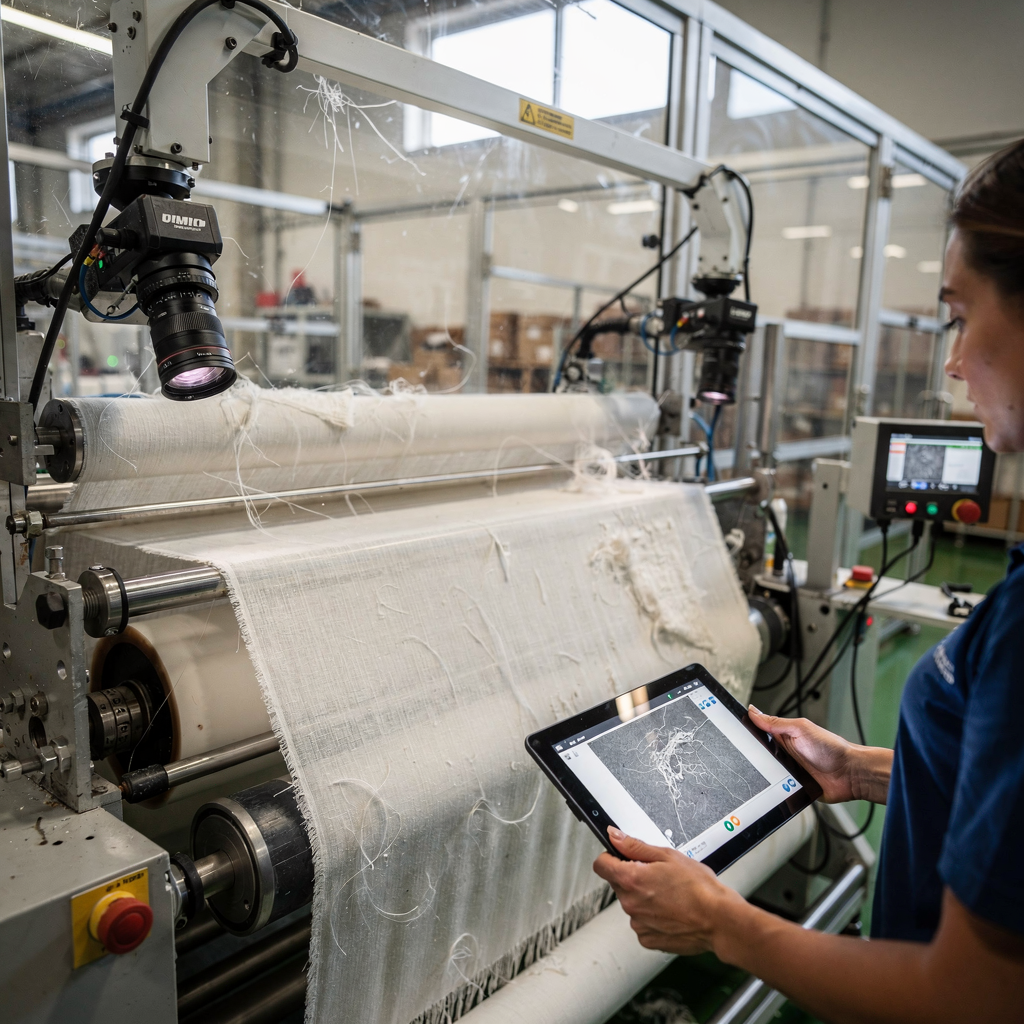
AI is changing how factories check fabric and maintain consistent fabric quality. First, vision systems pair cameras with deep learning to spot holes, stains and weave faults as the material moves. Next, these systems flag issues on production lines and create structured reports for operators. For example, vendors have built on-line inspection tools that run at line speed and detect tiny faults that human eyes miss. The result is fewer throws to rework and a higher first-pass yield.
Also, automated visual inspection reduces manual checks while it speeds throughput. For instance, FabricEye and Serkon.AI supply tools that monitor rolls continuously and alert technicians when parameters fall outside limits. In practice, this lowers rework and reduces wastage. A manager can then redirect staff to value tasks instead of repetitive inspection. In addition, integrating these tools with shop-floor systems helps capture defect locations and link them to raw material batches.
Furthermore, inspection systems do more than find a flaw. They classify fault type, measure size and store images for traceability. Then, factories can analyze patterns and adjust processes. For example, detecting consistent edge fraying may point to a loom setting or a supplier issue. By contrast, a sporadic stain suggests handling errors. These insights help textile manufacturers reduce costs and improve consistent quality.
Also consider measurable gains. Vision systems typically increase detection accuracy and inspect continuously at high speed. As a result, first-pass yield improves and waste falls. Moreover, managers report faster decisions because data is available immediately. For operations teams overwhelmed by manual messages about quality, AI agents can also automate the email workflow around exceptions. Our platform for operational email removes triage time and routes context-rich alerts to the right people; see how a virtual assistant for logistics handles similar tasks here.
Practical next step: run a short pilot that compares manual checks to a vision system across one shift. Track defect counts, processing time and handling emails. Then, ask vendors about integration with MES. Also measure ROI from fewer rejects and lower rework.
Agentic and autonomous: agentic ai and autonomous operations for real-time optimization in textile manufacturing
Agentic AI means systems that set goals, plan steps and act with limited human input. First, an AI agent observes sensor feeds and decides on corrective moves. Next, it can change a parameter on a machine, or request a human override. By contrast, autonomous operations focus on systems that run without continual human control. Both approaches reduce variability on production lines and help optimize textile workflows.
Also, agent behaviour follows three stages: sense, plan, act. Sensors collect vibration, tension and temperature. Then, models analyze the data and propose actions. Finally, controllers apply those actions within safety bounds. In many factories, an edge AI module performs the sensing and short-loop intervention, while a central AI platform coordinates longer-term planning. This split keeps latency low and governance intact.
Furthermore, a real time feedback loop speeds correction. For instance, if a loom starts to drift, an AI agent can adjust RPM or tension to prevent a defect. If the agent cannot resolve the issue, it escalates via an automated message that contains images and suggested fixes. In addition, these systems include constraints and safety checks so they never exceed machine limits.
Also, when you compare agentic ai to traditional automation, the difference is adaptability. Traditional automation follows fixed rules. Agentic systems plan with goals and adapt when conditions change. As a result, factories can handle material variability and new fabric types without lengthy reprogramming. For options on how to scale agent-driven workflows in logistics and operations, review a practical guide on scaling operations with AI agents here.
Practical next step: map a short feedback loop that covers sensing, decision rules and actions. Then, test a safe intervention on a non-critical line. Track decision latency, number of human escalations and the number of prevented quality incidents. Finally, record lessons for governance and safety checks.
Drowning in emails?
Here’s your way out
Save hours every day as AI Agents label and draft emails directly in Outlook or Gmail, giving your team more time to focus on high-value work.
Industrial ai and predictive maintenance: predictive systems to reduce downtime and integrate into textile operations and supply chain
Industrial AI brings predictive intelligence to machines so teams can cut unplanned downtime. First, sensors on motors, bearings and drives feed models that detect signature shifts. Then, these models predict failures before they occur. As a result, maintenance teams plan interventions and avoid huge stoppages. Predictive maintenance is especially useful on looms and finishing lines where breakdowns stop several downstream production processes.
Also, common signals to monitor include vibration, temperature, acoustic emissions and RPM. These inputs help AI models identify bearing wear, misalignment or overheating. In addition, 5G and IoT systems often provide the low latency needed for quick alerts. For example, a system that flags rising vibration may reduce downtime by allowing an overnight repair instead of a daytime emergency fix.
Furthermore, the KPIs to expect include lower MTTR, higher uptime and reduced spare-part spend. A simple KPI set could be: mean time between failures, MTTR and percentage of unplanned downtime. Also measure productivity gains from less idle time on production lines. For integration, link predictive alerts into MES or ERP so maintenance work orders generate automatically. Our experience automating operational emails can show how to route and document these alerts inside existing IT systems; see ERP email automation for logistics resources.
Also, implement predictive systems in three steps. First, deploy sensors and a temporary data store. Second, run models to baseline normal operation and collect labelled events. Third, integrate alerts with maintenance processes and measure impact. A short checklist helps get started: define monitored assets, select sensor types, set data retention, train a baseline model and define escalation rules. Track ROI by comparing planned versus unplanned downtime over a quarter.
Practical next step: pick a critical loom and add vibration and temperature sensors for 30 days. Then, run a predictive model and track alerts and follow-up actions. Finally, review MTTR and downtime figures to calculate ROI.
AI-powered automation and orchestration: using ai to automate, scale and orchestrate textile industry processes for scalable optimization
AI-powered orchestration coordinates inspection, cutting, dye and packing to reduce queues and idle time. First, an orchestration layer reads production schedules and machine states. Then, it sequences jobs to cut changeover and balance load. Also, orchestration aligns upstream and downstream tasks to avoid bottlenecks and improve throughput.
Furthermore, a typical orchestration stack includes edge controllers for immediate actions, a central AI platform for planning and an integration layer to connect MES, ERP and warehouse systems. This stack lets textile businesses scale from pilot to factory-wide optimisation. For instance, aligning dye batches with cutter availability cuts wait time and lowers water usage. In addition, orchestrated sequences can reduce wastage by matching batches to fabric types and dye chemistry.
Also, start small with a pilot that links two systems, such as inspection and cutting. Then, measure cycle time, changeover time and the number of manual hand-offs. Next, expand to include dye and finishing steps. Pilot metrics for scalability should include throughput per shift, percentage of automated routings and reduction in manual interventions. Also track customer-facing timelines to see downstream benefits.
Furthermore, orchestration reduces variability by replacing manual scheduling with AI-powered decision-making. It can also manage exceptions and reroute work if a machine fails. Finally, clear integration points are critical. Work with system integrators and set up data fabric and APIs so the orchestration layer can analyze production data and act quickly. For ideas on automating email-driven exceptions and routing, review how automated logistics correspondence tools handle operational messages examples.
Practical next step: choose one workflow to orchestrate, define start and end points, connect the two systems and run the pilot for one production week. Track queue times, manual hand-offs and cycle time improvements.

Drowning in emails?
Here’s your way out
Save hours every day as AI Agents label and draft emails directly in Outlook or Gmail, giving your team more time to focus on high-value work.
Sustainable practices and waste: ai in textiles for textile waste management, recycling and sustainable practices across the supply chain
AI helps reduce waste through better sorting, traceability and reverse logistics. First, vision and spectral analysis classify fabric types, separating cotton, polyester and blends. Then, AI models guide recycling centres to route materials to appropriate processes. Studies from 2014 to 2024 show that AI improves sorting accuracy and helps reclaim higher‑quality fibres, which supports circular economy goals research.
Also, AI agents can read labels, barcodes and batch data to track raw material origins. This traceability aids compliance and helps brands meet sustainability targets. In addition, reverse logistics becomes more efficient when classification data informs routing and repair decisions. For example, fabrics that are pure cotton may go to mechanical recycling, while mixed fibres are routed to chemical recovery or downcycling.
Furthermore, there are technical limits. Blended fabrics remain hard to separate at scale without dedicated processes. Also, current sorting accuracy depends on training data and sample coverage. Despite this, factories that use AI-enabled sorting often see lower wastage and fewer loads sent to landfill. For wearable tech or smart textiles, AI can also support design that reduces materiali intensity while preserving function study on AI-driven design.
Also, environmental KPIs include reduced landfill percentage, lower water usage and lower carbon per garment. For instance, better sorting improves recycling yields and so cuts the need for virgin raw material. In addition, AI-driven demand forecasting helps limit overproduction and lowering unsold inventory. As a practical note, textile businesses should combine sorting pilots with traceability projects and link them to supplier reporting.
Practical next step: pilot an AI sorting line for mixed waste streams and track reclaimed fibre quality, percentage sent to landfill and water usage. Also ask suppliers for batch-level data to test traceability. Finally, monitor regulatory benefits and any cost offsets from reclaimed materials.
Key benefits and the future of ai: how ai agents drive quality control, cost reduction and the future of ai in the textile industry
AI agents drive measurable gains across quality and cost. First, expect fewer defects, higher uptime and faster turnarounds. Second, reducing rework cuts direct labour and material costs. Third, better traceability improves compliance and customer trust. These are core ROI drivers for operations managers evaluating new technology.
Also, top benefits include improved first-pass yield, lower wastage, reduced downtime, faster cycle times, stronger sustainable manufacturing credentials and easier scaling. In practice, early adopters report productivity gains from automating repetitive tasks and faster decision loops. For market context on adoption and trends, review industry statistics and predictions about agent adoption industry report and McKinsey on how generative systems enrich ideation analysis.
Furthermore, challenges remain. Integrating multiple data sources requires a robust data fabric. Also, designing unified agentic ai that balances cognition, planning and interaction is still a grand challenge review. In addition, many textile manufacturers must address data quality and legacy system constraints. Finally, unique challenges of the textile include material variability and blend complexity, which need careful model training.
Also, a governance checklist helps reduce risk. First, define escalation paths and safe action limits. Second, keep humans in the loop for high‑risk decisions. Third, capture logs for traceability and audits. Fourth, measure key metrics like ROI, defect reduction and time saved on email triage. For help automating exception messages and ensuring consistent replies across stakeholders, see how email automation improves logistics operations resource.
Practical next step: build a 90‑day roadmap that includes a pilot, integration plan, KPI targets and an ROI estimate. Then, pick one production process to optimize, record baseline metrics and run the pilot. Finally, capture lessons and plan the expansion to other value chain points.
FAQ
What is the difference between agentic AI and traditional automation?
Agentic AI sets goals, plans and adapts, while traditional automation follows fixed rules. Agentic systems can respond to changing conditions without full human reprogramming.
Can AI systems detect all fabric defects?
No. Vision systems detect many common defects like holes and stains, but some issues still need human review. Also, detection quality depends on camera resolution and training data.
How does predictive maintenance reduce downtime?
Predictive maintenance uses sensor data to predict failures before they occur. As a result, teams schedule repairs and avoid unplanned downtime, improving MTTR and uptime.
Will AI replace production staff?
No. AI automates repetitive tasks and supports decisions, but humans still manage complex exceptions and strategy. Also, teams shift to higher value work as routine tasks decline.
How can small textile businesses start with AI?
Start with a focused pilot on one line or task, such as vision inspection or predictive sensors. Then, measure KPIs and scale when you see clear benefits.
What sustainability gains can AI deliver?
AI improves sorting, reduces wastage and supports traceability, which lowers landfill and water usage. In addition, better demand forecasting curbs overproduction.
How do AI agents handle supplier variability?
AI models can analyze supplier batch data and detect patterns of inconsistency. Also, traceability lets teams identify where raw material issues originate.
Are there governance risks with autonomous operations?
Yes. Risks include unsafe automated actions and data privacy concerns. Therefore, implement safety limits, human oversight and audit logs for all agent decisions.
What KPIs should managers track in pilots?
Track defect rates, first-pass yield, MTTR, unplanned downtime, cycle time and handling time for operational messages. Also measure ROI from reduced rework and faster responses.
How long before AI projects show ROI?
Some pilots show benefits within weeks for inspection and email automation. More complex integrations, like full orchestration, may take quarters to deliver full ROI.
Drowning in emails?
Here’s your way out
Save hours every day as AI Agents label and draft emails directly in Outlook or Gmail, giving your team more time to focus on high-value work.