


AI for automotive: how AI is reshaping the automotive industry
AI is changing how suppliers and car dealerships operate every day. Suppliers and dealerships use AI to turn sensor, production and market data into faster decisions and measurable gains. First, AI processes streams of data from factory lines, from telematics and from supply chain partners. Next, it turns raw signals into actions that reduce downtime and improve throughput. The dominant architecture today is a cloud plus edge hybrid. McKinsey notes that “Many current-generation in-vehicle generative AI applications use cloud-based or hybrid approaches for model execution, enabling suppliers to deliver smarter, more responsive components that enhance vehicle performance and safety” McKinsey. That hybrid split keeps latency low while supporting fleet learning in the cloud.
Why must suppliers adopt AI now? Market pressure and measurable KPIs demand it. Suppliers that use AI often report productivity lifts. Recent industry analysis highlights productivity improvements of up to 20% in AI-enabled factories S&P Global. In addition, the AI assistant market is growing fast and cloud solutions lead because they scale and reduce upfront cost Grand View Research. Track a focused set of KPIs. Downtime, OEE, lead time and service NPS show progress. Also track return on investment and mean time between failures for assets. For operations teams that deal with frequent email and supplier queries, AI agents can reduce manual triage and speed replies, which helps improve operational OEE. Learn how automating logistics correspondence can reduce handling time with tailored AI agents for ops by visiting our guide on automated logistics correspondence.
Use this chapter as context for the rest of the article. It outlines market context, why suppliers must adopt AI and which headline KPIs to track. The future of AI in the supply chain is bright. Suppliers that act early gain a measurable edge. The future of automotive will be data driven, faster and more responsive to customer signals.
use cases of AI: predictive maintenance, quality control and supply chain optimisation
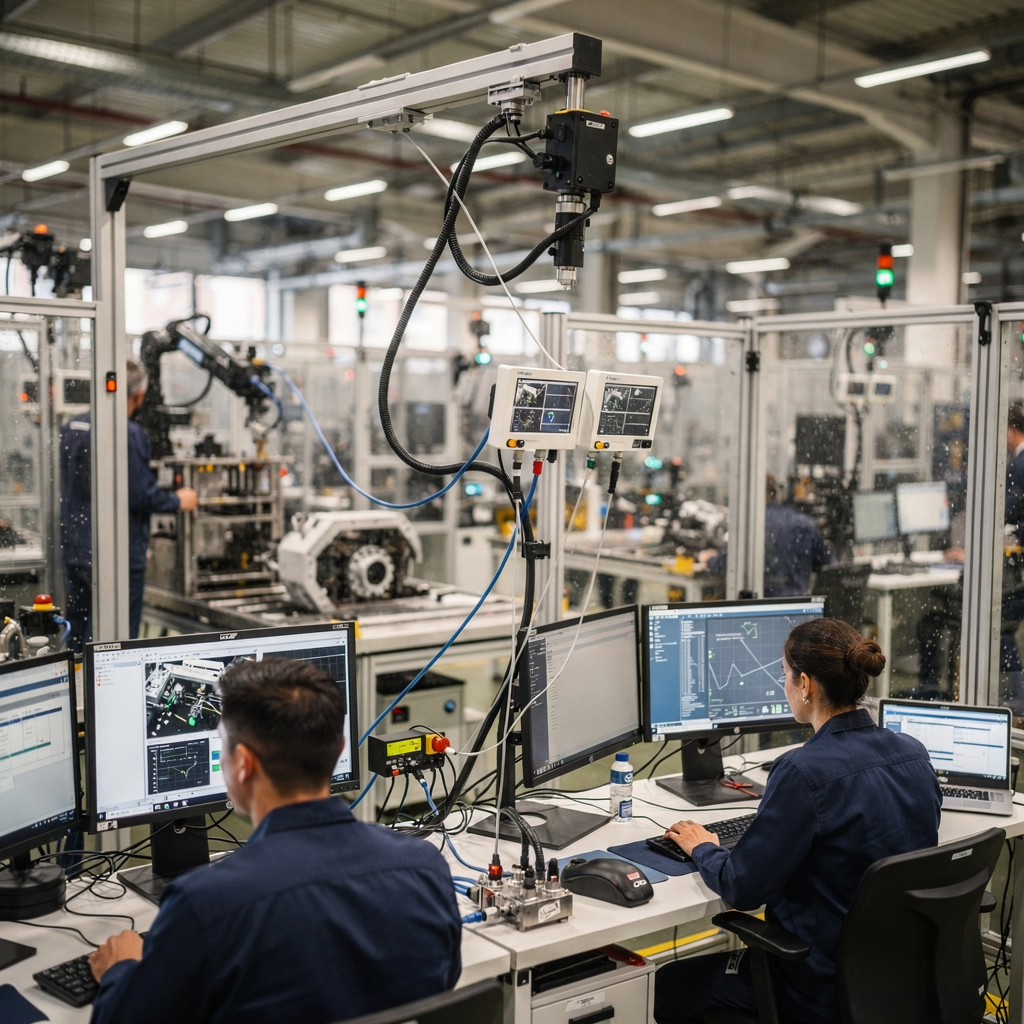
This chapter outlines core use cases for suppliers. Primary use cases include predictive maintenance, automated visual inspection and demand forecasting. Predictive maintenance aims to reduce unplanned downtime by 20–30%. For example, line-side anomaly detection flags vibration, temperature or acoustic patterns. Then the AI agent triggers an anomaly alert and creates a maintenance work order. Automated pass/fail cameras catch surface defects and assembly errors. The result is fewer defects and faster repair cycles. Demand and parts forecasting shortens lead times and reduces excess inventory. These applications improve OEE and lower cost.
Start small and prove value quickly. Instrument high-value assets first. Run a three-to-six month pilot. Measure ROI and track measurable outcomes like reduced downtime and lower defect rate. Use a controlled data pipeline and integrate with ERPs. Our platform experience shows that automating parts of the ops email lifecycle speeds approvals and part sourcing. For teams focused on logistics emails, see our instructions on ERP email automation for logistics to link operational data into workflows. In addition, a focused pilot that combines visual inspection with predictive alerts often delivers payback within a single production quarter. Cloud and edge hybrid deployments let models run close to the line for real-time decisions, while fleet updates and retraining happen in the cloud. That split reduces latency and ensures model updates reach vehicles and modules reliably.
For technical teams, implement sensors, consolidate data and use a repeatable workflow for model validation. Use the pilot to compare automated versus manual mean time to repair. If you want a practical starting set, consider three projects: predictive maintenance on a bottleneck press, automated visual QC on a final assembly station and a short-horizon parts forecast. These use cases of AI deliver clear, measurable returns and help suppliers move from experimentation to scaled delivery.
Drowning in emails?
Here’s your way out
Save hours every day as AI Agents label and draft emails directly in Outlook or Gmail, giving your team more time to focus on high-value work.
Dealerships and automotive retail: conversational AI, virtual assistant and sales assistant for better customer experience
Car dealerships and dealership groups use AI to improve customer experience and to speed the buying process. Conversational AI powers chat, qualifies leads and books test drives. A virtual assistant can answer common queries, schedule service and guide car buying decisions. Salesforce research shows strong consumer appetite for agentic AI: 61% of U.S. drivers want AI agents to help find and recommend the best car Salesforce. That expectation drives demand for richer digital tools at the point of sale. Dealerships that deploy an AI-powered virtual assistant often shorten lead response time and increase appointment bookings.
Use AI to support both the showroom and service lane. An AI sales assistant helps the sales team handle queries and frees the salesperson to focus on closing. An AI agent can pre-qualify buyers, surface preferred trims and arrange financing pre-approval. For service, customers use a conversational AI flow to schedule service appointments and to check estimated wait times. These flows cut wait times and raise CSAT. In practice, dealerships that combine chat with live handover gain higher show rates and better lead-to-sale conversion. For operations teams that juggle many inbound service emails and parts requests, AI agents can automate the email lifecycle to resolve routine queries and route exceptions to a human. Learn more about how to improve logistics customer service with AI on our guide to how to improve logistics customer service with AI.
Track specific KPIs: lead response time, appointment booking rate, CSAT and conversion-to-sale. Also measure repeat business and average service repair order value. AI-driven tools deliver measurable boosts in speed and consistency. Ultimately, well‑designed conversation flows and a connected AI platform reduce manual work and lift customer satisfaction across automotive retail channels.
ai-powered agents and gen ai: in‑car assistants and advanced AI that revolutionize automotive experiences
Advanced AI and generative AI are shaping in-car experiences and vehicle services. In-car assistants deliver natural language interactions, contextual suggestions and personalised content. For safety and latency reasons, many in-car features run on edge compute while model training and fleet learning happen in the cloud. As McKinsey explains, this hybrid approach lets vendors deliver responsive functions and continuous improvement McKinsey. Suppliers must provide embedded compute, secure model updates and clean API integration for OEM services.
Generative AI and gen AI accelerate content creation for UX and for diagnostics. For example, advanced AI can draft diagnostic narratives for service technicians. It can also personalise route suggestions and in-car entertainment. Voice AI enables hands-free control and reduces distraction. OEMs and suppliers need clear governance for model updates and for data privacy. AI agents for automotive must be secure, auditable and robust under intermittent connectivity. For companies integrating many tools, an ai platform that manages deployments and rollback simplifies the release process.
Suppliers who supply sensors, ECUs and embedded modules will be evaluated on their ability to support secure OTA model updates and to integrate with OEM backends. AI-powered virtual assistants in cars will become a key differentiator. This is the future of automotive and the future of AI for mobility. Suppliers who design with safety and low latency in mind will win long-term contracts. For teams exploring how to operationalise AI agents for in-vehicle and backend workflows, consider piloting an ai agent for diagnostics and a gen ai workflow for service text generation. These projects demonstrate clear return on investment and shorten time to production.

Drowning in emails?
Here’s your way out
Save hours every day as AI Agents label and draft emails directly in Outlook or Gmail, giving your team more time to focus on high-value work.
Automation to automate workflows: how AI boosts suppliers — benefits of AI across manufacturing, supply chain and quality
Automation and AI combine to automate recurring workflows across plants and partners. AI systems automate inspection, scheduling, parts routing and routine supplier communications. This reduces manual handoffs and repeated lookups. For operations teams, AI can transform the largest unstructured workflow: email. virtualworkforce.ai builds AI agents that automate the full email lifecycle for ops teams, which trims handling time and improves traceability. That kind of automation helps suppliers focus engineering time on higher value work.
The benefits of AI are clear. Higher throughput, fewer defects, lower inventory cost and faster ramp to volume are common outcomes. Track cycle time, defect rate, stock days and mean time between failures. Also include total cost of ownership for AI tools when you model ROI. Many teams see a payback window inside a few quarters on targeted projects. The benefits of AI show up across supply chain and production. For example, predictive alerts reduce unplanned stops, and automated QC lowers scrap rates. AI systems also improve supplier-to-OEM integration by standardising messages and by routing exceptions.
To achieve these outcomes, choose a single platform that connects data sources and can operate across every channel. For logistics-heavy suppliers, automation that links ERP and emails speeds parts approvals and confirmations. See how teams scale operations without hiring in our guide on how to scale logistics operations without hiring. Use staged pilots, measure KPIs and then scale. With clear metrics in place, AI not only boosts efficiency but also reduces transactional errors and improves customer engagement.
Transform and implement: use AI to seamlessly improve customer satisfaction, streamline customer service and book a demo
Transforming an organisation with AI requires a clear plan and disciplined execution. Begin with a firm business case and a defined ROI. Next, secure the data pipeline and decide on edge versus cloud for each workload. Run a controlled pilot and measure the agreed KPIs. Typical pilot windows are three to nine months. Popular proof-of-value projects include predictive maintenance, chatbots that schedule service appointments and visual quality control lines. These projects deliver measurable outcomes and support scaling.
Manage risks with practical mitigations. Protect data with encryption and careful access controls. Limit model drift with scheduled retraining and use staged updates or federated learning where needed. Prepare teams for change with operator upskilling and clear escalation paths. For email-heavy operations, an ai agent that understands intent and routes or resolves emails can reduce handling time from about 4.5 minutes to 1.5 minutes per message, while improving consistency. Learn about ROI scenarios and demo plans in our resources on virtualworkforce.ai ROI for logistics.
Set a clear call to action. Prepare a short demo scope with live KPI targets and a 90-day pilot plan. Book a demo to validate assumptions and to set expectations for return on investment. Use an ai platform that connects to ERPs, TMS and WMS so automation works across systems. When you start with concrete goals and a staged rollout, you can improve customer satisfaction and streamline operations rapidly. To move forward, build a pilot that targets measurable wins, then scale across plants and across the supply chain.
FAQ
What is an AI assistant for automotive suppliers?
An AI assistant for automotive suppliers is a software agent that automates data analysis, communications and routine decisions. It can handle tasks like email triage, maintenance alerts and parts forecasting to reduce manual work and improve throughput.
Which use cases of AI deliver the fastest ROI?
Predictive maintenance, automated visual inspection and email automation often show fast ROI. Pilots in these areas usually prove value within three to nine months because they reduce downtime and cut handling time.
How do dealerships benefit from conversational AI?
Conversational AI qualifies leads, books test drives and schedules service appointments. It reduces lead response time and increases appointment booking rates while freeing sales teams to focus on closing deals.
What is the role of generative AI in vehicles?
Generative AI helps create personalised content, diagnostic narratives and UX text in cars. It speeds content generation for in-car experiences while edge AI handles low-latency tasks for safety.
How can suppliers ensure data security when implementing AI?
Use encryption, access controls and staged model updates. Consider federated learning for sensitive data and apply strict governance to protect IP and customer information.
What KPIs should suppliers track when deploying AI?
Track downtime, OEE, lead time, defect rate, stock days and mean time between failures. Also measure return on investment and customer satisfaction to assess business impact.
How do AI agents for automotive improve customer satisfaction?
AI agents resolve routine queries, route exceptions and provide faster, consistent replies. These capabilities reduce wait times and increase reliability, which improves customer satisfaction.
Can AI systems integrate with existing ERPs and WMS?
Yes, modern AI platforms provide connectors and APIs to integrate with ERPs, TMS and WMS. This integration creates end-to-end automation and reduces manual data lookups.
What is a practical first pilot for implementing AI?
Start with a high-value, measurable workflow such as predictive maintenance on a bottleneck machine or an email automation pilot for parts requests. These pilots validate ROI and build confidence for scaling.
How do I book a demo and what should it include?
Book a demo with a clear scope: target KPIs, a 90-day pilot plan and data access requirements. The demo should show live examples, projected ROI and a roadmap to scale the solution across operations.
Drowning in emails?
Here’s your way out
Save hours every day as AI Agents label and draft emails directly in Outlook or Gmail, giving your team more time to focus on high-value work.