


ai assistant, ai chatbots and ai voice agent: automate customer support and inbound calls
AI assistants and AI chatbots now automate the bulk of routine customer support for courier companies. They handle frequently asked questions, track packages, and confirm delivery windows so phone agents can focus on complex problems. For example, FedEx reported that Nina resolves about 80% of enquiries without handover to a human agent, which freed staff for higher‑value tasks (FedEx Nina ~80% self‑service). Also, UPS cut response times by roughly 50% after deploying its assistant, MeRA, which improved speed and customer satisfaction (UPS MeRA 50% faster).
Practical deployments combine an AI voice agent with text chat and email. This approach keeps customers informed across SMS, CRM and tracking channels. Integrations with ERP and CRM systems let the AI surface order status and delivery updates automatically. Then the virtual assistant can fetch real-time data from TMS or WMS and reply with accurate delivery details. If the AI cannot resolve an inquiry, it routes the thread to a human agent with full context and suggested replies. This reduces average handle time and lowers abandoned‑call rates for inbound calls.
virtualworkforce.ai helps operations teams automate email and inbound workflows by connecting ERP, TMS and WMS data to the AI. Our platform labels intent, drafts grounded replies, and routes or resolves messages. Teams typically cut email handling time from ~4.5 minutes to ~1.5 minutes per message. Therefore support teams scale without hiring. For more detail on how a logistics assistant can automate email and triage, see our guide on virtual assistant logistics (virtual assistant logistics).
Start small and measure containment. Track self‑service rate, transfer rate to human agents, and customer satisfaction. Also measure phone support metrics alongside chat containment so you capture the full benefit of automation. Finally, remember to configure tone and escalation rules so the AI follows brand voice and hands off when necessary. This approach keeps customers informed and reduces operational friction at scale.
logistics operations, dispatch and analytics: optimize deliveries with ai in real-time
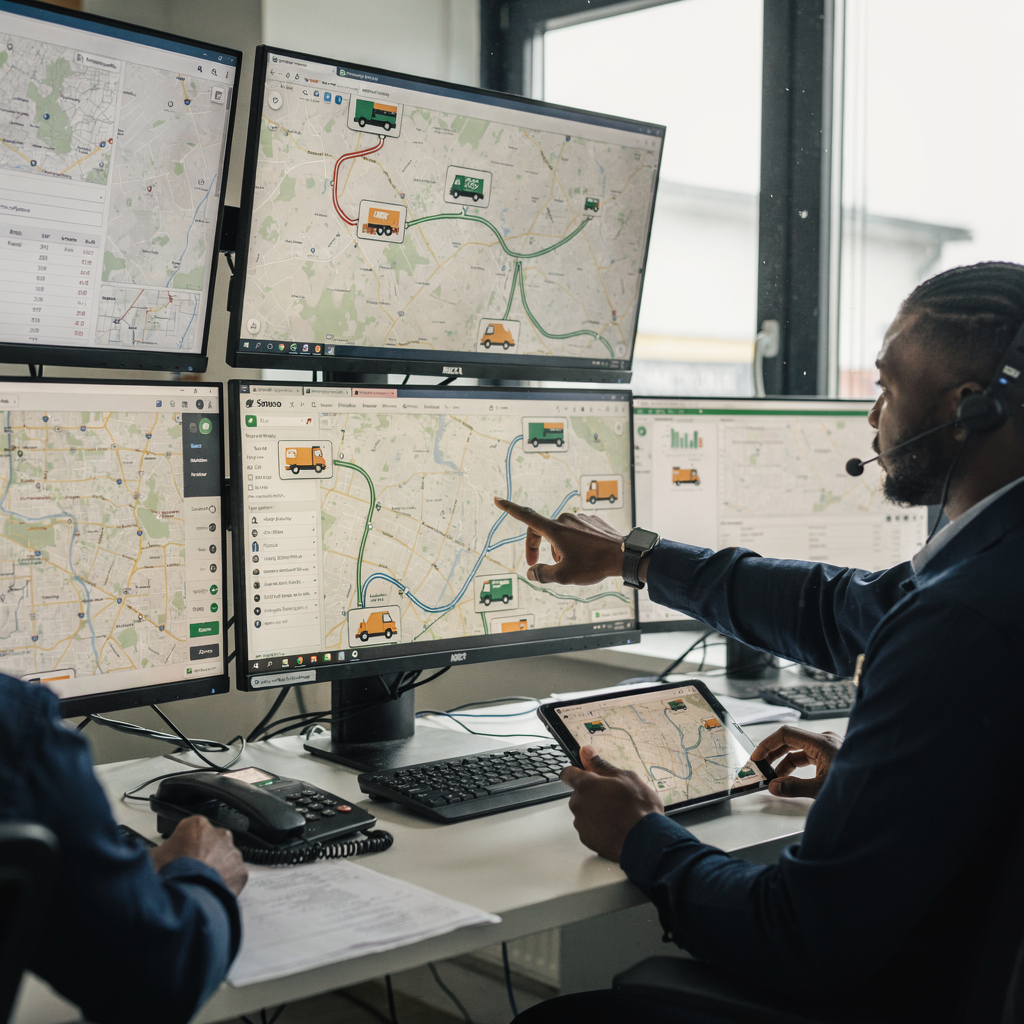
AI in logistics operations brings real-time analytics to dispatch and routing. It analyzes traffic, weather, driver telemetry, and historical patterns to optimize delivery routes and update ETAs. Real-time route optimization lowers fuel use and cuts last‑mile delays. As FarEye explains, processing large datasets lets providers consider many variables at once, which results in faster, more reliable deliveries (FarEye on last‑mile AI).
Use cases include dynamic dispatch, load balancing across fleets, and automated ETA updates. An AI agent can rebalance runs when a vehicle falls behind. It can suggest alternative routes and reassign stops to an available dispatcher. This reduces driver idle time and improves on-time delivery. Key KPIs to monitor are on-time delivery rate, average delivery time, driver idle time, and fuel per km. These metrics tie AI actions directly to operational costs and service levels.
Analytics and machine learning also detect patterns that humans miss. For example, AI can flag repetitive delay causes on certain routes. Then teams can redesign schedules or change delivery windows accordingly. To streamline rollout, pilot the solution on high-volume corridors. Integrate AI with TMS and telematics so data flows seamlessly. If your team wants to explore email-driven automation for dispatch exceptions and updates, check our logistics email drafting resource (logistics email drafting AI).
In short, AI logistics assistants enable real-time updates and smarter dispatch decisions. They connect planner tools, telemetry and customer‑facing channels to reduce manual rework. Therefore, logistics teams can optimize delivery performance while cutting fuel and labour costs. This combined approach supports a measurable ROI and improves the speed and precision of last‑mile operations.
Drowning in emails?
Here’s your way out
Save hours every day as AI Agents label and draft emails directly in Outlook or Gmail, giving your team more time to focus on high-value work.
courier service, courier business and courier companies: deploy ai-powered automation for pickup and on-time delivery
Courier companies can capture quick wins by adding AI at order entry and pickup. Automated address verification reduces failed runs at scale because address data problems cause a large share of failed deliveries. In fact, many sources show address inaccuracies are responsible for roughly a quarter of failed deliveries, and poor address data drives the majority of failed attempts (address data failures). AI-powered validation and correction at checkout cut redeliveries and save operational costs.
Other rapid improvements include smart pickup windows and automated rescheduling. An AI module can suggest the best pickup slot based on historical load, driver locations and delivery windows. When a pickup fails, AI can automatically propose alternatives to the customer, or route the request to the nearest driver. These features improve pickup success and increase on-time delivery rates. Start with the highest-volume routes to get measurable value fast, then scale integration across TMS and WMS.
Some courier businesses also use AI to manage exceptions. For example, when a parcel is delayed, AI sends targeted delivery updates and offers options to change the delivery address or choose a new time. This keeps customers informed and limits manual outreach. If your team needs to automate logistics correspondence and reduce email bottlenecks, our automated logistics correspondence page shows practical patterns (automated logistics correspondence).
Deploying AI requires clear KPIs and governance. Track pickup success, failed delivery rate, and customer feedback. Use no-code setup where possible so planners and ops can tune business rules without IT. With these controls in place, courier companies can reduce costs and improve customer trust while keeping every customer informed during pickup and delivery.
ai agent, ai agents handle and ai-powered dispatch: reduce failed delivery, improve customer experience and improve customer satisfaction
AI agents handle exceptions and automate many of the tasks that used to require manual intervention. They probe failed delivery reasons, reach out to recipients, and offer rebook or collection options. Using rules and historical data, an AI agent can escalate only the true exceptions to a dispatcher or human agent. This lowers redelivery volumes and raises recovery rates for misplaced parcels.
Business results are measurable. Companies that deploy ai-powered dispatch report fewer redeliveries and faster resolutions. A clear benefit is higher Net Promoter Score because customers get faster, more consistent answers. AI agents handle routine outreach via email and SMS and produce structured data that re-enters the TMS and ERP. This keeps tracking and reporting accurate and reduces risk of human error.
To make this work, feed the system historic delivery exceptions, address quality data, contact attempts and final delivery outcomes. With that data, machine learning models learn which interventions work best. They then suggest the best action for each case. For teams that want to reduce costs and improve recovery rates, consider integrating AI agents with your dispatcher console and CRM. For more on scaling operations without hiring, our guide explains practical steps to deploy and measure AI in the field (how to scale logistics operations without hiring).
Ultimately, AI agents improve customer experience by resolving more issues without human input. They keep customers informed about next steps and offer self‑service options that match customer needs. The result is quicker fixes, fewer touches, and improved customer satisfaction across the courier industry.
Drowning in emails?
Here’s your way out
Save hours every day as AI Agents label and draft emails directly in Outlook or Gmail, giving your team more time to focus on high-value work.
inquiry, frequently asked questions and inbound: relieve phone agents and speed responses in courier companies
AI chatbots and AI voice agent systems answer the bulk of routine inquiries. They respond to frequently asked questions about tracking, delivery windows, and returns. By resolving standard queries, these systems relieve phone agents and lower inbound volume. That means human agents can focus on exceptions that require judgment and empathy.
How it works in practice: an automated customer channel receives a query, checks customer data and tracking status via APIs, and replies with the correct delivery details. If the system cannot confirm a status, it escalates to a human agent with the full thread and suggested responses. This containment path reduces average handle time and cuts the load on phone support teams.
Metrics to track are containment rate (self‑service %), transfer rate to human agents, and abandoned‑call rate. For inbound calls specifically, AI reduces abandoned calls by answering or triaging faster. Also, build a clear escalation path so the AI hands off seamlessly and preserves tone and context for the human agent. For email-heavy ops teams who want to automate this triage, see our page on logistics email automation and ERP integration (ERP email automation for logistics).
Finally, ensure system training uses realistic queries gathered from past tickets. Include common customer needs like changing the delivery address or selecting a new pickup time. With iterative tuning and monitoring, AI systems steadily improve containment and keep customers informed. This approach helps logistics companies meet the fact that customers expect real-time and accurate status updates.
supply chain, logistics and courier business: how to use ai, deploy and start delivering value
To start delivering value with AI, follow a clear roadmap. First, identify high‑volume pain points such as inbound calls, address errors and route delays. Second, pilot solutions with measurable KPIs like on-time delivery and pickup success. Third, scale integrations across ERP, TMS and WMS so data flows seamlessly. This staged approach reduces risk and shows ROI quickly.
Industry evidence supports this path. Several deployments report a 3x ROI where AI reduces labour and failed‑delivery costs while improving throughput (3x ROI report). Also, AI that runs real-time analytics improves route efficiency and reduces fuel use by considering traffic, weather and driver telemetry together (AI improves last-mile). These outcomes justify investment when pilots focus on measurable gains.
Operational requirements include data access and governance. Ensure IT exposes data from ERP, TMS and WMS via secure APIs. Define SLAs for handover to human agents and set privacy controls that meet regional rules. Use no-code configuration so business teams can tune rules and escalation paths without heavy IT work. virtualworkforce.ai provides a zero-code setup that connects operational systems, drafts grounded replies and automates the full email lifecycle. This removes a major bottleneck in ops where email triggers repetitive manual work.
Finally, measure continuously. Track delivery windows met, reduction in failed runs, and improvements in customer engagement. As you scale, keep teams involved so AI augments staff rather than replacing institutional knowledge. This balanced rollout helps the logistics sector reduce operational costs and keep customers informed while improving service quality.
FAQ
What is an AI assistant in courier operations?
An AI assistant is a software agent that automates customer interactions and operational tasks. It can answer tracking queries, verify addresses, and route exceptions to the right team while integrating with ERP and TMS systems.
How do AI chatbots and AI voice agent reduce inbound calls?
They answer common questions and provide delivery updates automatically, which lowers abandoned-call rates. When needed, they escalate to a human agent with full context to keep customer interactions smooth.
Can AI improve on-time delivery?
Yes. AI helps optimize routing and dispatch in real-time, which reduces delays and fuel use. Tracking KPIs like on-time delivery and driver idle time shows the impact.
What quick wins should courier companies deploy first?
Start with address verification at order entry, smart pickup windows, and automated rescheduling. These changes reduce failed deliveries and are relatively quick to implement.
How do AI agents handle failed deliveries?
AI agents probe the cause, contact recipients with proposed options, and escalate only when necessary. This reduces redeliveries and improves recovery rates for misplaced parcels.
What data do I need to deploy AI for dispatch?
Historical delivery exceptions, address quality, contact attempts and delivery outcomes are essential. Also include telemetry from vehicles and route history for better predictions.
How does virtualworkforce.ai help logistics teams?
virtualworkforce.ai automates the full email lifecycle, grounding replies in ERP, TMS and WMS data. This reduces handling time, improves traceability and frees teams for higher‑value work.
Is compliance a concern when deploying AI?
Yes, you must secure customer data and define SLAs for human handover. Use governance and access controls to meet regional privacy rules and operational needs.
What KPIs should I monitor after deploying AI?
Monitor on-time delivery, containment rate, transfer-to-agent rate, pickup success and operational costs. These metrics tie AI performance to business outcomes.
How quickly can I start delivering value with AI?
With focused pilots on high-volume pain points you can see results in weeks. Use no-code tools and integrate with ERP, TMS and WMS to shorten time to value.
Drowning in emails?
Here’s your way out
Save hours every day as AI Agents label and draft emails directly in Outlook or Gmail, giving your team more time to focus on high-value work.