


ai and mining: what an ai-powered assistant does on site
An AI assistant on a mining site blends real-time analytics with automation to support crews, supervisors, and remote operators. It ingests sensor streams, fuses data from control systems, and then provides actionable guidance. First, it collects vibration, temperature, and position feeds. Next, it applies models at the edge to spot anomalies. Then, it issues an alert or can autonomously dispatch a technician if rules allow. This pattern helps reduce unplanned downtime by up to 30–50% in documented case studies, and it shortens mean time to repair for critical equipment. For a statistic on market adoption, note that North America held about a 34.98% share of the global AI in mining market in 2024 (market report).
Core functions include sensor fusion, edge processing, predictive maintenance, environmental monitoring, and remote control. It will integrate with a SCADA interface and with ERP records so teams can follow SOPs and corrective action steps. The assistant uses predictive models to flag failing bearings or clogged conveyors before a shutdown. It also provides contextual troubleshooting tips in natural language for the operator on site, and it can route tickets to the right supplier. Importantly, artificial intelligence models run alongside digital twins and fleet management tools to model ore flows and haul cycles.
An industry researcher said, “AI algorithms are revolutionizing how we approach mineral exploration and equipment maintenance, enabling predictive insights that were previously impossible” (source). In addition, mining companies experimenting with analytics have reported faster discovery cycles and safer operations. Finally, teams can leverage enterprise grade deployments to ensure data governance while they scale. If you want a practical reference for operations email automation that reduces lot of manual work, see our virtual assistant logistics resource (virtual assistant logistics).
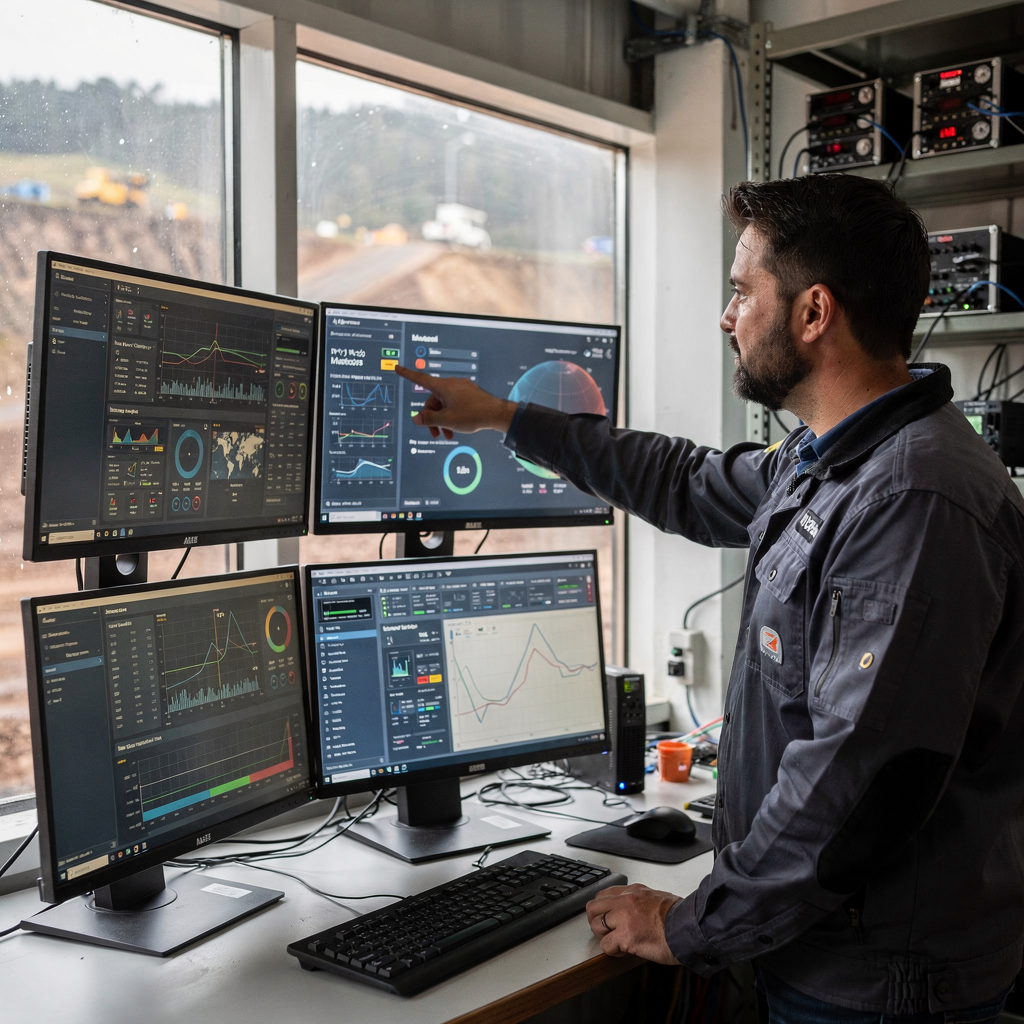
ai-driven workflow: how ai to boost uptime and transform maintenance
Use AI to boost uptime through a clear workflow. First, data capture happens at sensors and gateways. Then, model inference runs either at the edge or in the cloud, depending on latency needs. Next, scheduling logic converts predictions into maintenance activities. Finally, automated actuation or dispatch follows the plan. This simple chain—capture → infer → schedule → act—reduces manual work and shortens repair cycles. It also helps teams make smarter decisions about spare parts and technician allocation.
Digital twins and fleet optimisation tools help by simulating the impact of repair choices on throughput and maintenance OPEX. For example, a predictive model can raise an early alert and then recommend a corrective action that lowers maintenance cost. As a result, teams can defer some CAPEX by extracting more life from existing haul trucks. Predictive analytics models track mean time between failures and then update maintenance activities automatically. This model-driven scheduling reduces the lot of manual checks that used to clog shift handovers.
The technology stack includes sensors, edge gateways, cloud model training, and integration with work order systems like SAP. It must also connect with local data sources to keep models grounded. For operational workflows that involve email-based coordination or long threads, organisations can use automated logistics correspondence tools to draft and route messages, which reduces handling time and improves traceability (automated logistics correspondence). In practice, an operator receives a conversational alert, inspects a recommended spare, and then either approves a remote fix or schedules a field crew. This approach boosts efficiency and helps minimize risky manual interventions on conveyors and crushers.
Because models may run on large language models for conversational guidance, teams must balance latency and accuracy. Therefore, many sites run critical inference in real-time at the edge while using cloud resources for heavier analysis. That hybrid deployment preserves responsiveness and allows scalability when new use cases appear.
Drowning in emails?
Here’s your way out
Save hours every day as AI Agents label and draft emails directly in Outlook or Gmail, giving your team more time to focus on high-value work.
insight and roi: how use ai to quantify gains
Measuring returns makes it possible to justify an AI deployment across the mine. First choose KPIs: downtime hours saved, throughput lift, maintenance OPEX, deferred CAPEX, and safety incidents. Then measure baseline performance. Next estimate the impact of interventions. For instance, cutting downtime by 40% on an ore conveyor can materially increase annual tonnage. To illustrate, assume a line moves 5,000 tonnes per day and operates 300 days. A 40% cut in unplanned downtime that previously cost 30 operating days would convert some of those lost days into production. As a result, the site could gain thousands of tonnes of ore and a notable revenue uplift.
Use a worked example to create ROI clarity. If each tonne sells at a given market price, then additional output converts directly to margin. Also factor in reduced maintenance spend. Many mining companies report lower spare parts usage and fewer emergency call-outs once they integrate analytics. Freeport-McMoRan, for example, reported clearer value as teams became familiar with analytics and could scan vast datasets to optimise workflows (case example).
Beyond raw production gains, include softer benefits such as actionable insights for safety, and lower carbon per tonne through optimized haul cycles. Stakeholder buy-in grows when you show real numbers. Therefore, present ROI with scenario ranges. Present conservative, base, and aggressive outcomes so stakeholders can choose a risk profile. To make mining more resilient, tie the initiative to ESG goals and show how predictive analytics lower incidents and improve compliance. Finally, document maintenance activities and the SOPs that change, and track how many alerts led to corrective action to demonstrate measurable benefit.
solutions for mining: ai-powered monitoring and predictive maintenance
Solutions for mining range from condition monitoring packages to anomaly detection services and full predictive models. Condition monitoring continuously measures vibration, oil quality, and temperature. Anomaly detection flags departures from normal patterns. Predictive models forecast failures days or weeks ahead. Environmental monitoring tracks gas, dust, and water levels to protect crews. Each solution links sensors, edge gateways, cloud analytics, and control-system integration to close the loop from data to act.
The typical technology solutions stack includes industrial sensors, edge compute, a secure network, cloud model training, and an interface into maintenance management. That interface must include SOP links and a clear dispatch flow. AI-powered dashboards deliver visual trends and conversational recommendations. They can also generate natural language work orders, which reduce the lot of manual email triage and speed dispatch. For teams already using ERP or SAP, connectors ensure tickets flow into procurement and spare parts systems.
Expected benefits include fewer breakdowns, improved safety, and lower compliance risk. Predictive analytics help minimize catastrophic failures by scheduling parts replacement at the right moment. Fleet optimisation reduces fuel burn and increases productivity. For mineral processing, machine learning can tune mills and crushers to keep throughput steady while lowering energy use. To ensure adoption, choose enterprise grade deployments that provide scalability and local data governance. Also consider vendors that support domain-specific models and offer off-the-shelf use cases for drill and haul cycles. If your operations rely on heavy email coordination, explore our resource on scaling logistics operations without hiring to see how automation reduces manual work across teams (scale operations).
Drowning in emails?
Here’s your way out
Save hours every day as AI Agents label and draft emails directly in Outlook or Gmail, giving your team more time to focus on high-value work.
implementation: steps to revolutionize operations and integrate ai-driven solutions
Start with a clear rollout plan. First select a pilot asset that is critical and instrumentable. Next perform a data readiness audit. Then build models using local data and validate them against historical incidents. After that, deploy models to edge devices or to the cloud depending on latency constraints. Finally, integrate outputs into work order systems and existing operational processes.
A practical deployment roadmap includes: pilot asset selection, data cleaning, model development, edge/cloud deployment, workflow integration, and training. Also define change control, escalation paths, and SOP updates. To overcome common barriers—poor data quality, legacy kit, and cultural resistance—plan data harmonisation, phased retrofits, and hands-on training sessions. For cultural change, appoint a cross-functional owner who can bridge operations, IT, and procurement.
Reskilling matters. Train crews on reading AI alerts, on following the script for corrective action, and on when to escalate. Provide human like conversational tools so operators can query systems with natural language and get contextual guidance. You can also run a 90‑day pilot to test models and to refine KPIs. During deployment, monitor for bias and for model drift. Use local data to retrain models when equipment or ore characteristics change. For email-heavy coordination between site teams and external suppliers, consider AI agents that automate the full email lifecycle. Our platform automates intent labelling, routing, and reply drafting so teams can focus on high-value tasks rather than a lot of manual messages (email automation example).
Finally, plan for scalability. Design for enterprise grade security, for integration with SAP and other systems, and for clear governance. That way new technologies will not only improve uptime but will also redefine how teams collaborate and how the workforce spends time. The result is a practical, phased approach to revolutionize operations while keeping operators and stakeholders aligned.
faqs and next steps: common questions on ai adoption and who benefits
This section answers the most common queries on adopting AI in mining. It also gives next steps you can take right away. For further operational guidance, review our materials on ERP email automation in logistics, which shows how to remove email as a bottleneck and to increase response speed (ERP email automation).
Is AI safe for on-site workers and does it reduce incidents?
Yes. Predictive analytics and environmental monitoring can reduce risks by providing early alerts and by automating safety checks. When paired with clear SOPs and training, these systems minimize exposure to hazardous conditions and provide actionable insights for crews.
Will AI replace maintenance jobs?
AI shifts roles rather than replaces them. Routine diagnostics and lot of manual triage may be automated, while technicians take on higher-value repairs and diagnostics. Workforce reskilling is therefore critical to make the transition work for employees.
Who owns the data and models?
Ownership depends on contracts and governance policies. Sites typically retain ownership of local data, and vendors provide models under license. Ensure contracts specify local data controls and access for stakeholders.
Should I run models at the edge or in the cloud?
Run low-latency, safety-critical inference at the edge and heavier training tasks in the cloud. This hybrid approach preserves responsiveness while enabling scalability using new technologies and large language models for non-critical analysis.
How do I measure ROI quickly?
Define three KPIs for a pilot: downtime hours saved, maintenance OPEX reduction, and throughput lift. Run a 90-day pilot, collect results, then project annualised gains to build a business case.
What about regulatory and ESG concerns?
Use AI to improve compliance by logging corrective action and by providing traceable alerts. Predictive insights can also reduce energy use and emissions, which helps ESG reporting and stakeholder confidence.
Can vendors integrate with SAP and procurement systems?
Yes. Many technology solutions provide connectors to SAP and to procurement systems for spare parts and dispatch. Verify that the supplier offers enterprise grade integration and secure APIs before procurement.
Are conversational agents useful on site?
Conversational agents help by answering operator queries in natural language and by producing human like responses that follow SOPs. They reduce manual work around email and tickets, and they speed troubleshooting.
What is a realistic pilot scope?
Select one asset or fleet, instrument it, and run models focused on a single use case such as bearing failures or conveyor jams. Keep scope narrow to validate impact and to refine the deployment script for broader rollout.
What should my next actions be?
Run a 90-day pilot, define three KPIs, and assign a cross-functional owner to the initiative. Also scope data readiness and identify one supplier for integration tests so you can start to reduce downtime and boost efficiency.
FAQ
What is an AI assistant for mining?
An AI assistant for mining is a system that combines predictive analytics, sensor fusion, and automation to support site teams. It helps with maintenance activities, alerts, troubleshooting, and decision support so crews can work more safely and productively.
How does AI improve productivity on a mine?
AI improves productivity by predicting failures, optimising fleet utilisation, and reducing manual checks. As a result, maintenance becomes proactive, unplanned downtime drops, and throughput can rise without extra capital.
What are common use cases for AI in mining?
Common use cases include condition monitoring, anomaly detection, mineral processing optimisation, and autonomous haulage. They also cover environmental monitoring and email automation for operational coordination.
How long does implementation take?
Implementation timelines vary. A focused pilot can run in 90 days, while a full site rollout may take 6–18 months depending on integration needs and retrofits.
Can AI work with legacy equipment?
Yes. Edge gateways and retrofits can connect legacy sensors and PLCs to modern analytics. Still, data quality work is required to ensure models perform well.
Is the technology secure?
Security depends on deployment choices. Enterprise grade solutions include encryption, role-based access, and on-site data governance to protect local data and to meet compliance requirements.
Who benefits from AI in mining?
Operators, maintenance teams, safety managers, and procurement all benefit. Senior leaders gain clearer ROI data and stakeholders see improved ESG performance.
What budget should I expect?
Costs depend on scope, from modest pilots to larger fleet programmes. Factor sensors, edge compute, integration, and change management into the budget to avoid surprises.
Do I need large language models on site?
Large language models can help with conversational queries and report drafting, but they are not required for core predictive tasks. Use them for post-incident analysis and operator guidance when useful.
How do I choose a supplier?
Choose a supplier with domain-specific experience, proven use cases, and secure integrations. Check references, verify scalability, and ensure the vendor supports local data control and a clear deployment plan.
Drowning in emails?
Here’s your way out
Save hours every day as AI Agents label and draft emails directly in Outlook or Gmail, giving your team more time to focus on high-value work.