


ai in property management: what an ai assistant does for tenant, lease and maintenance
AI assistants transform everyday property management by answering tenant questions, managing lease tasks, and triaging maintenance. In plain terms, an AI assistant is software that understands intent, reads messages, and acts or routes work. For tenant inquiries it can answer common questions 24/7 and ensure consistent replies. For lease actions it can send renewal reminders, prepare digital documents, and route signed forms to accounting. For maintenance it can log a maintenance request, categorize urgency, and book vendors automatically.
In pilot projects, AI triage has reduced manual triage time by roughly 50–70%, freeing staff to focus on higher‑value work and strategic planning (source). As a result, property managers use AI to handle routine enquiries while they tackle move-ins, inspections, and relationship work. A simple example: a virtual assistant reads an email about a leaking sink, creates a work order, schedules a contractor, confirms cost approvals, and updates the tenant automatically. That flow reduces back‑and‑forth and speeds resolution.
AI also improves data consistency. It extracts property information from emails, maps it to a property management system, and creates structured records for followup. Many property management companies see faster response times and fewer lost requests. For operations teams that rely on email, virtualworkforce.ai uses AI agents to automate the full email lifecycle so that teams reduce handling time and keep context across long threads. If you want to see how email automation applies beyond property, read the virtual assistant logistics overview at virtualworkforce.ai/virtual-assistant-logistics/.
Finally, AI helps with tenant satisfaction by ensuring fast, accurate replies and predictable next steps. It also records audit trails so managers and tenants can see timelines. In short, an AI-powered conversational layer answers questions, logs work orders, speeds lease tasks, and makes maintenance scheduling reliable and transparent.

property management ai and operational efficiency: quantify time, cost and valuation gains
Property management teams that adopt AI report measurable gains in time, cost, and property performance. Industry data shows high pilot intent — about 92% of commercial real estate firms have started or plan pilots — but only around 5% say they have fully realised their AI programs (source). This gap highlights implementation challenges yet confirms strong demand.
When AI valuation models are used, accuracy can jump from roughly 70% to about 95%, improving investment decisions and reducing costly appraisal errors (source). For operational KPIs, track time saved per week, reduction in vacancy days, maintenance cost avoidance from predictive alerts, and NOI uplift. For example, AI that predicts equipment failure reduces unplanned downtime and lowers maintenance spend. Dynamic rent pricing and faster tenant screening shorten vacancy days and raise occupancy, which lifts net operating income.
Quantify savings this way: measure handling time before and after AI, count fewer phone tags, and log reduced admin incidents. Property management software that integrates AI can push alerts into accounting systems, cutting reconciliation time. For teams swamped by email and forms, consider tools that automate replies and routing; virtualworkforce.ai cuts email handling time substantially and keeps full context in shared inboxes. If you want a playbook for scaling these automations without hiring, see how-to-scale-logistics-operations-without-hiring.
Finally, don’t forget intangible gains. Faster decisions mean managers can make informed decisions quickly and focus on portfolio strategy. Therefore, AI delivers time savings, cost avoidance, and valuation improvements when implemented with clear metrics and staged pilots.
Drowning in emails?
Here’s your way out
Save hours every day as AI Agents label and draft emails directly in Outlook or Gmail, giving your team more time to focus on high-value work.
property managers use ai-powered tools to automate tenant screening and lease management
Property managers use AI-powered tools to automate tenant screening, dynamic pricing, and lease management workflows. Tenant screening powered by AI analyses credit, rental history, and other public data to produce a multi‑data risk score. This reduces time-to-approval and helps match potential tenants to units faster. Automated tenant screening also reduces bias risks when teams apply consistent rules and fairness testing.
Dynamic rental pricing uses real-time market signals to set competitive rents and maximise revenue. Platforms in the rentals industry demonstrate how AI-powered pricing adjusts rates daily to reflect demand and competition (source). For lease management, AI sends renewal reminders, coordinates digital signing, and records lease clauses into a central property management system. Those automated workflows reduce administrative errors and cut renewal churn.
AI also predicts maintenance needs so that property managers can schedule repairs before failures occur. Predictive maintenance reduces emergency repairs and keeps tenants happy. For tenant support, conversational AI and ai chatbots can answer routine questions, log requests, and escalate complex issues to humans. In fact, more prospective homebuyers and renters are using AI tools during their search, which drives expectations for fast digital service (source).
To implement, property management teams should map the tenant journey. Identify tasks like tenant screening, lease renewals, rent collection, and maintenance scheduling that benefit most from automation. Use a staged approach and include human review rules. If your operations involve heavy email volumes, learn how AI drafts and routes operational correspondence at automated-logistics-correspondence. These tools help property managers automate repetitive tasks and free staff to improve tenant satisfaction and portfolio performance.
property management software, ai agent and property management ai agent: setup, workflow and ai agent template
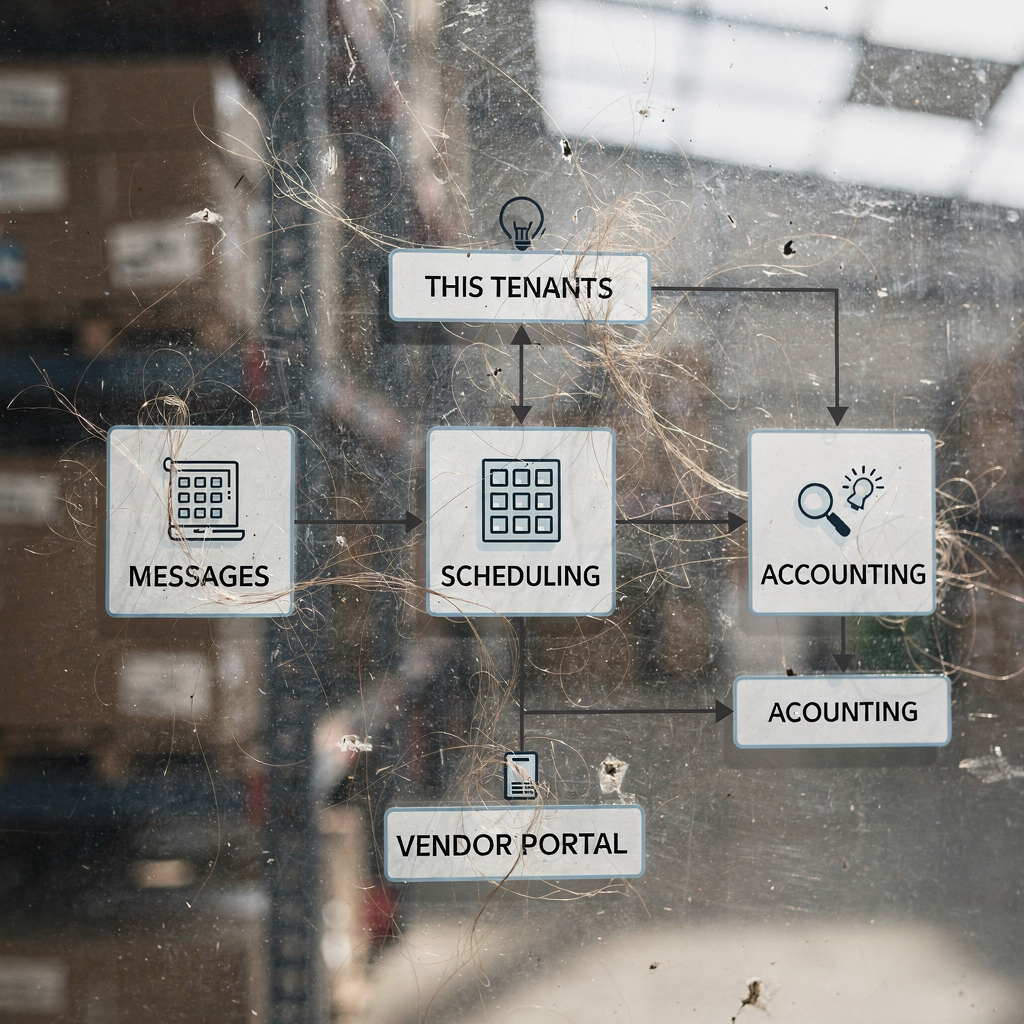
Choosing the right toolset starts with integration. Prioritise open APIs and data security. Your checklist should include connections to PMS, CRM, accounting, and vendor portals. Confirm the vendor supports common management systems and can push structured data back into your accounting ledgers. A staged rollout reduces risk: pilot on one building or a single portfolio slice, measure results, then expand.
Workflows matter. A common workflow looks like this: tenant report → AI triage → schedule vendor → close ticket → update lease record. An ai agent can handle intent detection, extract property information, and create work orders. Below is a simple ai agent template you can adapt for operations teams:
AI agent template: On inbound message, detect intent; if maintenance request, extract unit, issue, urgency; check vendor availability; schedule a slot; notify tenant; escalate if human approval needed. This pattern works for everything from maintenance issues to rent collection emails. For email-heavy ops, virtualworkforce.ai automates the full email lifecycle so replies are grounded in ERP and historical threads, which keeps handoffs clean and reduces errors.
Setup tips: keep governance tight, define human review rules, and create audit logs. Train your AI on sample emails and rules; then run a 60–90 day pilot. Track metrics like save time per user, response times, and reduction in manual triage. Integration with platforms such as Yardi or your chosen property management system is essential for seamless lease management and billing. Finally, document workflows and share them with vendors so everyone knows responsibilities and SLAs.
Drowning in emails?
Here’s your way out
Save hours every day as AI Agents label and draft emails directly in Outlook or Gmail, giving your team more time to focus on high-value work.
ai solutions and ai chatbots for the property management business: risks, data and compliance
AI solutions bring clear benefits, but they also introduce risks. Key concerns include data privacy, tenancy law compliance, model bias, vendor lock‑in, and false positives in predictive maintenance. Address these risks with clear mitigation steps, such as data minimisation, human review rules, fairness testing, and audit trails. Ensure all processing meets local rules like GDPR or equivalent privacy laws.
Model bias in tenant screening can create legal exposure. To limit this risk, run fairness testing, document decision rules, and keep humans in critical loops. For predictive alerts, set conservative confidence thresholds and require human confirmation for costly repairs. Vendor lock‑in is common; prefer vendors with open exports and clear exit clauses.
Operational controls matter. Maintain detailed logs so you can trace why an AI agent made a decision. Define escalation paths for disputed tenant outcomes and ensure tenants can request human review. If your management company handles sensitive tenant data, encrypt data at rest and in transit. Also, limit data retention to what you need for operations and compliance.
For practical adoption, pilot with a narrow use case like tenant support or rent collection. This reduces exposure while you measure benefits. Property management teams should also train staff on how to interact with AI and on ways to review and override decisions. Virtualworkforce.ai provides a model where IT connects data sources and business teams configure rules, which keeps control with the business while leveraging advanced AI. Finally, maintain a risk register and review it periodically so the property management business can scale AI responsibly.
frequently asked questions: how to use ai, leverage property management tools and provide valuable insights
This section answers frequently asked questions for decision makers and on-site teams. It removes blockers and offers quick, actionable steps. Map workflows, choose 1–2 quick wins, run short pilots, and measure results. For teams that need email automation playbooks, review how to scale operations with AI agents at how-to-scale-logistics-operations-with-ai-agents.
Start with tenant enquiries and lease renewals as fast wins. Then add predictive maintenance and dynamic pricing. Track response times, vacancy days, and maintenance cost avoidance. Train your AI with real examples, and build human review rules so decisions remain explainable. Use tools that integrate with your property management software and accounting to avoid duplicate entry. Above all, prioritize tenant privacy and clarity in communication.
FAQ
Which tasks should we automate first?
Start with high-volume, low-risk tasks such as tenant enquiries and lease renewals. These deliver quick wins, reduce manual triage, and save significant time for property managers.
How do we keep tenants happy when using AI?
Use AI to speed responses and ensure consistent communication, but always offer a clear human escalation path. Fast automated acknowledgements plus timely human followup improve tenant satisfaction.
How secure is tenant data with AI platforms?
Security depends on vendor controls: encryption, access management, and data minimisation. Require vendors to certify compliance with local privacy laws and to provide audit logs.
What KPIs improve first after AI adoption?
Response times, time saved per staff member, and reduced vacancy days commonly improve first. Track maintenance cost avoidance and NOI uplift as the next-level metrics.
Can AI replace the property manager?
No. AI handles repetitive tasks and provides insights, while property managers remain essential for tenant relationships and strategic decisions. AI helps property managers make informed decisions quickly.
How do we avoid bias in tenant screening?
Apply fairness testing, document decision rules, and keep humans in the loop for final approvals. Regular audits and transparency reduce legal and ethical risks.
What should a pilot look like?
Run a 60–90 day pilot on a single building or portfolio slice. Measure the metrics from earlier chapters, gather feedback from staff and tenants, and iterate before scaling.
How do we integrate AI with existing systems?
Prioritise vendors with open APIs and connectors for PMS, accounting, and vendor portals. Ensure data mapping is tested end-to-end before go-live.
Which vendors work well for email-heavy operations?
Look for solutions that automate the full email lifecycle, extract structured data, and route or resolve messages automatically. virtualworkforce.ai is built for ops teams that need accurate, traceable email automation.
What are the next steps to get started?
Map current workflows, choose 1–2 quick wins like tenant enquiries and lease reminders, and run a short pilot. Measure improvements, document results, and then expand to predictive maintenance and dynamic pricing.
Drowning in emails?
Here’s your way out
Save hours every day as AI Agents label and draft emails directly in Outlook or Gmail, giving your team more time to focus on high-value work.