


AI recruiting software, ATS and ai assistant: why integrate AI with your recruitment stack
Integrating AI into your recruitment stack starts with clear goals and a plan that links an AI recruiting software to your ATS. First, connect systems via APIs, parsing layers and webhooks so candidate records update automatically. This removes manual work and speeds the hiring process. In practice, AI can perform resume parsing, match scoring and auto-updates in the ATS, which reduces the repetitive tasks that slow recruiting teams. For example, AI tools can cut cost-per-hire by roughly 30% through automation and better matching, reducing time-to-fill and unnecessary screening steps AI-Driven Candidate Screening: The 2025 In-Depth Guide.
When you design integration flows, map data movement from job listings and the ATS to AI models and back. Make sure logging captures decisions, so you can audit source-of-truth fields and candidate status changes. GDPR and EU requirements demand consent tracking and data subject access procedures, so include controls for data retention and erasure. For an operations example that shows how automation reduces manual lookup and improves consistency, review our logistics-focused case studies. See how end-to-end email automation reduced handling time and preserved context at scale via our virtual assistant examples virtual-assistant-logistics.
Checklist for integration: define data flows, secure API keys, test parsing accuracy, log decision trails, and set vendor SLAs. Also vet vendor model transparency, bias testing and update cadences. Use a phased rollout: connect a single job family, validate matches, then expand. A hiring assistant that respects ATS source fidelity avoids losing history during bulk updates.
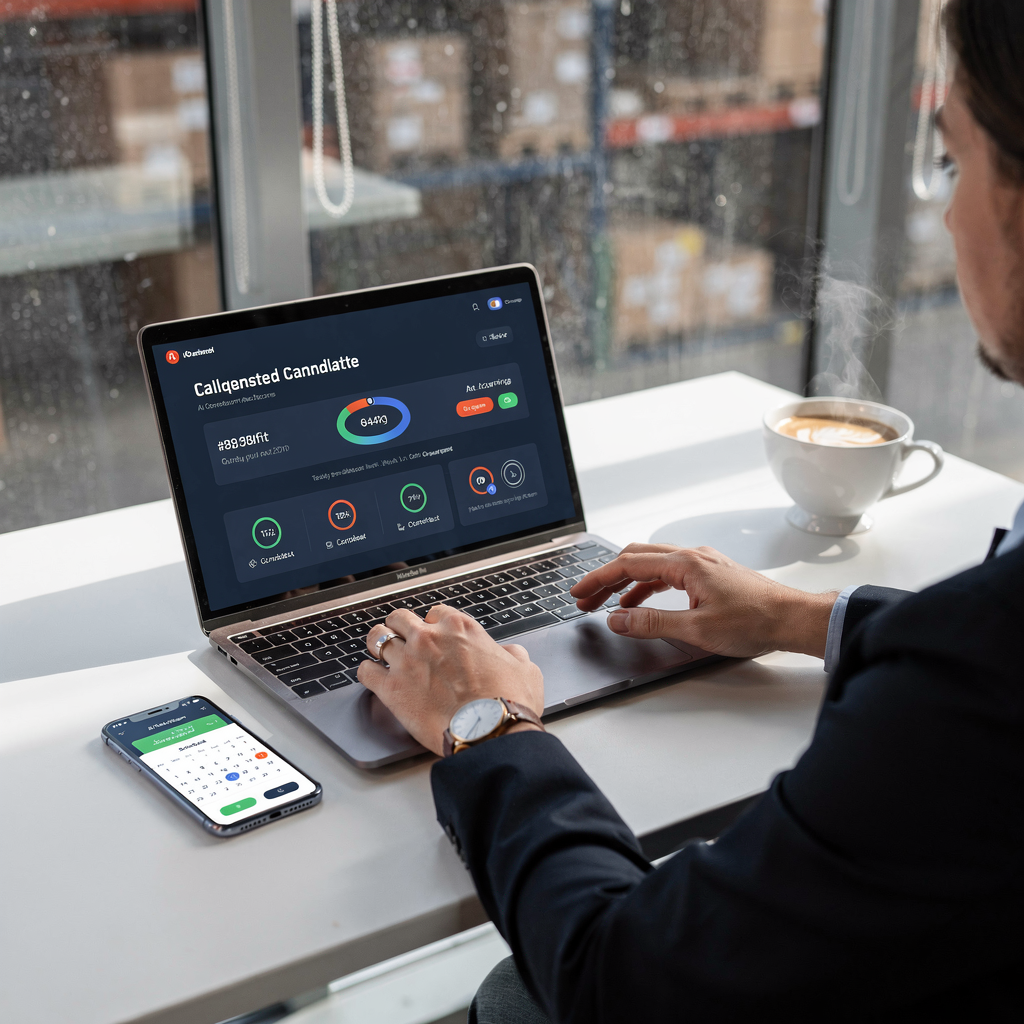
Use a monitoring dashboard to track metrics like time-to-fill, source-to-hire and quality-of-hire. Recruiters gain time for high-value work when AI handles parsing and scheduling. If your staff handles high-volume hiring, this approach scales better than manual pipelines. Finally, keep humans in the loop: set approval gates for final hiring decisions and preserve the recruiter’s role in complex selection and offer negotiation.
ai sourcing, ai recruiting tool and ai-powered sourcing tools: find qualified candidates faster
AI sourcing expands the talent pool and helps you find qualified candidates faster. Semantic search and resume parsing detect skills even when candidates use different wording, and enrichment taps public profiles such as linkedin to fill missing data. Combine AI recommendations with boolean searches so you avoid false positives and preserve precision. For high-volume recruiting, mixing automated candidate scoring with human review prevents missed matches and reduces bias.
Conversational outreach and ai-powered messaging lift engagement. In some programs, conversational AI increased application completion and engagement by magnifying follow-up and answering candidate questions in real time; this improves pipeline quality and keeps job seekers connected How AI-Powered Assessments Are Revolutionizing Skills-Based …. Also, track source-to-hire so sourcing tools can be measured against hire quality rather than click rate alone.
Practical sourcing tip: start with a boolean base, then apply an ai sourcing layer that ranks matches by semantic fit. Next, run a quick human review to confirm role fit. This hybrid method increases the odds you find the best candidates while reducing time-consuming tasks like manual resume hunts. Use AI for enrichment, but require recruiter verification before outreach.
In addition, preserve candidate consent and transparency when you enrich profiles. For outreach, personalize at scale with templates that the recruiter can edit. That approach gives the recruiting team context for a human-first touch. If you want more detail on automating operational messages tied to candidate follow-up and email threading, see our example on automating logistics correspondence to understand threading and context in shared inboxes automated-logistics-correspondence.

Drowning in emails?
Here’s your way out
Save hours every day as AI Agents label and draft emails directly in Outlook or Gmail, giving your team more time to focus on high-value work.
ai interviewing, ai interviewer and conversational AI: boost application completion and early screening
Conversational AI and AI interviewers can dramatically increase application completion and speed up early screening. Evidence shows conversational AI can raise completion rates up to threefold by guiding candidates and answering questions during the application flow How AI-Powered Assessments Are Revolutionizing Skills-Based …. Use ai interviewing for asynchronous video checks, automated skills tests and initial scoring. These tools flag qualified candidates and surface best candidates for human review.
Typical ai interviewer use cases include short video interview prompts, timed coding exercises and automated scoring of core competencies. For example, a video interview can ask standardized situational questions, then an AI resume screening layer and scoring model produce a preliminary recommendation for the recruiter. But always pair automated scoring with human oversight. Recruiters must confirm contextual fit and judge soft skills that models cannot yet interpret reliably.
Measure the right metrics: completion rate, dropout points, screening accuracy and candidate satisfaction. Track where applicants leave the process so teams can iterate on question phrasing and flow. Also monitor candidate experience: conversational tools should shorten friction, not add it. If you want to incorporate structured operational data into candidate responses—such as role-specific score thresholds—consider an intelligence platform that merges assessment outputs into the ATS.
Keep in mind independent studies that urge caution. One major study found AI assistants had issues in a significant share of responses, which highlights the need for monitoring and continuous improvement Beyond the Hype: Major Study Reveals AI Assistants Have Issues in …. Therefore, treat ai interviewing as an efficiency layer, not as a replacement for recruiter judgment. Finally, combine asynchronous video interview software with scheduled human follow-up to ensure fairness and accuracy while preserving a positive hiring experience for job seekers.
Recruit, recruiter and recruitment workflow: how AI reshapes recruiter roles and staffing agencies
AI reshapes the recruiter’s day by taking on routine tasks so humans can focus on relationships and strategy. With automation handling scheduling, initial screening and standardized communications, recruiters spend more time on candidate engagement, offer strategy and complex selection. A McKinsey analysis notes that “With AI handling more common tasks, people will apply their skills in new contexts. Workers will spend less time preparing documents and doing routine work, and more time on creative and interpersonal activities” AI: Work partnerships between people, agents, and robots | McKinsey.
For staffing agencies, this change means rethinking role mapping and the recruitment workflow. Staffing agencies can scale by assigning AI to high-volume screening while recruiters manage client relationships and candidate coaching. Yet the shift requires clear handoff rules between automation and people. Define governance, upskill the HR team and create escalation paths when a candidate requires human judgment.
Start a change plan: map current tasks, tag activities as routine or strategic, then assign automation where it saves time. Train recruiters on new tools, and run shadowing sessions so staff trust model outputs. Track confidence scores and give recruiters the right to override automated recommendations. Additionally, include customer service best practices when automation touches candidate communications; tone and timing matter for candidate experience.
Despite optimism—62% of talent acquisition professionals view AI positively—many teams still lack projects in areas like employee relations, so you should plan for gradual adoption AI recruiting: revolutionizing hiring and talent acquisition in 2025. That cautious rollout supports a sustainable shift. Finally, balance efficiency gains with responsibility by auditing decisions, bias-testing your models and keeping the recruiter central to hiring decisions and complex candidate matching.
Drowning in emails?
Here’s your way out
Save hours every day as AI Agents label and draft emails directly in Outlook or Gmail, giving your team more time to focus on high-value work.
Integration, recruiting platform and recruitment software: best practices for existing recruiting systems
When you integrate AI with existing recruiting software, follow best practices that protect data, maintain audit trails and preserve ATS source fidelity. Roll out incrementally; start with a single function such as automated screening or job descriptions generation using generative ai. Then A/B test models and monitor impact on hiring metrics. Preserve the origin of each candidate record in the ATS so reporting remains credible for hiring managers.
Keep a strict logging policy: record model inputs, outputs and decision tags. This audit trail proves critical for compliance and for debugging when a model drifts. Also, require human override on automated job offers or rejections. Use an ai recruitment platform that supports versioning and rollback of model updates, and insist on vendor transparency about model training data and bias testing.
Tools to consider range from ai agent plugins that automate scheduling to full recruiting platforms with built-in ai screening. For teams that rely on operational email workflows, integrating an agent that handles the entire email lifecycle can reduce time spent on thread triage and preserve context for candidate communications how-to-scale-logistics-operations-without-hiring. Also evaluate connectivity to job boards, linkedin recruiter and search engines so you maintain multi-channel sourcing.
KPI playbook: track cost per hire, time-to-fill, hire quality and diversity metrics. Add an AI error-rate metric to catch false positives and negatives early. Practice rollback tests before applying model updates to live campaigns. Finally, document best practices and train the recruiting team on operational nuances so your integration delivers consistent value.
ai agent, best ai recruiting tools and risks: choosing tools, monitoring bias and proving ROI
Choosing the right ai agent or ai recruitment tool starts with a procurement checklist. First, require vendor demos with your real data so you can assess performance on your roles. Second, demand transparency: ask for model cards, bias test results and data retention policies. Third, check integrations with linkedin and other data sources, and verify SLAs for latency and uptime when you rely on real-time responses.
Be mindful of risk. Independent research showed AI assistants had issues in about 45% of responses in a major study, which underlines the need for human oversight and continuous improvement Beyond the Hype: Major Study Reveals AI Assistants Have Issues in …. Therefore, create a governance framework that includes bias audits, explainability checks and periodic revalidation of scoring models. Also, set guardrails so an ai recruiter never performs irreversible hiring actions without approval.
Proving ROI requires a baseline. Record current cost-per-hire, time-to-fill and quality metrics, then run pilots to measure impact. Many deployments report cost reductions in the range of 30% per hire after automation, so you can model expected savings and break-even timelines AI-Driven Candidate Screening: The 2025 In-Depth Guide. Include softer metrics as well, like improved candidate experience and reduced recruiter burnout.
Procurement checklist: model transparency, bias testing, data retention and clear integration to ATS and recruitment software. Also ask for a sandbox that links to your ATS and a demo using your job descriptions and historically anonymized resumes. Finally, monitor outcomes and iterate. If you need examples of email-driven automation that preserves context across long threads, review our guide to AI for freight forwarder communications to see how agents attach full context before escalation ai-for-freight-forwarder-communication.
FAQ
What is AI recruiting software and how does it work?
AI recruiting software uses machine learning to automate tasks like resume parsing, candidate matching and scheduling. It connects to your ATS and other data sources to improve speed and reduce manual work.
Will AI replace the recruiter?
No. AI handles time-consuming tasks while the recruiter focuses on relationships, negotiation and final hiring decisions. Humans still oversee fairness and cultural fit.
How much can AI reduce hiring costs?
Many implementations report cost-per-hire reductions near 30% through automation and better candidate-job matching AI-Driven Candidate Screening: The 2025 In-Depth Guide. Results depend on role complexity and rollout quality.
Are AI interviews fair for job seekers?
AI interviewing can improve access by offering asynchronous options and clear prompts, but fairness depends on model design and bias testing. Always include human review and measure candidate experience to ensure fairness.
How do I integrate an AI agent with my ATS?
Integration usually uses APIs, parsing layers and webhooks to sync candidate records and actions. Begin with a single use case, log decisions and validate results before scaling.
What risks should staffing agencies watch for?
Risks include biased scoring, over-reliance on automation and data privacy issues. Conduct bias audits, impose human approval gates and maintain detailed audit trails to mitigate risk.
Can AI improve candidate experience?
Yes. Conversational tools can answer questions and guide candidates, raising completion rates and reducing dropouts. Yet human follow-up remains essential for complex queries.
How do I prove ROI for an AI recruitment tool?
Start with baseline metrics like time-to-fill and cost-per-hire, then run pilots and compare outcomes. Track both direct savings and qualitative improvements like reduced recruiter time spent on manual tasks.
What compliance considerations matter for AI in recruitment?
Pay attention to data protection laws such as GDPR, consent for profile enrichment and records of automated decisions. Maintain data subject access processes and clear retention policies.
Where can I learn more about automating candidate communications and operational email workflows?
For examples of end-to-end email automation that preserves context and reduces handling time, see our resource on scaling operations without hiring and related case studies how-to-scale-logistics-operations-with-ai-agents.
Drowning in emails?
Here’s your way out
Save hours every day as AI Agents label and draft emails directly in Outlook or Gmail, giving your team more time to focus on high-value work.