


battery, supply chain: why an email assistant matters for ev batteries and lithium-ion battery programmes.
An efficient battery supply chain depends on fast, accurate communication. Teams in OEMs, suppliers and logistics partners exchange hundreds of messages each day. Those messages include order confirmations, shipment notices, quality reports and regulatory files. When staff manage that volume manually they lose time. Delays then cause production disruption for electric vehicle programmes and for broader manufacturing schedules. A virtual assistant can reduce friction and save time, and it can save hours of low-value work so teams can focus on exceptions and strategy.
AI already handles repetitive communication workflows in logistics, which shows clear potential for battery communications. For example, research highlights how AI can automate routine messages and reduce delays by handling repetitive communication workflows. Market analysis also forecasts rapid growth in AI tools used across logistics and supply chain, which reflects rising investment in digitisation for AI in Logistics and Supply Chain. Meanwhile, studies report measurable operational benefits from AI adoption, including cost reduction and improved visibility. One report notes up to a 30% reduction in operational costs and roughly 25% better supply chain visibility when AI tools are in use AI is Rewriting the Rules of Supply Chain.
In practice, an email assistant centralises threads, standardises confirmations for POs and shipments, and captures QA reports automatically. It reduces manual follow-ups and enforces consistent formats for shipping and compliance files. As a result, teams reduce errors and increase response times. The assistant routes messages to the right people, and it provides searchable context for long conversations. That adds transparency, and it improves due diligence across procurement and logistics. For battery manufacturers and battery manufacturers’ suppliers the improvements translate into faster production cycles and fewer line stoppages.
Start small and expand. First, automate 2–3 repetitive email types. Then measure time saved and the reduction in manual steps. Our platform virtualworkforce.ai automates the full lifecycle of operational email, and it integrates with ERP and TMS to ground replies in live data. For teams that need examples, see our guide to virtual assistant logistics for real templates and rollout tips virtual assistant logistics. Use this staged approach to accelerate adoption, and to protect production continuity while supporting supply chain development for EV programmes.
battery supply chain: automate supplier checks, improve transparency and track battery materials.
Automating supplier checks is one of the fastest ways to boost transparency in the battery supply chain. A focused email assistant parses order acknowledgements, extracts shipment ETAs, and collects certificates such as CoC and SDS. It also handles supplier replies to standard requests. That automation reduces manual triage and shortens lead times. The assistant can tag messages by urgency, and it can create structured records that integrate with procurement and quality systems.
Key traceability fields should be captured automatically. Capture material origin and lot numbers. Capture CO2 footprint, cathode chemistry and the weight of lithium, nickel and cobalt per shipment. Also capture supplier ID, batch test results and certificates tied to a lot. Those fields make it easier to produce audit-ready records and to support battery recycling or reuse later in the value chain. A short list of fields includes: material origin, lot number, cathode chemistry, weight of Li/Ni/Co, supplier ID and CO2 per kilogram. That data helps with compliance and with supplier scorecards, and it supports transparency for downstream customers.
Targets for pilots are pragmatic. Aim to cut supplier-check time per event by 50% and to reduce manual email count by 40–60% in early phases. Use measurable KPIs such as mean first response time and percent automated replies. The assistant should create exportable records in common formats so passport-ready data can be pushed to procurement systems. For practical examples and drafting help see our automated logistics correspondence resource, which shows how to route and resolve messages while keeping audit trails automated logistics correspondence.
Simple email templates help teams start quickly. For order acknowledgement: “Thank you. We confirm PO #12345. ETA: please confirm shipment date and carrier.” For missing certificate: “Please provide the CoC and SDS for Lot #789 within 48 hours to avoid shipment delay.” The assistant can auto-send these templates, and it can attach the required forms. That reduces back-and-forth and improves throughput. It also frees procurement and quality engineers to focus on exceptions and on supplier development.

Drowning in emails?
Here’s your way out
Save hours every day as AI Agents label and draft emails directly in Outlook or Gmail, giving your team more time to focus on high-value work.
recycle, battery recycling and reuse: use the assistant to meet compliance and enable the digital battery passport.
Regulation is changing quickly, and email automation helps teams stay compliant. The EU requires a digital battery passport for EV and industrial batteries of 2 kWh or more by 18 August 2027. An assistant can gather and normalise passport data from suppliers and from internal tests so records are audit-ready. It can request recycling certificates, log recovery rates, and flag missing recovery data before a shipment leaves the dock. These tasks speed audits and reduce the risk of non-compliance.
Assistants also support battery recycling workflows. They collect certificates for recovered material, and they track reuse status for cells or modules. They create structured exports that fit the expected passport schema, and they push data back into procurement and quality systems. That means faster compliance checks and better reporting on material recovery. As Ideapoke notes, “Recycled products will become the new normal in the industrial supply chain,” and automated data capture helps deliver that change Lithium-ion Battery as the Innovation Enabler.
Practical tasks to automate include requesting recycling certificates, recording recovery percentages, generating passport-ready records, and producing exportable CSVs or API payloads. The assistant should add metadata such as end-of-life condition, reuse probability and chain-of-custody. Those details matter for circular economy reporting and for decisions about refurbishing modules or sending materials to smelters. They also enable service providers and professional services teams to plan reuse offers and secondary market sales.
Simple template for passport data request: “Please provide the following for Lot #ABC: origin, cathode chemistry, mass of lithium, nickel and cobalt, CO2 per kg, and recycling certificate. Deliver within 7 days.” Use another template to request recycling certificates: “Please attach the recycling certificate and recovery rate for Lot #ABC.” Automating these messages reduces manual follow-up, accelerates audits, and supports traceability from mine to end-of-life. For more on customs and document automation see our AI for customs documentation emails guide AI for customs documentation emails.
using AI, artificial intelligence and AI-powered drafting: speed responses and improve productivity with chatgpt-style tools.
AI-powered drafting speeds routine replies, and it improves consistency. A mailbox-first assistant triages and tags emails, drafts context-aware replies, extracts action items, and produces short supplier summaries. It can use generative models such as ChatGPT for templates and for quick drafting. That increases productivity and reduces the cognitive load on procurement teams. It also helps maintain tone and accuracy across many suppliers and geographies.
Capabilities include intent detection, priority tagging, and action extraction. The assistant can auto-draft confirmations and missing-certificate requests. It can summarise long threads, and it can present the next steps in bullet points. Use guardrails to keep humans in control for high-risk content. For instance, require human approval for contract language, non-conformance reports, or any reply that changes shipment terms. Log all drafts and model outputs for audit and compliance. That approach protects quality and ensures traceability.
Productivity gains are real and measurable. Teams reduce handling time per email from ~4.5 minutes to ~1.5 minutes with full lifecycle email automation. virtualworkforce.ai reports that performance delta in operations, and it shows how structured data and thread-aware memory improve resolution speed. For teams seeking to scale without hiring see our guide to how to scale logistics operations without hiring, which explains staged rollout and control mechanisms how to scale logistics operations without hiring.
Sample draft template for supplier summary: “Summary: PO #234 needs CoC, ETA moved from X to Y, QA report pending. Action: Request CoC and confirm carrier.” The assistant writes that automatically and includes links to ERP entries or attachments. Use automated keyword monitoring to detect risk terms such as shortage, delay, or quality hold. Then escalate only when thresholds are hit. This method extracts signals early, and it prevents small issues from growing into production-impacting incidents.
Drowning in emails?
Here’s your way out
Save hours every day as AI Agents label and draft emails directly in Outlook or Gmail, giving your team more time to focus on high-value work.
new mining, mine and source: manage upstream risk and decarbonization pressures through automated workflows.
Upstream risk in battery value chains often begins at the mine. Emails from suppliers, brokers and logistics partners carry signals such as supply interruptions, political risk at a mine, or changes in payment and shipment terms. An assistant can extract these signals, tag them for due diligence, and feed them into supplier scorecards. That enables faster mitigation actions and diversification of sourcing.
Include carbon and decarbonization metrics in routine email exchanges. Automate prompts for lower-carbon sourcing or for offers of recycled material. Capture supplier carbon data alongside lot numbers and certificates. That helps procurement teams evaluate trade-offs between raw materials and recycled inputs. It also supports wider decarbonization goals across the energy economy and accelerates the energy transition.
Risk signals to extract include supply interruptions, ESG concerns at a mine, changes in shipment terms, and price or lead-time notices. Flags for nickel, cobalt and lithium content matter for cost and compliance. For strategic sourcing, feed those signals into procurement triggers that start diversification or secondary sourcing. Use automated alerts to notify category managers when a supplier’s extraction or recovery metrics drop below thresholds.
Simple template for reporting a source risk: “Alert: Supplier X reports delayed extraction at Mine Y. Estimated delay: 14 days. Please confirm alternative supply or mitigation plan.” Another helpful template requests lower-carbon options: “Please confirm if recycled cathode material is available for this shipment and provide CO2 per kg.” These messages improve transparency and resilience. They also help mining companies and OEMs collaborate on decarbonization and secure supply for growing demand for EVs.
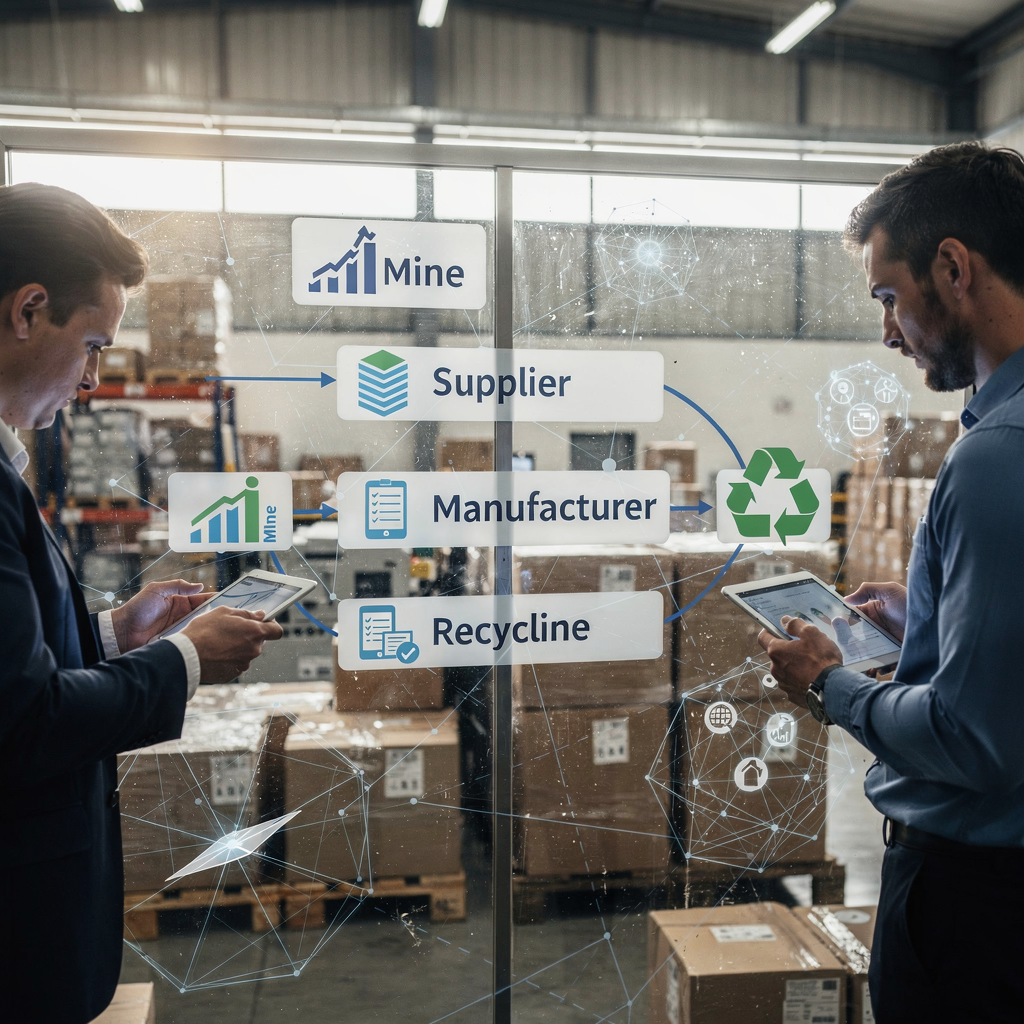
industry: KPIs, security, integration and rollout to automate supplier communications across the battery supply chain.
Define KPIs before launching a pilot. Focus on mean first response time, percent automated replies, supplier check time, passport completeness percentage, and number of exceptions escalated. Also measure savings and resilience. Track response times and productivity gains, and then review impact on production and quality. That gives procurement and quality teams the evidence they need to scale the assistant.
Integration matters. Connect the assistant to ERP, MRP, TMS, quality management and the battery passport system. Map data fields and define error handling. Export formats should include API payloads and CSVs that match the passport schema. Ensure records remain accessible to downstream systems and to auditors. For practical setup guidance for ERP integration and email grounding see our ERP email automation guide ERP email automation logistics.
Security and privacy cannot be an afterthought. Comply with GDPR and obtain contractual consent for data processing. Store supplier documents in encrypted storage. Append audit logs for all automated actions. Maintain strict role-based access and require human sign-off for contract changes. These controls protect suppliers and buyers and preserve trust across the value chain.
Rollout recommends a quick pilot by supplier tier. Start with the top 10 suppliers. Measure KPI deltas at 30 and 90 days. Expand gradually, and keep humans on the loop for complex or high-risk workflows. Use dashboards to keep KPIs visible and to guide continuous improvement. For more examples of staged scaling across logistics teams see our guide on how to scale logistics operations with AI agents how to scale logistics operations with AI agents.
Simple escalation template: “Escalation: QA hold on Lot #321. Failed parameter: porosity. Please advise containment and corrective action plan within 24 hours.” Start with two or three repetitive email types. Measure time saved and the reduction in manual emails. Then expand to routing, scoring and proactive alerts. These best practices reduce manual work, improve transparency, and help the sector adapt to growing demand for evs and to new regulation.
FAQ
What is a battery supply chain email assistant?
A battery supply chain email assistant is an AI-driven virtual assistant that automates operational email workflows for procurement, logistics and quality teams. It triages messages, drafts replies, extracts structured data and routes emails to the right person while maintaining an audit trail.
How does an assistant improve response times?
The assistant auto-drafts common replies and routes messages to the correct owner, which reduces manual triage and speeds mean first response time. It also attaches contextual data from ERP and TMS so humans can act faster.
Can the assistant support battery recycling and the digital passport?
Yes. The assistant collects recycling certificates, records recovery rates and normalises data for export into a digital battery passport format. That simplifies compliance with upcoming EU rules and supports reuse and end-of-life reporting.
What kinds of emails should I automate first?
Start with order acknowledgements, missing certificate requests and shipment ETA parsing. Automate two to three repetitive types first, measure savings and then expand to routing and scoring for exceptions.
Does this require access to ERP and TMS systems?
Yes. Integrations with ERP, TMS and quality management systems improve accuracy and trust in automated replies. The assistant uses those systems to ground drafts and to create structured exports for procurement or passport systems.
How do you handle quality non-conformance responses?
Guardrails keep humans in control for contract language and quality non-conformance. The assistant drafts suggested responses and records the draft, but it requires human approval before sending. That preserves compliance and traceability.
What security measures are recommended?
Use GDPR-compliant processing, encrypted document storage and audit logs for every automated action. Implement role-based access and require approvals for high-risk replies or contract changes.
Can the assistant help with supplier due diligence?
Yes. The assistant extracts risk signals from email streams, such as supply interruptions or ESG concerns at a mine, and pushes them into supplier scorecards for due diligence and mitigation planning.
Will this work for both battery manufacturers and service providers?
Yes. OEMs, battery manufacturers and service providers can all benefit from automated email workflows. The tool improves consistency and reduces manual errors across the value chain.
How do we measure savings and productivity?
Track KPIs such as mean first response time, percent automated replies and supplier check time. Compare baseline metrics with performance after 30 and 90 days to quantify savings and increased productivity.
Drowning in emails?
Here’s your way out
Save hours every day as AI Agents label and draft emails directly in Outlook or Gmail, giving your team more time to focus on high-value work.