


AI and local government: why municipalities need an AI email assistant
Municipal offices face growing email volumes. Staff juggle hundreds of messages daily. Citizens expect fast replies. However, limited staff time makes that hard. Therefore, municipalities look to AI to help. AI can triage messages, draft replies, and reduce repetitive work. A study found near a 30% reduction in average response time after adoption, which shows real value in practice. In addition, local pilots report 25–35% productivity gains when routine emails are handled by an AI assistant that use of predictive analytics.
First, where does value appear? Triage is a primary area. AI can label and route emails so staff spend less time sorting. Next, draft replies and standard letters speed work and improve consistency. Also, an always-on AI can answer basic enquiries outside office hours. As a result, backlog size shrinks, response time improves, and citizen satisfaction rises. For example, operations teams that ground replies in ERP data reduce errors. Our company, virtualworkforce.ai, builds AI agents that automate the full email lifecycle for ops teams. This design helps preserve institutional knowledge and route requests with full context. You can read how we draft and route messages in ERP contexts via our ERP email automation resource ERP email automation.
What outcomes should a municipality measure? Response time is essential. Backlog size is also key. Citizen satisfaction must be tracked through surveys and open rates. Finally, staff hours saved should be measured against budget and staff reports. In addition, teams should monitor for hallucination and errors from AI replies. Also, plan training and onboarding for government staff to use the tool. For an operational example of end-to-end email automation and how it reduces handling time, see a logistics-focused overview that illustrates similar gains for operations teams virtual assistant for logistics.
public sector and government: measurable benefits and risks
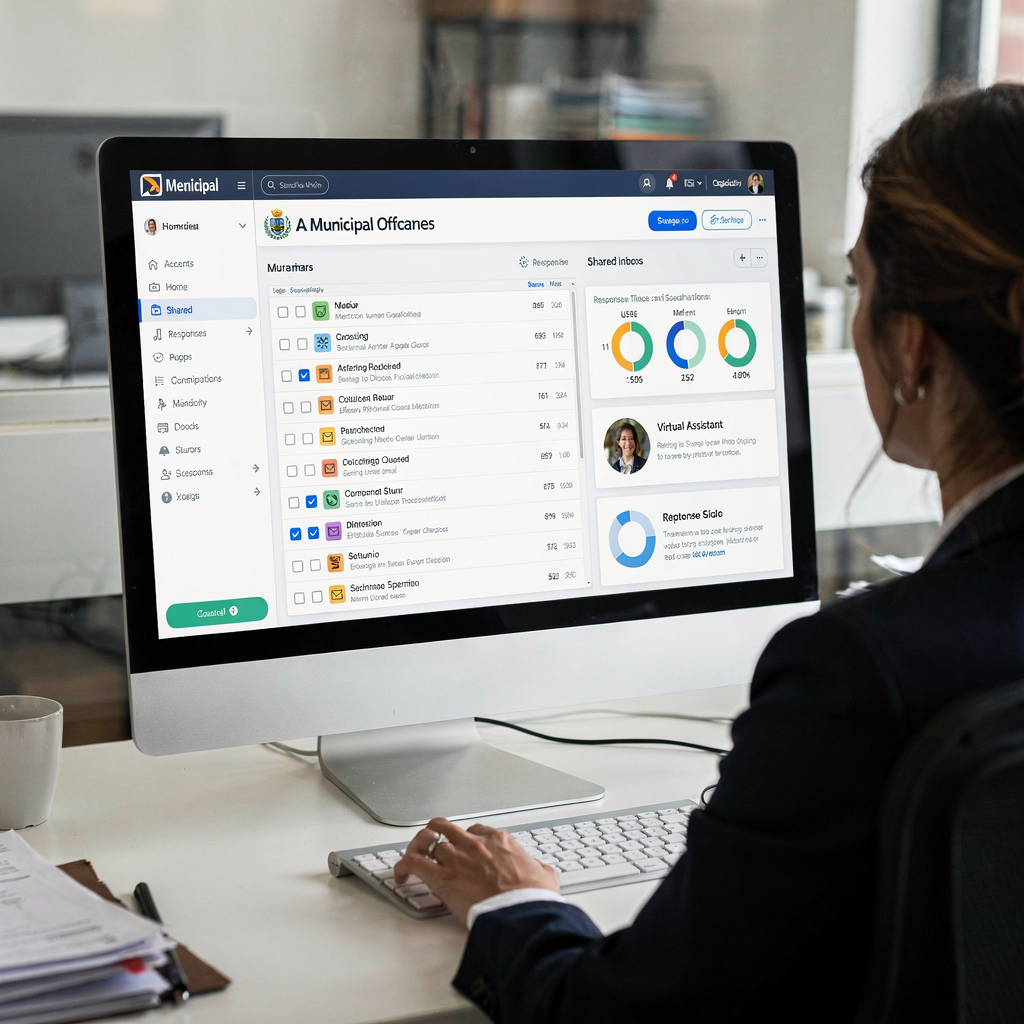
Public sector adoption of AI shows measurable benefits. For instance, a survey of local governments found that about 65% experienced improved operational efficiency after deploying chatbots and email tools survey data. Furthermore, some authorities reported a 25% fall in staff hours spent on routine email tasks research on AI-powered chatbots. Therefore, the numbers support pilot investments in an AI-powered email assistant for local government services.
However, risks must be weighed. Data security and privacy is a top concern. A single privacy breach can damage trust. In addition, algorithmic bias can lead to uneven service levels. Transparency also matters. Citizens expect to know when they interact with an AI chat or human. A checklist helps public sector teams start securely. First, define KPIs and baseline metrics. Next, set a monitoring cadence for accuracy, response time, and citizen feedback. Then, require Data Protection Impact Assessments and logs for audit. Also, tie procurement rules and compliance to formal policy. These steps help government employees and elected officials judge risk before they deploy at scale.
Practical controls should include role-based access, retention limits, and encryption for private data. In addition, flagging must be enabled for legal or complex permit or regulatory queries. Also, incorporate human review for low-risk versus sensitive data. For public trust, add clear AI disclosure statements and mechanisms to appeal automated decisions. For deeper guidance on digital transformation and government workflows, consider case examples from e-government surveys that document trends and compliance expectations E-Government Survey 2024. Finally, track staff reports and alerts to refine system rules over time.
Drowning in emails?
Here’s your way out
Save hours every day as AI Agents label and draft emails directly in Outlook or Gmail, giving your team more time to focus on high-value work.
Built for government: preserving institutional knowledge and ensuring data protection
Municipal communications depend on institutional memory. An AI assistant must preserve templates, policies, and tone. Capture council meeting templates, permit workflows, and common letters. Then, tailor replies so they match legal language and local policy. Institutional knowledge must stay central. For example, building permit responses must reflect local codes. Therefore, bespoke training of the assistant with local policy helps reduce errors.
Data rules are essential. Apply privacy-by-design from the start. Conduct DPIAs and set retention limits. Encrypt data at rest and in transit. Also, restrict AI systems to the minimum required data sets. This reduces exposure of private data. In addition, log accesses for audit and FOI. For municipalities operating across systems, integration with GIS and ERP data can ground responses. To see how grounding in operational systems reduces lookup time, review an explanation of integrated email agents for logistics that illustrates deep data grounding across ERP and SharePoint how to scale operations.
Practical control means human-in-the-loop for sensitive cases. Route high-risk queries to specialists. Use role-based permissioning to limit what the ai-driven platform can read. Also, test for hallucination, and ensure accuracy benchmarks are in place. Audits and third-party review help verify compliance and governance. Finally, plan for multilingual support where needed to improve accessibility. In short, design the assistant as built for government purpose. That approach keeps confidential records safe, supports legal compliance, and lets staff focus on complex work rather than repetitive tasks.
demo and prompt: how to test and tune an assistant in practice
A practical demo shows value quickly. A good demo will triage, draft a reply, escalate an inquiry, redact PII, and produce an audit log. For a demo checklist, include test emails for council meetings, permit requests, council tax queries, and bin collections. Then, run A/B tests on AI drafts versus human drafts. Next, collect citizen feedback and quality scores. These steps help teams validate real-world performance.
Prompt design matters. Use short, repeatable prompts for common enquiries. For example, create a prompt template for council tax, a prompt for planning permit guidance, and a prompt for service complaint replies. Also, keep prompts simple and measurable. Using ChatGPT-style systems can speed early tests, but municipal pilots often require tighter grounding in operational data. So, while using chatgpt for initial experiments is fine, municipal deployments should rely on grounded ai systems. For teams that want practical prompt templates for operations, explore how draft automation works in logistics scenarios to learn durable patterns logistics email drafting.
Validation must include A/B testing, accuracy tracking, and citizen satisfaction scores. Also, monitor for hallucination and unexpected tone shifts. Finally, tune the assistant from results. Use staff insights and research assistant summaries to refine prompt templates over time. In addition, collect metrics for response time, escalation rate, and ticket creation. A well-run demo provides clear evidence to deploy or iterate.

Drowning in emails?
Here’s your way out
Save hours every day as AI Agents label and draft emails directly in Outlook or Gmail, giving your team more time to focus on high-value work.
government agencies, municipal workflows and handling public inquiry at scale
Integration is the backbone of scale. Connect email servers, CRM, case management, records management, and phone or web channels. When you integrate the assistant with these systems, it can create tickets, attach evidence, and close loops in real-time. Also, tie responses to permit systems so permit status drives reply content. Integration reduces manual lookups and speeds resolution.
Automation patterns include auto-categorise, auto-acknowledge, suggest replies, create tickets, and route to teams. These patterns help staff concentrate on complex matters. For example, an auto-acknowledge reduces citizen anxiety and provides a notification of next steps. In addition, auto-categorise helps prioritize urgent public safety queries. Use automation sparingly to ensure low-risk items are handled automatically while sensitive queries get human review.
Safeguards are essential. Flag legal or complex queries automatically. Preserve audit trails for FOI requests and records retention. Also, keep evidence for procurement and budget decisions. Train government staff to review escalations and check for bias. For operational teams who already automate logistics correspondence, the same integration patterns apply in government work. You may find relevant technical patterns in automated logistics correspondence resources that explain data grounding and thread-aware memory automated logistics correspondence.
Finally, support multilingual access and accessibility for varied audiences. Use the assistant to summarize long staff reports and to summarize permit conditions. Also, integrate with portals so citizens can check status from a single place. When teams deploy with governance and training, AI becomes a tool to streamline operations and improve public confidence.
trust ai, use ai and digital transformation: governance, ethics and rollout
Adopting AI requires governance. Create policies for acceptable use and escalation rules. Ensure transparency with clear public notices that state when an AI tool drafted a reply. Also, perform regular bias checks and third-party audits. This builds trust and supports ethical use. A recent ethics study emphasizes holding systems to higher standards for urban planning and public communication ethical concerns research. Therefore, governance must be practical and visible.
Rollout in stages works best. Start with a pilot team or low-risk service. Then measure impacts and optimize. Use staff training and onboarding so government employees know how to edit drafts and escalate cases. Also, require logs for every automated decision to ensure accountability. For procurement and compliance, keep clear records and catalog data sets used for training. In addition, prepare for budget consequences and include a plan for HR impacts as some tasks shift.
Trust AI through transparency and performance. Regular audits, public reporting, and feedback loops help. Also, address hallucination and accuracy issues openly. Use external reviewers and invite citizen input. Finally, deploy gradually and tailor the assistant to local needs and institutional knowledge. For municipalities that want a focused example of ROI and deployment patterns, review an applied ROI case that covers measurable gains and governance considerations virtualworkforce.ai ROI and deployment patterns. By combining governance, ethics, and careful rollout, governments can optimize service delivery while protecting citizens and staff.
FAQ
What is an AI email assistant for municipalities?
An AI email assistant is a software agent that reads, categorises, drafts, and routes email for municipal inboxes. It helps government staff manage high volumes, reduces response time, and automates low-risk enquiries.
How does an AI assistant preserve institutional knowledge?
The assistant is trained on local templates, policies, and past replies so it mimics the municipality tone. It can reference permit rules and council meeting templates to create consistent responses.
Are there measurable benefits from using an AI email assistant?
Yes. Studies report up to a 30% reduction in response time and 25–35% productivity gains in pilots. Also, about 65% of local authorities reported improved efficiency after deploying similar tools source.
How do municipalities protect sensitive data?
Protection starts with privacy-by-design, DPIAs, encryption, and access controls. In addition, logs and retention policies guard private data, and human review is used for sensitive cases.
Can an AI assistant handle permit or regulatory queries?
Yes for routine permit status checks and standard replies. Complex or legal permit matters should be flagged and routed to specialists for review.
How should a demo be run for a municipal pilot?
Run a demo that triages, drafts, redacts PII, escalates complex inquiries, and logs actions. Then A/B test AI drafts against human drafts and gather citizen feedback to validate quality.
Will AI replace government staff?
No. The typical outcome is that staff focus on complex work while the assistant handles repetitive messages. This frees time and can improve productivity without reducing service quality.
How do we ensure fairness and reduce bias?
Implement regular bias checks, third-party audits, and transparent logs. Also, involve diverse reviewers in training data selection and monitor outcomes across populations.
Can the assistant support multiple languages?
Yes. Multilingual models and translation layers can enable support for diverse communities. Always validate translations with native speakers before deployment.
How do we begin procurement and rollout?
Start with a low-risk pilot and define KPIs such as response time and citizen satisfaction. Then procure with clear compliance requirements, pilot, measure, and scale with governance in place.
Drowning in emails?
Here’s your way out
Save hours every day as AI Agents label and draft emails directly in Outlook or Gmail, giving your team more time to focus on high-value work.