


private equity: why email matters for deal flow and strategic goals
Email remains the primary communication channel for private equity teams. First, it carries deal leads from intermediaries. Next, it records limited partner updates and investor queries. Then, it hosts portfolio performance notes and board communications. For many firms, email is the persistent ledger of relationships and decisions. Therefore, good inbox practice affects deal flow and strategic goals directly.
Private equity teams handle high volumes. For example, ops staff often face 100+ inbound messages per person per day, which causes manual copy-paste and lost context in shared mailboxes. Also, AI email assistants can reduce email handling time by roughly 30% (SmartDev), which frees analysts and partners to pursue higher-value work. Furthermore, only a small share of AI projects capture most returns; a 2025 study showed that just 5% of AI initiatives in private markets generate the majority of value (Private Equity International). This finding underlines the need to target email tools where they drive outcomes, not to adopt AI for its own sake.
Professionals in private equity must weigh operational time against strategic priorities. For instance, faster responses and better thread triage mean more opportunities reach the right decision-maker. Also, better thread summaries help teams make informed decisions faster. Many partners report that improved email triage improves time to first response, which in turn impacts whether a lead stays warm or goes cold. As a result, firms that adopt focused email automation can align daily work with broader business strategy and boost productivity.
To learn how a no-code, data-grounded assistant can reduce handling time and integrate ERP sources, see resources that explain how to scale logistics operations without hiring and how integrated email drafting works in practice (how to scale logistics operations without hiring). Finally, private equity professionals should treat email as a structured input into deal processes. By doing so, they keep strategic goals top of mind and reduce administrative burden.
virtual assistant, vas and inbox: how AI tools delegate routine tasks
A virtual assistant for inbox work acts like an operational teammate. First, it triages incoming threads. Next, it prioritises messages that match investment criteria or flag urgent LP issues. Then, it summarizes long threads into concise bullets and can draft replies that follow firm tone. As a result, a virtual assistant can help with repeated actions such as schedule meetings, calendar management, and simple status replies. Also, the assistant reduces time spent on manual processes, enabling a team member to focus on analysis and relationship work.

VAs work best when they connect to internal systems. For example, virtualworkforce.ai’s no-code agents ground replies in ERP/TMS/WMS and SharePoint while keeping audit trails. This deep data fusion removes the need for repeated data entry and ensures consistent answers in shared mailboxes. In practice, virtual assistant services handle tasks like scheduling and travel and expense management, and they can update management systems as part of a single flow. The virtual assistant offers measurable time savings and better thread memory than simple rule-based rules.
Some teams use va’s as first-line filters. They route high-priority leads to partners, while low-priority senders get templated responses. Virtual assistant can assist by pulling terms and extraction from attachments. For example, a new ai assistant like Petra is designed to act as a private equity transformation research agent, filtering deal signals from communication streams (Axios). In addition, discover how virtual assistants can reduce administrative tasks and improve accuracy across teams. Finally, hiring a va remains a cost-effective solution compared with hiring a full-time coordinator, especially when the assistant links thread context to firm research and CRM records.
Drowning in emails?
Here’s your way out
Save hours every day as AI Agents label and draft emails directly in Outlook or Gmail, giving your team more time to focus on high-value work.
venture capital and private equity: crm, email platforms and altvia in practice
In both venture capital and private equity, CRMs capture deal provenance and investor contact histories. First, good CRM linkage ensures every significant email maps to the right opportunity. Second, it enriches contact records with email metadata and interaction notes. Third, this mapping supports investor relations and fundraising workflows. For instance, Altvia products sync email to CRM records so conversations are logged against contacts and funds.
Altvia itself shows a common approach. An email platform that links to the CRM reduces duplicate manual data entry and increases traceability for onboarding new LPs and portfolio companies. In practice, altvia’s inbox sync helps compliance and audit trails by storing correspondence against investment funds and deal records. Also, integration with crms makes it easier to run queries for investor outreach lists and to track touchpoints for IR reports.
Venture capital teams often mirror private equity processes but with faster cycles and different investment criteria. A good system extracts key insights from email and routes them into the pipeline. For example, email platforms that feed the CRM let sourcing teams spot high-velocity leads and then assign follow-ups. This reduces the overhead costs of manual data capture and improves the likelihood that a promising lead becomes an actual investment opportunity.
Practically, teams should evaluate how an assistant for private email ties to their tech stack. Look for connectors that handle mail, attachments, and third-party storage. Also, confirm that the platform allows filtering by deal type and investment strategies. Finally, teams that integrate email and CRM minimize manual data and improve the signal-to-noise ratio in busy inboxes. For deeper examples of integrated email drafting and inbox automation in logistics-style operations, consult the automated logistics correspondence resources (automated logistics correspondence).
investment firms: streamline operations to boost productivity and ROI
Investment firms aiming to streamline operations should focus on predictable, measurable wins. First, attach email context to records so manual data entry drops. Second, automate routine follow-ups and reminders so staff can focus on analysis. Third, use AI to extract financial terms and deadlines to reduce errors in due diligence.
Evidence supports this approach. Firms using integrated email assistants report 20–25% faster deal sourcing and a 15% improvement in due diligence accuracy thanks to faster access to relevant information and automated extraction (Axios) and (SmartDev). Therefore, tie the time saved to measurable KPIs such as reduced time to first response, lower error rates in extracted terms, and improved pipeline conversion. Also, track ROI so leadership can see where automation pays off.
virtualworkforce.ai demonstrates one path. Our no-code agents cut handling time from roughly 4.5 minutes down to ~1.5 minutes per email by fusing research and data sources and by grounding replies in ERP and file stores. As a result, teams reduce administrative burden and free up time to focus on building relationships and portfolio monitoring. In short, time to focus on strategy rises and overhead costs fall.
To implement change, pilot on a single deal team. Then measure improvements and scale as ROI becomes clear. Also, make sure tools support audit trails and role-based permissions. Finally, view automation as a way to boost productivity, improve efficiency, and align day-to-day operations with broader business strategy and investment decisions.
Drowning in emails?
Here’s your way out
Save hours every day as AI Agents label and draft emails directly in Outlook or Gmail, giving your team more time to focus on high-value work.
vas for deal flow: measurable impact on speed and accuracy
Vas can alter deal flow by surfacing high-priority leads and by reducing the time spent on manual triage. First, automated extraction pulls investor terms, valuation hints, and key milestones from threads and attachments. Next, alerts notify the right partner so the response is timely. Then, consolidated thread context reduces the error rate in data captured for screening. Consequently, teams respond faster and capture more investment opportunities.
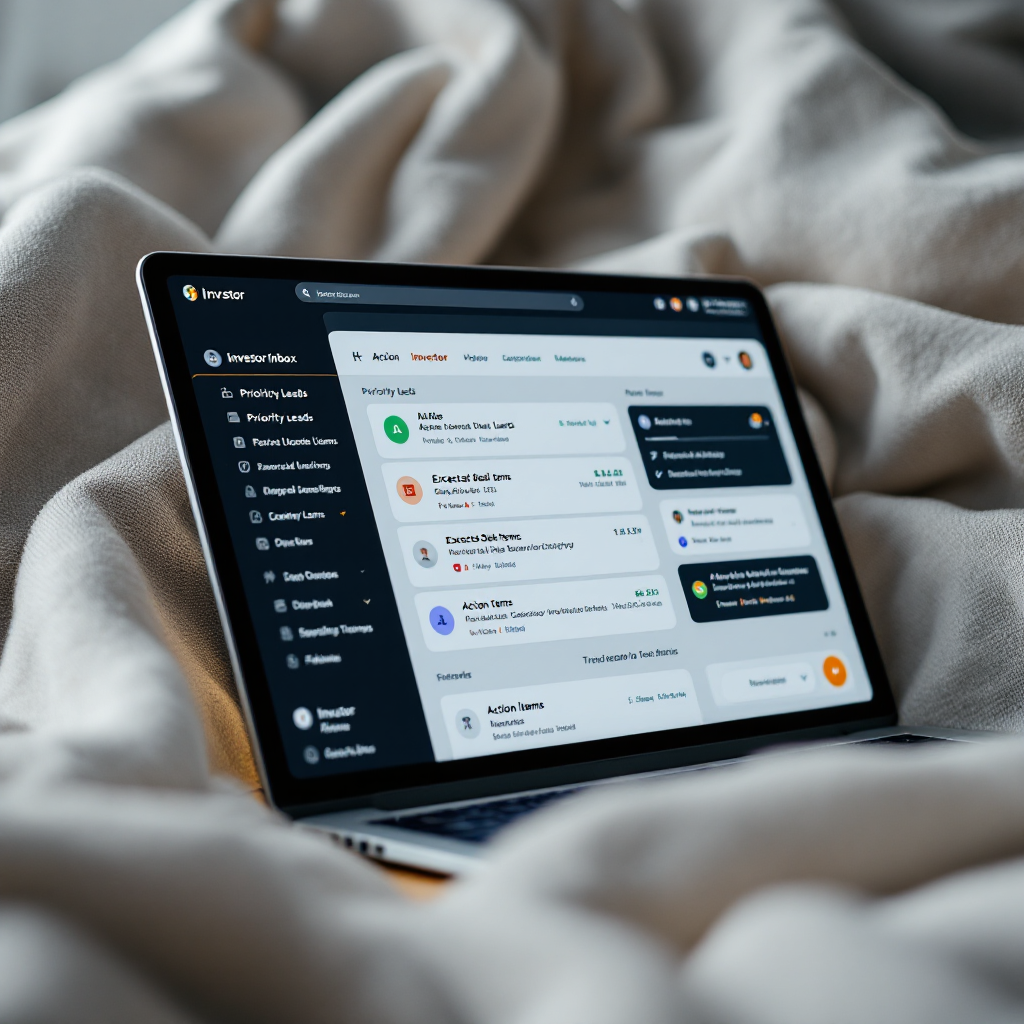
Measure progress with clear metrics. For example, track time to first response, percentage of leads captured from email, and error rate in extracted data. Also, measure the percentage change in qualified leads and the time saved on tasks like logging terms into the CRM. Good governance is essential here, because only well-governed deployments deliver measured gains. The MIT and EY research stresses targeted use and strong oversight; EY wrote, “Generative AI is not just automating tasks; it is fundamentally reshaping how private equity firms create value by enabling faster, data-driven decision-making and unlocking new revenue models” (EY).
Governance also relates to security. For example, establish access controls and audit logs before switching assistants on for shared mailboxes. Also, ensure the assistant cites sources when it drafts answers, and ensure model outputs are traceable. Atlan notes, “AI tools used for investment research, including email assistants, must respect strict governance frameworks to safeguard sensitive information and maintain trust” (Atlan). Finally, quantify the ROI of automation by linking freed-up time to higher-value tasks, such as market research and portfolio monitoring, so partners can see the net benefit to deal sourcing and investment decisions.
best practices: governance, compliance and how to choose an email platform
Start governance early. First, define data privacy rules and role-based access. Second, require audit trails and logging in the contract with any vendor. Third, demand vendor security reviews and clarity on model explainability. These steps make management is essential and protect sensitive LP and deal data. Also, define escalation paths for ambiguous replies so the assistant delegates complex investment decisions to humans.
Choose a platform that checks key boxes. Look for integrations with CRM, support for inbox syncing, and connectors to management systems such as ERP and content stores. Also confirm that the platform allows custom templates and rules for communication style and tone. The selection checklist should require measurable KPIs, vendor compliance with applicable regimes, and clear support for onboarding and project management. In addition, seek an assistant that supports calendar management and travel and expense management if the team expects to reduce overhead costs tied to logistics.
Operationally, pilot on a single deal team. Then measure time saved, accuracy in extracted data, and impact on pipeline conversion. Also, compare outcomes to hiring a full-time coordinator to assess whether hiring a va or adopting virtual assistant services is a more cost-effective solution. Moreover, track metrics tied to strategic goals and ROI so leadership can prioritize where to scale. Finally, combine governance and best practices to help you streamline and to free up your time for higher-value tasks like market research, investment strategies, and deep relationship work with portfolio companies.
For practical guidance on how automated email drafting ties into ERP-driven replies and to review ROI case studies, consult resources that explain ERP email automation and virtualworkforce.ai’s ROI approach (ERP email automation) and (virtualworkforce.ai ROI). These pages show one platform approach and how the platform allows safe, auditable, and fast rollout with minimal IT involvement.
FAQ
What is an AI email assistant for private equity?
An AI email assistant is software that reads and acts on incoming messages to reduce manual processes. It can triage, summarise, extract terms, and draft replies while linking to internal systems to ground answers.
How much time can email automation save a team?
Studies and vendor reports suggest up to a 30% reduction in email handling time in many cases (SmartDev). The exact savings depend on integration depth and the volume of routine messages.
Are AI assistants secure enough for deal-related emails?
Yes when governance is applied. Require role-based controls, audit logs, vendor security reviews, and data redaction to protect sensitive information. Atlan recommends strict governance frameworks for research and communications (Atlan).
How do AI assistants improve due diligence?
They extract and standardise key terms from threads and attachments, reducing manual data entry and human error. This leads to measurable improvements in due diligence accuracy and faster access to key insights.
Can assistants integrate with my CRM?
Most modern assistants connect to CRMs to log correspondence and enrich records. Integration reduces duplicate manual data entry and improves traceability during fundraising and investor relations.
What governance controls should I require?
Require access controls, audit trails, model explainability, and clear escalation paths for complex investment decisions. Also ensure vendor compliance with applicable regulatory regimes and conduct security reviews.
Should I pilot or roll out across the firm?
Pilot on a single deal team first and measure time saved and accuracy gains. Scale only when ROI and governance controls are proven to avoid wasted investment and poor adoption.
How do email assistants affect relationship-building?
They free up time for partners to focus on high-value engagement and deepen relationships. By automating administrative tasks, the team can prioritise in-person meetings and strategic conversations.
Do assistants replace human judgment in investment decisions?
No. Assistants speed data capture and surface signals, but humans retain decision authority. Clear rules should force escalation for material investment decisions and exceptions.
Where can I see examples of email automation in practice?
Explore case studies and product pages that show how no-code agents ground replies in ERP and email history. For logistics-style examples and ROI guidance, see virtualworkforce.ai’s resources (virtual assistant for logistics) and related automation guides (scaling operations without hiring).
Drowning in emails?
Here’s your way out
Save hours every day as AI Agents label and draft emails directly in Outlook or Gmail, giving your team more time to focus on high-value work.