


ai agent and customer service: what ai agent for customer teams does and why organisations adopt it
An AI agent is autonomous software that handles enquiries, suggests actions and triggers workflows. It reads intents, checks records, and replies or routes work. Teams use it to reduce repetitive work, to provide 24/7 availability, and to scale capacity without linear headcount increases. Many organizations now deploy AI to transform how they respond to customer issues and to transform customer relationships into measurable outcomes.
Adoption rates rose fast. In 2025, 79% of organisations reported AI agent use in service, and two-thirds of those companies could quantify benefits from deployments (AI-ügynökök statisztikái 2025). That stat helps explain why teams move to AI quickly. Analysts also forecast that agentic systems will handle a much larger share of routine inquiries over the next few years (Cisco előrejelzés). These figures show both adoption and the path ahead.
Quick value appears in three areas. First, AI agent cuts repetitive tasks, which frees human agents to solve complex customer issues. Second, AI ensures persistent coverage and reduces abandonment during peaks. Third, AI scales capacity without proportional hires, which improves ROI and service quality. For example, many operations teams reduce email handling time dramatically when they automate the full lifecycle of messages. Our platform, virtualworkforce.ai, focuses on that exact problem by automating email lifecycles for ops and customer service teams, cutting average handling time from about 4.5 minutes to about 1.5 minutes per email while keeping full control for business teams.
AI agent tools now span triage, knowledge retrieval and automated replies. Companies that use AI agents report improved response speed, better consistency, and measurable cost savings. For teams planning customer service initiatives, start with a narrow scope, measure outcomes, and expand as confidence grows. If you want a practical example of how email automation looks in logistics, see our guide on how to improve logistics customer service with AI (logisztikai útmutató). This stepwise approach helps teams adopt the best AI safely and effectively.
ai agent in customer service to automate work and empower customer service agents
AI agent in customer service automates triage, knowledge retrieval, routine transactions and routing. It reads subject lines, matches intents, consults a knowledge base, and then either replies or routes to the right team. By design, agents perform repetitive work, they reduce manual search, and they let service reps focus on complex, high-value tasks. This approach helps service teams and empowers your customer service team to make faster decisions.
Automation shortens response times and raises first-contact resolution. When an AI system handles routine exchanges, support teams see fewer escalations and lower backlog. For example, an AI agent can complete address updates, billing confirmations, and simple status checks, while human agents handle exceptions and nuanced negotiation. Service reps gain time and can offer more personalised service for complex customer situations. In short, AI and human support complement each other.
Design matters. Set clear escalation rules, confidence thresholds, and guardrails so human agents remain in control. For safety, require human approval for high-risk changes and sensitive data updates. Train the system with tagged examples from real customer inquiries and adjust thresholds over time. Also, add short templates and auto-summaries so customer service representatives spend less time writing notes and more time resolving problems.
Teams that deploy AI see operational wins. Many support teams reduce average handling time and increase consistency. AI agents can also help with routing by matching cases to specialists, and they can flag repeat issues so teams can fix root causes. If you want hands-on logistics examples of automated correspondence that reduce manual effort, review our automated logistics correspondence page (automatizált levelezés). This reduces triage time, decreases misrouting, and improves SLA compliance.

Drowning in emails?
Here’s your way out
Save hours every day as AI Agents label and draft emails directly in Outlook or Gmail, giving your team more time to focus on high-value work.
conversational ai and ai customer support: how conversational ai improves cx, customer support and helps support agents
Conversational AI brings natural language understanding and context retention into customer conversations. It supports multi-turn dialogues, remembers prior context and manages follow-up steps. These systems make conversations feel more human, and they handle many routine flows without human intervention. They also enable proactive outreach, which elevates customer care and reduces reactive load.
Impact on CX appears in speed and relevance. Customers receive personalised replies faster, and the system can surface history so replies match prior context. That reduces friction and improves customer experience. For support agents, conversational AI supplies real-time suggestions, auto-summaries, and note capture. These features cut handling time and reduce after-call work. Teams that use conversational AI report higher CSAT and clearer customer journeys.
Conversational tools can also work omnichannel. Bots manage chat, email, and messaging in one flow and hand off smoothly to phone or human chat when needed. That helps maintain continuity across customer conversations. Agents provide escalation context, and the AI tracks the thread so no history is lost. This reduces repetitive questioning and boosts satisfaction.
Generative AI now helps draft responses and propose next steps, but guardrails remain essential. Train models on company policies and on a controlled knowledge base so replies stay accurate. Use role-based access to limit edits to sensitive areas. For hands-on teams that run high-volume email workflows, an AI agent that drafts grounded replies based on ERP and logistics data can be transformative. If you manage freight communications, check our AI for freight forwarder communication page (szállítmányozói kommunikáció) to see a concrete use case.
ai customer service agents, ai customer support agents and enterprise ai: integrating with CRM and delivering real‑time insights
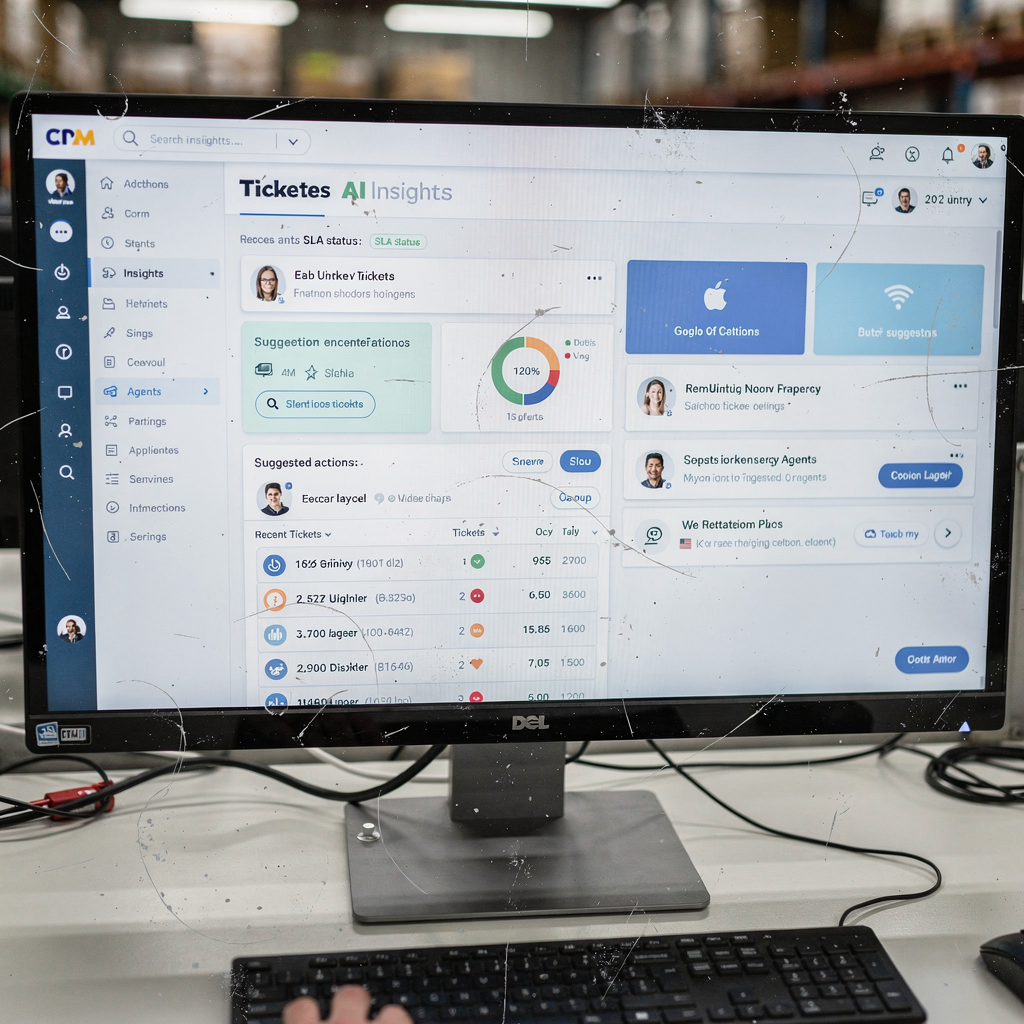
Integrate AI with CRM and you give agents context-aware answers. Sync history, tickets, product data and SLAs so the AI reads the right facts before it suggests replies. Good integration ensures the agent recommends actions that match contracts and warranty rules. When the system can access customer data and order history, it can resolve many requests end-to-end.
Checklist: sync ticket history, link product records, map SLAs, and surface current entitlements. Also connect operational systems such as ERP and WMS where relevant so the AI has grounded facts. These steps let AI systems produce accurate replies and reduce manual lookups. Teams often report that integrated systems reduce errors and improve service quality.
Enterprise AI needs governance. Define model owners, monitoring routines, and rollback plans. Keep a single source of truth for customer data and logs for auditability. Use metrics to show ROI, including average handling time, SLA compliance, CSAT, cost per contact, and percentage automated. Tracking these KPIs proves value and guides expansion.
AI systems also help you analyze customer trends. Use automated summaries to identify repeat customer issues and to prioritize product fixes. An AI that can analyze customer signals across tickets will surface common pain points. For logistics teams that need ERP-grounded emails, our ERP email automation for logistics page explains how to connect operational data to replies (ERP e-mail automatizálás). This approach increases traceability and reduces rework.
Drowning in emails?
Here’s your way out
Save hours every day as AI Agents label and draft emails directly in Outlook or Gmail, giving your team more time to focus on high-value work.
using ai agents across support teams: agent uses to serve every customer, measure customer experience and drive customer success
Common agent uses include FAQ bots, guided troubleshooting, account updates, proactive churn prevention and routing. These examples show how AI agents help service teams respond to routine demands and free staff for complex problems. Many organisations use AI to serve every customer during peak times and to provide multilingual coverage. That reduces abandonment and keeps customers engaged.
Scale is key. AI handles volume spikes without hiring extra staff and it supports across channels so customers get consistent replies. For example, an AI agent that can complete order status checks in email and chat will reduce peak queue times. Teams measure automation rate and link it to customer experience metrics to ensure automation improves outcomes, not just efficiency.
Measure what matters. Track automation rate, CSA T, human handoffs, CSAT, and NPS. Report how many cases were fully resolved by the AI and how many needed human aid. Tie those figures to business outcomes like churn and upsell. That links AI activity to customer success and to revenue.
AI agents for customer service must hand off clearly when a human touch matters. Design the handoff so human agents see the thread, the suggested fixes, and past attempts. Agents provide judgement and nuance, and the AI can provide suggested scripts. For specialised flows like customs documentation or container shipping, teams often use tailored AI agents that pull from specific operational systems; see our container shipping AI automation resource for examples (konténerszállítási MI). This reduces errors, speeds replies, and helps customers and support get back to work.
ai agents for customer service and the future of customer: ethics, governance and how to scale ai support
Ethics by design requires transparency about AI use, privacy compliance such as GDPR, bias checks and audit trails. Put logs in place so reviewers can see why an agent recommended a decision. Assign model owners who track drift and approve retraining. This governance protects customers and the brand.
Organizations should plan clear roles for monitoring and continuous training. Create escalation paths for failures and clear thresholds for when to route to human support. Using agentic approaches will increase autonomy, so teams must test in controlled slices and expand with evidence. Cisco and other analysts project that agentic AI will manage a growing share of interactions, and that projected rise should inform capacity planning (agentikus MI előrejelzés).
Start small, measure, iterate and then scale. First pilot a narrow workflow, measure CSAT and SLA compliance, and then expand to adjacent processes. Prepare to deploy AI at scale by defining data governance, by creating structured feedback loops, and by linking model performance to business KPIs. Businesses that optimize AI infrastructure early report smoother expansion and stronger ROI.
Finally, consider both technology and people. Train service reps to work with autonomous AI agents and to take ownership of complex cases. Encourage human and AI collaboration so the system learns from agent corrections. The future of customer service will combine autonomous agents, ethical governance and human judgement. If you want ROI examples for logistics teams that scaled AI carefully, see our virtualworkforce.ai ROI resource (megterülés logisztikában). This helps teams plan measurable, safe growth.
FAQ
What is an AI agent and how does it differ from a chatbot?
An AI agent is autonomous software that can handle enquiries, suggest actions and trigger workflows end-to-end. It often connects to systems and performs tasks, while a chatbot typically focuses on conversational exchanges without deep system integration.
How do AI customer service agents improve response times?
AI agents can triage requests, retrieve facts, and draft replies instantly, which reduces manual lookups and delays. They also provide 24/7 coverage, so customers receive faster initial responses outside business hours.
Are AI agents safe to use for sensitive customer data?
Yes, when deployed with strict governance, privacy controls and audit trails. Implement role-based access, encryption, and compliance checks such as GDPR to keep sensitive customer data secure.
Can AI handle multilingual customer conversations?
Many AI systems support multiple languages and can route language-specific cases to native speakers or to language-capable agents. This capability helps serve every customer and reduces abandonment during peaks.
What KPIs should I track when I deploy AI in customer service?
Track average handling time, SLA compliance, CSAT, cost per contact, percentage automated, and human handoff rates. These metrics show both efficiency gains and impacts on customer experience.
How do I ensure a smooth handoff from AI to human agents?
Design clear escalation rules and attach context to handoffs, including prior attempts, suggested fixes and relevant records. This saves time for customer service representatives and keeps conversations seamless.
Will AI replace human agents in customer support?
AI will handle more routine tasks and automate many workflows, but human agents still manage complex, high-empathy situations. Human judgement remains critical for negotiation, escalation and relationship building.
How can I start a pilot for AI in my support operations?
Begin with a narrow use case such as FAQ automation or email triage, set measurable KPIs, and scale once performance is proven. Use real ticket data to train and validate the system.
What governance practices are essential for enterprise AI?
Assign model owners, monitor performance, maintain audit logs, enforce privacy rules, and plan retraining cycles. These practices prevent drift and protect customer trust.
Where can I learn more about AI for logistics and operational email automation?
Explore resources on AI for freight communication and ERP email automation to see concrete examples of operational grounding. Our guides cover logistics-specific implementations and ROI for teams that automate emails across operations.
Drowning in emails?
Here’s your way out
Save hours every day as AI Agents label and draft emails directly in Outlook or Gmail, giving your team more time to focus on high-value work.