


AI agents for staffing speed hires and cut manual processes.
Summary: Virtual AI agents are accelerating hiring, reducing recruiter time and cutting manual processes across staffing operations. They shorten the recruitment cycle, improve candidate engagement, and free recruiters to focus on high-value work. For staffing teams that handle high-volume roles, AI can save hours per hire and reduce placement costs. Furthermore, AI supports data-driven decisions that improve hiring outcomes and recruiter productivity.
Data box: Headline stats — 35% of organisations already using agentic AI and 44% planning adoption; up to 30% reduction in time-to-hire; screening and scheduling savings of up to 23 hours per hire; agentic projects can accelerate processes by 30–50% (BCG/MIT study; case reports).
AI agents for staffing focus on repetitive tasks and on fast decision support. First, an AI agent can parse job briefs, match candidates, schedule interviews, and draft outreach. Next, these agents integrate with ATS and CRM systems so the hiring team sees real-time updates. This reduces manual processes, and it reduces time spent on low-value work. Third, staffing firms benefit because placements happen faster and recruiter bandwidth expands. For example, agentic AI adoption is growing: a recent study found 35% of organisations already running agentic AI with 44% planning rollout soon (BCG). Also, AI staffing projects report up to a 30% reduction in recruitment cycle time and measurable cost savings per placement (case study collection).
Practical benefits include reduced screening time and lower candidate drop-off. For high-volume hiring, AI systems screen thousands of resumes in minutes, freeing the recruiter to validate best-fit candidates. Tools that combine talent intelligence with automation improve pipeline health, and they help staffing teams keep continuous talent pools alive. However, firms must balance speed with governance. Agentic AI can accelerate processes 30–50%, but it needs human oversight to avoid errors and bias. For staffing firms considering AI recruiting, a clear plan to protect candidate fairness and to measure recruiter productivity is essential. For readers who want to see how AI can automate complex operational email workflows that touch hiring and HR, see our guidance on scaling operations with AI agents (how to scale logistics operations with AI agents).
How an AI agent automates resume screening to help recruiters and recruiting teams.
An AI agent handles resume parsing, matching, ranking, and shortlist creation. First, it extracts structured data from unstructured resumes. Then, it compares skills, experience, and certifications to the job brief. Next, it ranks candidates and creates a CV shortlist for the recruiter. This shortlists qualified candidates at scale and limits manual sifting. In practice, AI screening can process thousands of resumes in minutes, which increases recruiter productivity and reduces screening time.
The screening workflow is straightforward. An applicant uploads a resume to the ATS. The AI agent parses the resume, normalises fields such as job titles and dates, and maps skills to taxonomies. After that, it runs matching algorithms and assigns a relevance score. Recruiters then review a ranked shortlist and make final decisions. Suggested KPIs include time-to-shortlist, false-positive rates, false-negative rates, and quality-of-hire. These metrics show whether the AI screening improves hiring outcomes over time.
There are clear pros and cons. On the plus side, AI screening slashes manual processes and handles high-volume flows reliably. On the minus side, AI systems must be audited for bias and for data drift. For ethical AI, include human oversight thresholds and regular bias testing. Also, track recruiter feedback so the model learns from human decisions. Talent intelligence helps recruiters see where the pool is strong or weak, and it helps staffing teams plan outreach campaigns to bring in diverse talent.
For integration, ensure the AI agent writes clean data back to the ATS and to candidate pipelines. Validate field mapping and latency during integration tests. Also, monitor false-positive and false-negative trends in real time to fine-tune matching logic. In addition, combine AI screening with brief human review steps so that recruiter judgement remains central for critical hiring. If your team wants a practical example of AI-driven email and data grounding that supports operations and hiring communication, learn more about automating logistics emails and related workflows (automated logistics correspondence).

Drowning in emails?
Here’s your way out
Save hours every day as AI Agents label and draft emails directly in Outlook or Gmail, giving your team more time to focus on high-value work.
AI recruiter and AI interviewer: conversational AI and AI voice agents that improve candidate engagement.
AI recruiter chatbots and AI interviewer systems improve candidate engagement by offering immediate, around the clock responses. Conversational AI handles candidate questions, invites applicants to pre-screening, and manages interview scheduling. AI voice agents run simple telephone screens and capture candidate responses for later review. Together, conversational flows and voice-first interactions reduce drop-off and raise response rates.
An AI recruiter can run a first-pass Q&A, validate key credentials, and log responses to the ATS. An AI interviewer can conduct a structured first-round interview, using behavioural prompts and scoring rubrics. These tools support multilingual interviews and allow candidates to use their native language, expanding the talent pools available to the staffing industry. Analytics from voice and text — such as response times, sentiment, and keyword frequency — supply talent insights that help hiring teams refine selection criteria and improve hiring outcomes.
There are clear analytics advantages. Speech and text cues help surface indicators of fit, and conversational transcripts create auditable records. For candidate engagement this is powerful: immediate replies and clear next steps improve perceptions of the employer brand and speed the hiring process. Yet transparency is essential. Candidates must be told when they interact with an AI interviewer or AI voice agents, and consent must be explicit. Ethical AI practice requires that human recruiters review and validate automated interview scores before moving candidates to critical hiring stages.
For staffing firms running high-volume hiring, AI recruiter bots preserve recruiter bandwidth and ensure consistent candidate experiences. Integrate conversational AI and AI interviewer outputs into the ATS so the recruiting teams see a single candidate record. For ideas on how AI can automate message drafting and structured replies across operational systems, consider how full email automation helps operational teams respond faster and keep context intact (ERP email automation for logistics).
Talent intelligence and AI-powered automation: source, evaluate and integrate for an end-to-end workflow.
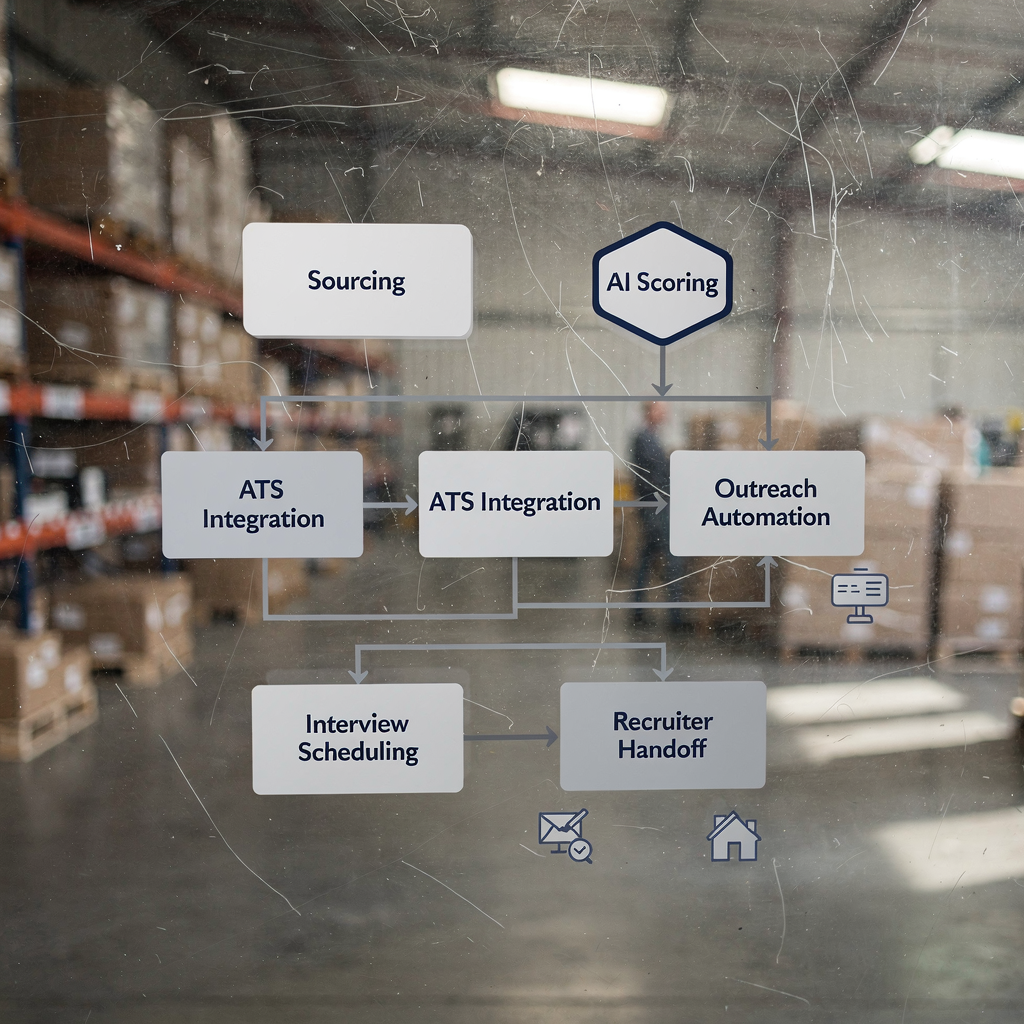
Talent intelligence amplifies sourcing, evaluation, and integration across the hiring workflow. First, talent intelligence tools index public and proprietary sources to surface best candidates. Then, AI-powered scoring evaluates fit against job criteria and predicts likely success in role. Finally, integration links those signals to ATS, CRM, and reporting systems so hiring teams can act quickly. This end-to-end approach reduces handoffs and accelerates placements.
In practice, an AI agent can auto-populate outreach campaigns and maintain candidate pipelines. Automated outreach cadence combined with intelligent sequencing improves response rates and ensures steady flow into talent pools. Integration must include robust data mapping so candidate records stay consistent from source to placement. Key checks include mapping fields between source systems and the ATS, checking latency on updates, and keeping audit logs for compliance. These integration steps ensure that talent intelligence systems feed accurate data into the hiring pipeline.
Operationally, talent intelligence helps recruiters find the right talent faster. For example, predictive ranking can highlight best-fit candidates and show why they match. Hiring managers then spend time only on the most promising profiles. Also, AI-powered automation can push interview scheduling invites, reminders, and follow-ups while logging candidate responses. This reduces back-and-forth and shortens the time to placement.
For governance, implement hand-off rules where the AI agent escalates to a human recruiter at defined thresholds. Auditing is critical: keep traceable decision logs and run bias tests regularly. To connect the dots between automated communication and operational grounding, see how virtualworkforce.ai automates full email lifecycles so replies are grounded in ERP, TMS, and document history (virtual assistant logistics).
Drowning in emails?
Here’s your way out
Save hours every day as AI Agents label and draft emails directly in Outlook or Gmail, giving your team more time to focus on high-value work.
Agentic AI and customizable AI for staffing firms: balancing recruiter productivity, ethics and human oversight.
Agentic AI offers more autonomy than basic automation. It can take actions, follow-up, and learn from outcomes. For staffing firms, agentic AI can run outreach campaigns, manage interview scheduling, and update candidate statuses. Customizable AI lets teams tune models for specialist roles and for sectors where nuance matters. This adaptability improves recruiter productivity and helps staff place the right talent.
However, agentic AI has limits. It can hallucinate facts and may lack nuanced judgement. Human oversight remains necessary for critical hiring decisions. Ethical AI controls protect candidates and the business. A governance checklist should include validation datasets, human-in-loop thresholds, audit trails, and scheduled bias testing. These items reduce risk and keep hiring fair.
Risk controls also include data protection and compliance with regional law. Staffing firms must ensure that AI systems respect privacy rules and allow candidates to correct or remove data. Use metrics such as recruiter productivity, screening time, and hiring outcomes to measure business impact. Regularly ask recruiters for feedback so models learn from human corrections. That loop improves candidates per placement and raises quality-of-hire.
For firms selecting tools, consider vendor transparency and explainability. Look for leading AI vendors that document training data and provide clear escalation rules. If you need a hands-on example of how AI automates complex email and data tasks while keeping control in the business, review a comparison of outsourcing versus end-to-end AI for logistics communication (virtualworkforce.ai vs traditional outsourcing). Finally, include regular governance reviews and a plan to evolve models as recruiting agents learn from new data. That approach keeps recruiter bandwidth focused on interviews and relationship-building rather than routine tasks.
Implementation roadmap to integrate AI agents designed for talent acquisition and talent management into the hiring process.
Phase 1: Plan and prioritise use cases. First, identify the highest-value workflows such as candidate screening, interview scheduling, and outreach campaigns. Next, decide whether to deploy an AI agent for partial automation or to run a pilot with specific recruiter groups. Define pilot success criteria including time-to-shortlist, candidate engagement rates, and placement velocity.
Phase 2: Vendor selection and integration. Evaluate vendors on data security, explainability, and ATS integration. Ensure the vendor supports audit logs and has documented escalation paths. During integration, map fields between the AI system and the ATS. Test latency and data flows. Also check that interview scheduling syncs with calendars and that transcripts write back to candidate records. For teams tackling email-heavy hiring coordination, automating inbox workflows with grounded data sources reduces error and speeds responses; see guidance on automating logistics correspondence with AI-driven drafting (automated logistics correspondence).
Phase 3: Pilot and train. Run a small pilot, then gather recruiter feedback and measure KPIs. Train recruiters on how the AI helps and where to intervene. Set human-in-loop thresholds for critical hiring and agree hand-off rules with hiring managers. Common pitfalls include insufficient data, unclear governance, and skipping recruiter training. Avoid these by having a short checklist: stakeholders identified, data readiness confirmed, KPIs set, and change management planned.
Phase 4: Scale and continual improvement. Expand the AI agents across roles once pilot targets are met. Maintain bias testing, update models with recruiter feedback, and monitor business impact. Use a template for pilot success criteria: selected roles, baseline time-to-shortlist, target improvement, sample size, and review cadence. This phased approach helps staffing firms adopt AI recruiting automation safely and effectively. For teams curious about ROI in operations and hiring, our site includes studies on scaling operations without hiring and on best tools for logistics communication that illustrate similar principles for recruitment automation (how to scale operations without hiring).
FAQ
What is a virtual AI agent in staffing?
A virtual AI agent is a software system that automates parts of the hiring process, such as candidate screening, outreach, and scheduling. It works with the ATS and other systems to create structured data and to reduce repetitive tasks for recruiters.
How much time can AI agents save per hire?
Metrics vary by use case, but reports show typical savings of up to 23 hours per hire on screening and scheduling in high-volume scenarios. These savings translate into faster placements and lower cost per placement.
Are AI interviewers accurate for first-round screens?
AI interviewers can reliably manage structured first-round screens and capture consistent responses. However, human recruiters should validate outcomes for nuanced judgement and for critical hiring decisions.
How do AI agents integrate with ATS systems?
Integration requires field mapping, API connections, and tests for latency and data quality. Good vendors provide documentation and audit logs so the hiring team can track candidate data end-to-end.
Will AI replace recruiters?
No. AI helps staffing by automating repetitive tasks and by surfacing best-fit candidates quickly. Recruiters remain essential for interviews, relationship building, and final hiring decisions.
How do we manage bias and fairness with AI?
Implement a governance checklist with validation datasets, human-in-loop thresholds, and regular bias testing. Keep audit trails and allow candidates to request corrections to their data.
What KPIs should we track during an AI pilot?
Track time-to-shortlist, candidate engagement, placement velocity, and false-positive/negative screening rates. Also track recruiter feedback and business impact on hiring outcomes.
Can AI handle multilingual candidate interactions?
Yes. Conversational AI and AI voice agents can support multilingual interactions, which helps expand talent pools and increases candidate engagement. Always disclose when candidates interact with AI and obtain consent.
How do we choose between agentic AI and rules-based automation?
Use rules-based automation for predictable tasks and agentic AI for workflows that need autonomy and learning. Ensure agentic AI has clear escalation paths and that the hiring team retains control.
How do we get started with AI agents for our staffing team?
Start with a focused pilot on one high-impact use case, set clear success criteria, pick a vendor with strong integration and governance, and train your recruiters. Then scale once metrics demonstrate improved recruiter productivity and better hiring outcomes.
Drowning in emails?
Here’s your way out
Save hours every day as AI Agents label and draft emails directly in Outlook or Gmail, giving your team more time to focus on high-value work.